 Back
BackValuation of Inventories: A Cost-Basis Approach (Intermediate Accounting, Chapter 7)
Study Guide - Smart Notes
 Tailored notes based on your materials, expanded with key definitions, examples, and context.
Valuation of Inventories: A Cost-Basis Approach
Goods and Costs Included in Inventory
Inventory valuation is a critical aspect of financial accounting, as it directly affects the cost of goods sold and net income. Companies must determine which goods and costs are included in inventory to ensure accurate financial reporting.
Goods Included in Inventory: Inventory consists of asset items held for sale in the ordinary course of business or goods to be used in production.
Passage of Title: Control over inventory is typically determined by the legal passage of title, which is often established by shipping terms such as FOB shipping point or FOB destination.
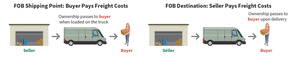
Consigned Goods: Goods out on consignment remain the property of the consignor and are not included in the consignee's inventory.
Example: FOB Shipping Point vs. FOB Destination
Under FOB Shipping Point, ownership transfers to the buyer when goods are shipped.
Under FOB Destination, ownership transfers to the buyer upon delivery.
Classification of Inventory
Inventory classification differs between merchandising and manufacturing companies, affecting how inventory is reported on the balance sheet.
Merchandising Company: Maintains a single inventory account for goods purchased in a ready-for-sale condition.
Manufacturing Company: Maintains three inventory accounts: Raw Materials, Work in Process, and Finished Goods.
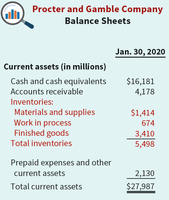
Example: The Procter and Gamble Company balance sheet (Jan. 30, 2020) shows inventory classified as materials and supplies, work in process, and finished goods.
Costs Included in Inventory
Inventory costs are divided into product costs and period costs, each with distinct accounting treatments.
Product Costs: Directly related to bringing inventory to a salable condition (e.g., purchase cost, freight-in, handling).
Period Costs: Indirectly related to inventory acquisition (e.g., selling expenses, administrative costs) and expensed in the period incurred.
Inventory Cost Flow Assumptions
Companies must adopt a cost flow assumption to allocate inventory costs between cost of goods sold and ending inventory. The chosen method does not need to match the physical flow of goods.
Specific Identification: Tracks the actual cost of each specific item sold. Used for unique, high-value items.
First-In, First-Out (FIFO): Assumes earliest goods purchased are the first sold. Ending inventory reflects recent costs.
Last-In, First-Out (LIFO): Assumes latest goods purchased are the first sold. Matches recent costs with current revenues but may result in lower reported income and inventory values.
Average Cost: Allocates cost based on the weighted average of all units available for sale.
Key Formulas
Cost of Goods Sold (COGS): \text{COGS} = \text{Beginning Inventory} + \text{Purchases} - \text{Ending Inventory} $ $
Weighted Average Cost per Unit: \text{Weighted Average Cost per Unit} = \frac{\text{Cost of Goods Available for Sale}}{\text{Total Units Available for Sale}} $ $
Special Issues Related to LIFO
LIFO presents unique accounting challenges and requires additional disclosures.
LIFO Reserve: The difference between inventory reported under LIFO and another method (e.g., FIFO). Disclosed in financial statements to provide comparability.
LIFO Liquidation: Occurs when older, lower-cost inventory layers are sold, resulting in higher income and taxes.
Dollar-Value LIFO: Measures inventory changes in dollar value rather than physical units, protecting LIFO layers from erosion and allowing for broader inventory pools.
Summary Table: Inventory Cost Flow Methods
Method | Cost Flow Assumption | Advantages | Disadvantages |
|---|---|---|---|
Specific Identification | Actual cost of each item | Exact matching of costs and revenues | Impractical for large volumes; manipulation risk |
FIFO | First purchased, first sold | Ending inventory at current cost | Higher taxes in inflationary periods |
LIFO | Last purchased, first sold | Tax benefits; matches current costs to revenues | Lower reported income and assets; complex |
Average Cost | Weighted average of all units | Smooths price fluctuations | May not reflect actual flow or current costs |
Learning Objectives Recap
Compute goods and costs included in inventory.
Distinguish between periodic and perpetual inventory systems.
Understand the relationship between beginning inventory, purchases, cost of goods available for sale, cost of goods sold, and ending inventory.
Calculate ending inventory and cost of goods sold under specific identification, FIFO, LIFO, Dollar-Value LIFO, and Average Cost methods.
