
Ch.11 - Liquids & Phase Changes
McMurry - Chemistry 8th Edition
McMurry8th EditionChemistryISBN: 9781292336145Not the one you use?Change textbook
Chapter 11, Problem 34

Choose any two temperatures and corresponding vapor pressures in the table given in Problem 11.30, and use those values to calculate ΔHvap for dichloromethane in kJ/mol. How does the value you calculated compare to the value you read from your plot in Problem 11.32?

Verified step by step guidance
1
Step 1: The problem is asking us to calculate the enthalpy of vaporization (ΔHvap) for dichloromethane using two sets of temperature and vapor pressure values. The formula to calculate ΔHvap is given by the Clausius-Clapeyron equation: ln(P2/P1) = -ΔHvap/R * (1/T2 - 1/T1), where P1 and P2 are the vapor pressures at temperatures T1 and T2 respectively, and R is the ideal gas constant.
Step 2: Choose any two sets of temperature and vapor pressure values from the table given in Problem 11.30. Convert the temperatures from Celsius to Kelvin by adding 273.15 to each temperature value.
Step 3: Substitute the chosen values into the Clausius-Clapeyron equation. Remember to use the correct value for R, which is 8.314 J/(mol*K) or 0.008314 kJ/(mol*K).
Step 4: Solve the equation for ΔHvap. This will involve rearranging the equation to isolate ΔHvap on one side, and then performing the necessary calculations.
Step 5: Compare the calculated ΔHvap value to the value you read from your plot in Problem 11.32. Note any differences and consider possible reasons for these differences, such as experimental error or the limitations of the Clausius-Clapeyron equation.

Verified video answer for a similar problem:

This video solution was recommended by our tutors as helpful for the problem above.
Video duration:
19m
Was this helpful?

Key Concepts

Here are the essential concepts you must grasp in order to answer the question correctly.

Vapor Pressure

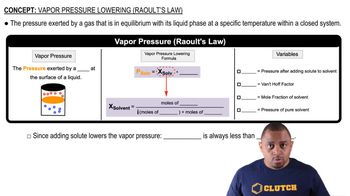
Vapor pressure is the pressure exerted by a vapor in equilibrium with its liquid or solid phase at a given temperature. It reflects the tendency of particles to escape from the liquid phase into the gas phase. Higher temperatures generally lead to higher vapor pressures, as more molecules have sufficient energy to overcome intermolecular forces and enter the vapor phase.
Recommended video:
Guided course
02:40
Raoult's Law and Vapor Pressure

Enthalpy of Vaporization (ΔHvap)

The enthalpy of vaporization (ΔHvap) is the amount of energy required to convert one mole of a liquid into vapor at constant temperature and pressure. It is a crucial thermodynamic property that indicates how much energy is needed to overcome intermolecular forces during the phase transition from liquid to gas. ΔHvap can be calculated using the Clausius-Clapeyron equation, which relates vapor pressure and temperature.
Recommended video:
Guided course
01:37
Enthalpy of Vaporization Example

Clausius-Clapeyron Equation

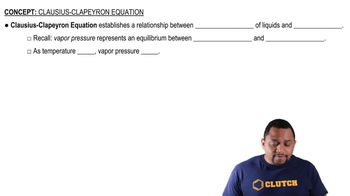
The Clausius-Clapeyron equation describes the relationship between vapor pressure and temperature for a substance. It is expressed as ln(P2/P1) = -ΔHvap/R(1/T2 - 1/T1), where P1 and P2 are the vapor pressures at temperatures T1 and T2, respectively, and R is the ideal gas constant. This equation allows for the calculation of ΔHvap by using two sets of vapor pressure and temperature data, making it essential for thermodynamic analysis.
Recommended video:
Guided course
00:59
Clausius-Clapeyron Equation