 Back
Back
- Which of the following reactions has ∆Ssys> 0? (a) N2(g) + 3H2(g) -> 2NH3(g) (b) Ag+(aq) + Cl-(aq) -> AgCl(s) (c) 2H2O2(aq) -> 2H2O(l) + O2(g) (d) 2I(g) -> I2(g)
Problem 2
- What is the change in entropy (∆S) when 1.32 g of propane (C3H8) at 0.100 atm pressure is compressed by a factor of five at a constant temperature at 20°C? Assume that propane behaves as an ideal gas. (a) ∆S = +13 J/K (b) ∆S = -13 J/K (c) ∆S = - 0.40 J/K (d) ∆S = + 0.40 J/K
Problem 4
- Identify the true statement about a spontaneous process. (a) A reaction that is nonspontaneous in the forward direction is spontaneous in the reverse direction. (b) Adding a catalyst will cause a nonspontaneous reaction to become spontaneous. (c) In a spontaneous process, the entropy of the system always decreases. (d) An endothermic reaction is always spontaneous.
Problem 7
- Calculate ∆Stotal, and determine whether the reaction is spon-taneous or nonspontaneous under standard-state conditions. (a) -429 J/K; nonspontaneous (b) -123 J/K; spontaneous (c) +3,530 J/K; nonspontaneous (d) +184 J/K; nonspontaneous
Problem 8
- Consider the following endothermic reaction of gaseous AB3 molecules with A2 molecules.
Problem 9
Identify the true statement about the spontaneity of the reaction. (a) The reaction is likely to be spontaneous at high temperatures. (b) The reaction is likely to be spontaneous at high temperatures. (c) The reaction is always spontaneous. (d) The reaction is always spontaneous.
- Ammonium hydrogen sulfide, a stink bomb ingredient, decomposes to ammonia and hydrogen sulfide: Calculate the standard free-energy change for the rection at 25 °C if the total pressure resulting from the solid NH4S placed in an evacuated container is 0.658 atm at 25 °C. (a) -43.8 kJ (b) +1.04 kJ (c) -462 kJ (d) +5.51 kJ
Problem 15
- Consider the following graph of total free energy of reactants and products versus reaction progress for the general reaction, Reactants -> Products. At which of the four points (labeled a, b, c, and d) is Q < K?
Problem 16
(a) Point a (b) Point c and d (c) Point a, c, and d (d) Point b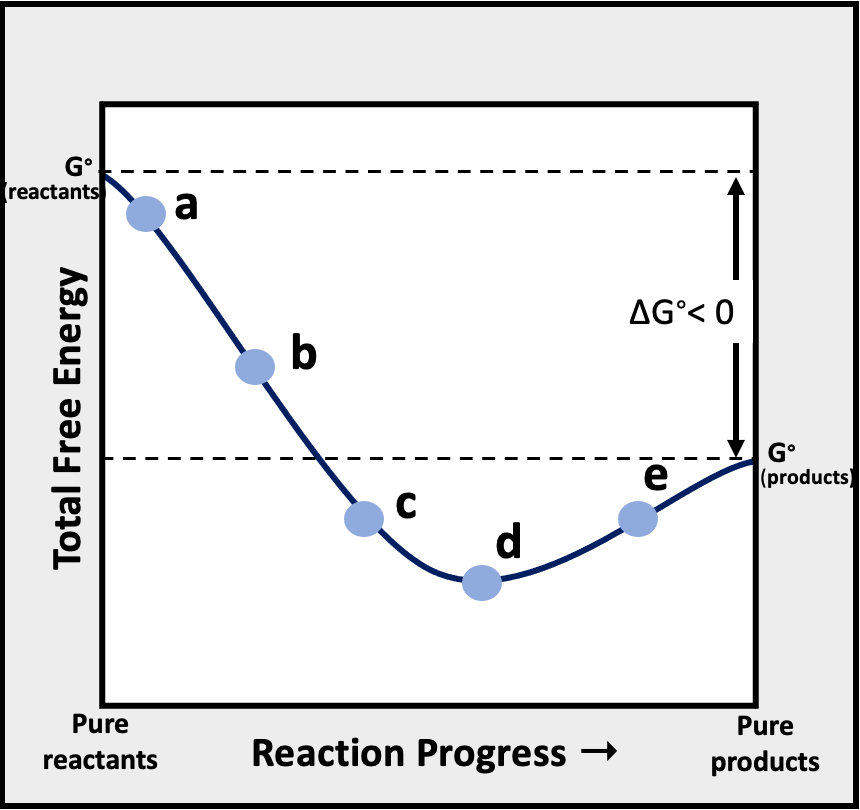
Problem 21.134b
Spinach contains a lot of iron but is not a good source of dietary iron because nearly all the iron is tied up in the oxalate complex [Fe(C2O4)3]3-.
(b) Under the acidic conditions in the stomach, the Fe3+ concentration should be greater because of the reaction
[Fe(C2O4)3]3-(aq) + 6 H3O+(aq) ⇌ Fe3+(aq) + 3 H2C2O4(aq) + 6 H2O(l)
Show, however, that this reaction is nonspontaneous under standard-state conditions. (For H2C2O4, Ka1 = 5.9 × 10⁻² and Ka2 = 6.4 × 10⁻⁵.)
Problem 21.135c
Formation constants for the ammonia and ethylenediamine complexes of nickel(II) indicate that Ni(en)32+ is much more
stable than Ni(NH3)62+:
(1) <REACTION>
(2) <REACTION>
The enthalpy changes for the two reactions, ΔH°1 and ΔH°2, should be about the same because both complexes have six Ni﹣N bonds.
(c) Assuming that ΔH°2 - ΔH°1 is zero, calculate the value of ΔS°2 - ΔS°1.
- Consider the gas-phase reaction of AB3 and A2 molecules:
Problem 26
(a) Write a balanced equation for the reaction. (b) What is the sign of the entropy change for the reaction?
Problem 27a
Ideal gases A (red spheres) and B (blue spheres) occupy two separate bulbs. The contents of both bulbs constitute the initial state of an isolated system. Consider the process that occurs when the stopcock is opened.

(a) Sketch the final (equilibrium) state of the system.
Problem 27b
Ideal gases A (red spheres) and B (blue spheres) occupy two separate bulbs. The contents of both bulbs constitute the initial state of an isolated system. Consider the process that occurs when the stopcock is opened.
(b) What are the signs ( + , - , or 0) of ∆H, ∆S, and ∆G for this process? Explain.
Problem 27c
Ideal gases A (red spheres) and B (blue spheres) occupy two separate bulbs. The contents of both bulbs constitute the initial state of an isolated system. Consider the process that occurs when the stopcock is opened.

(c) How dpes this process illustrate the second law of thermodynamics?
- Rank the situations represented by the following drawings according to increasing entropy.
Problem 28
Problem 32b
Consider the dissociation reaction A2(g) ⇌ 2 A(g). The following pictures represent two possible initial states and the equilibrium state of the system:
(b) What are the signs ( + , - , or 0) of ∆H, ∆S, and ∆G when the system goes from initial state 1 to the equilibrium state? Explain. Is this a spontaneous process?
- The following pictures represent equilibrium mixtures for the interconversion of A molecules (red) and X, Y, or Z molecules (blue):
Problem 35
What is the sign of ∆G° for each of the three reactions?
- Which of the following processes are spontaneous, and which are nonspontaneous? (a) Freezing of water at 2 °C (b) Corrosion of iron metal (c) Expansion of a gas to fill the available volume (d) Separation of an unsaturated aqueous solution of potassium chloride into solid KCl and liquid water
Problem 38
- Assuming that gaseous reactants and products are present at 1 atm partial pressure, which of the following reactions are spontaneous in the forward direction? (a) (b) (c) (d)
Problem 40
- Define entropy, and give an example of a process in which the entropy of a system increases.
Problem 42
- The following reaction of A3 molecules is spontaneous.
Problem 43
(b) What are the signs of ∆H, ∆S, and ∆G for the reaction? Explain.
- Predict the sign of the entropy change in the system for each of the following processes. (a) A solid sublimes. (b) A liquid freezes. (c) AgI precipitates from a solution containing Ag+ and I- ions. (d) Gaseous CO2 bubbles out of a carbonated beverage.
Problem 44
- Consider the distribution of ideal gas molecules among three bulbs (A, B, and C) of equal volume. For each of the follow-ing states, determine the number of ways (W) that the state can be achieved, and use Boltzmann's equation to calculate the entropy of the state. (a) 2 molecules in bulb A (b) 2 molecules randomly distributed among bulbs A, B, and C
Problem 50
- Which state has higher entropy? Explain in terms of probability. (a) A perfectly ordered crystal of solid nitrous oxide
Problem 54
or a disordered crystal in which the molecules are oriented randomly (b) Quartz glass (an amorphous solid) or a quartz crystal
Problem 56a
Which state in each of the following pairs has the higher entropy per mole of substance? (a) H2 at 25 °C in a volume of 10 L or H2 at 25 °C in a volume of 50 L
Problem 56d
Which state in each of the following pairs has the higher entropy per mole of substance? (d) CO2 at STP or CO2 at 100 °C and 0.1 atm
Problem 57a
Which state in each of the following pairs has the higher entropy per mole of substance? (a) Ice at -40 °C or ice at 0 °C
Problem 57d
Which state in each of the following pairs has the higher entropy per mole of substance? (d) Water vapor at 150 °C and 1 atm or water vapor at 100 °C and 2 atm
- What is the entropy change when the volume of 1.6 g of O2 increases from 2.5 L to 3.5 L at a constant temperature of 75 °C? Assume that O2 behaves as an ideal gas.
Problem 58
- Make a rough, qualitative plot of the standard molar entropy versus temperature for methane from 0 K to 298 K. Incorporate the following data into your plot: mp = -182 °C; bp = -164 °C; °S = 186.2 J/(K*mol) at 25 °C.
Problem 60
- An isolated system is one that exchanges neither matter nor energy with the surroundings. What is the entropy criterion for spontaneous change in an isolated system? Give an example of a spontaneous process in an isolated system.
Problem 69