Join thousands of students who trust us to help them ace their exams!
Multiple Choice
If 53.2kJ of heat are added to a 15.5g ice cube at - 5.00 oC, what will be the resulting state and temperature of the substance?
A
322.5°C, gas
B
-3.70ºC, solid
C
98.82 ºC, liquid
D
222.5 ºC, gas
7 Comments
Verified step by step guidance
1
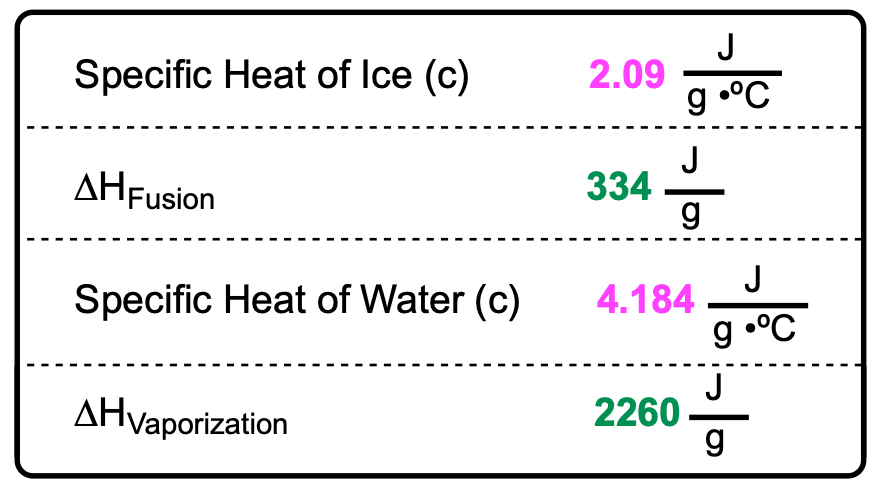
Step 1: Calculate the heat required to warm the ice from -5.00°C to 0°C using the formula q = m * c * ΔT, where m is the mass of the ice (15.5 g), c is the specific heat of ice (2.09 J/g·°C), and ΔT is the temperature change (0°C - (-5.00°C)).
Step 2: Determine the heat required to melt the ice at 0°C into liquid water using the formula q = m * ΔH_fusion, where m is the mass of the ice (15.5 g) and ΔH_fusion is the heat of fusion of ice (334 J/g).
Step 3: Calculate the heat required to warm the liquid water from 0°C to 100°C using the formula q = m * c * ΔT, where m is the mass of the water (15.5 g), c is the specific heat of water (4.184 J/g·°C), and ΔT is the temperature change (100°C - 0°C).
Step 4: If there is still heat remaining after the previous steps, calculate the heat required to vaporize the water at 100°C into steam using the formula q = m * ΔH_vaporization, where m is the mass of the water (15.5 g) and ΔH_vaporization is the heat of vaporization of water (2260 J/g).
Step 5: If there is still heat remaining after vaporization, calculate the temperature increase of the steam using the formula q = m * c * ΔT, where m is the mass of the steam (15.5 g), c is the specific heat of steam (assumed to be similar to water, 2.09 J/g·°C), and q is the remaining heat. Compare the total heat added (53.2 kJ) to the sum of all these steps to determine the final state and temperature.


 Verified step by step guidance

