An acid solution with a concentration of 0.500 M has a pH = 3.21. What is the Ka of the acid? (LO 16.8) (a) 1.2 * 10-5 (b) 1.7 * 10-6 (c) 7.6 * 10-7 (d) 5.4 * 10-3
Verified step by step guidance
1
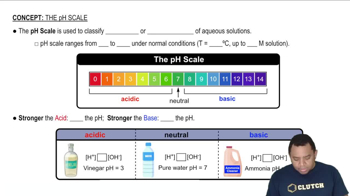
Calculate the concentration of hydrogen ions \([H^+]\) using the pH value. Use the formula \([H^+] = 10^{-\text{pH}}\).
Substitute the given pH value into the formula to find \([H^+]\).
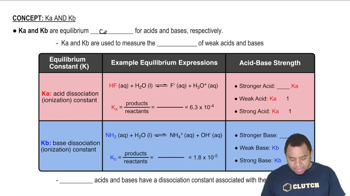
Write the expression for the acid dissociation constant \(K_a\) for the weak acid, which is \(K_a = \frac{[H^+][A^-]}{[HA]}\).
Assume that the initial concentration of the acid \([HA]\) is 0.500 M and that the change in concentration due to dissociation is negligible, so \([HA] \approx 0.500\).
Substitute the values of \([H^+]\) and \([HA]\) into the \(K_a\) expression to solve for \(K_a\).>
Verified video answer for a similar problem:
This video solution was recommended by our tutors as helpful for the problem above.
Video duration:
2m
Play a video:
0 Comments
Was this helpful?
Key Concepts
Here are the essential concepts you must grasp in order to answer the question correctly.
pH and pKa
pH is a measure of the hydrogen ion concentration in a solution, defined as pH = -log[H+]. The pKa is the negative logarithm of the acid dissociation constant (Ka) and provides insight into the strength of an acid. A lower pKa indicates a stronger acid, while a higher pKa indicates a weaker acid. Understanding the relationship between pH and pKa is essential for calculating the dissociation constant of an acid.
The acid dissociation constant (Ka) quantifies the strength of an acid in solution. It is defined by the equilibrium expression for the dissociation of an acid (HA) into its conjugate base (A-) and hydrogen ions (H+). The larger the Ka value, the stronger the acid, as it indicates a greater tendency to donate protons. Calculating Ka from pH involves using the concentration of the acid and the concentration of the dissociated ions at equilibrium.
In a chemical reaction, equilibrium concentrations refer to the concentrations of reactants and products when the reaction has reached a state where the rates of the forward and reverse reactions are equal. For weak acids, this involves determining the concentrations of the undissociated acid and the ions produced at equilibrium. These concentrations are crucial for calculating the Ka value, as they directly influence the equilibrium expression used in the calculation.


 Verified step by step guidance
 02:33
02:33