
Textbook Question
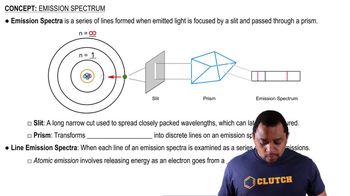
Is energy emitted or absorbed when the following electronic transitions occur in hydrogen? (a) from n = 3 to n = 2 (c) an electron adds to the H+ ion and ends up in the n = 2 shell?
734
views

 Verified step by step guidance
 01:51
01:51
 01:40
01:40Is energy emitted or absorbed when the following electronic transitions occur in hydrogen? (a) from n = 3 to n = 2 (c) an electron adds to the H+ ion and ends up in the n = 2 shell?
(a) Using Equation 6.5, calculate the energy of an electron in the hydrogen atom when n = 3 and when n = 6. Calculate the wavelength of the radiation released when an electron moves from n = 6 to n = 3.
Does the hydrogen atom 'expand' or 'contract' when an electron is excited from the n = 1 state to the n = 3 state?
Indicate whether energy is emitted or absorbed when the following electronic transitions occur in hydrogen: (a) from n = 2 to n = 3 (c) from the n = 9 to the n = 6 state.
Molybdenum metal must absorb radiation with an energy higher than 7.22 * 10-19 J ('energy threshold') before it can eject an electron from its surface via the photoelectric effect. (c) If molybdenum is irradiated with light of wavelength of 240 nm, what is the maximum possible velocity of the emitted electrons?