
Ch.4 - Chemical Quantities & Aqueous Reactions
Tro - Chemistry: A Molecular Approach 4th Edition
Tro4th EditionChemistry: A Molecular ApproachISBN: 9780134112831Not the one you use?Change textbook
Chapter 4, Problem 108

The combustion of liquid ethanol (C2H5OH) produces carbon dioxide and water. After 4.62 mL of ethanol (density = 0.789 g/mL) is allowed to burn in the presence of 15.55 g of oxygen gas, 3.72 mL of water (density = 1.00 g/mL) is collected. Determine the percent yield for the reaction. (Hint: Write a balanced equation for the combustion of ethanol.)

Verified step by step guidance
1
Step 1: Write the balanced chemical equation for the combustion of ethanol. The balanced equation is: C2H5OH + 3O2 → 2CO2 + 3H2O.
Step 2: Convert the volume of ethanol to mass using its density. The formula to use is mass = volume x density. In this case, the volume of ethanol is 4.62 mL and the density is 0.789 g/mL.
Step 3: Convert the mass of ethanol to moles using its molar mass. The molar mass of ethanol is approximately 46.07 g/mol.
Step 4: Determine the theoretical yield of water. According to the balanced equation, 3 moles of water are produced for every mole of ethanol. So, multiply the moles of ethanol by 3 to get the theoretical yield of water in moles. Then, convert this to grams using the molar mass of water (18.015 g/mol).
Step 5: Convert the volume of water collected to mass using its density (1.00 g/mL), then calculate the percent yield using the formula: percent yield = (actual yield / theoretical yield) x 100%. The actual yield is the mass of water collected, and the theoretical yield was calculated in the previous step.

Verified video answer for a similar problem:

This video solution was recommended by our tutors as helpful for the problem above.
Was this helpful?

Key Concepts

Here are the essential concepts you must grasp in order to answer the question correctly.

Combustion Reaction

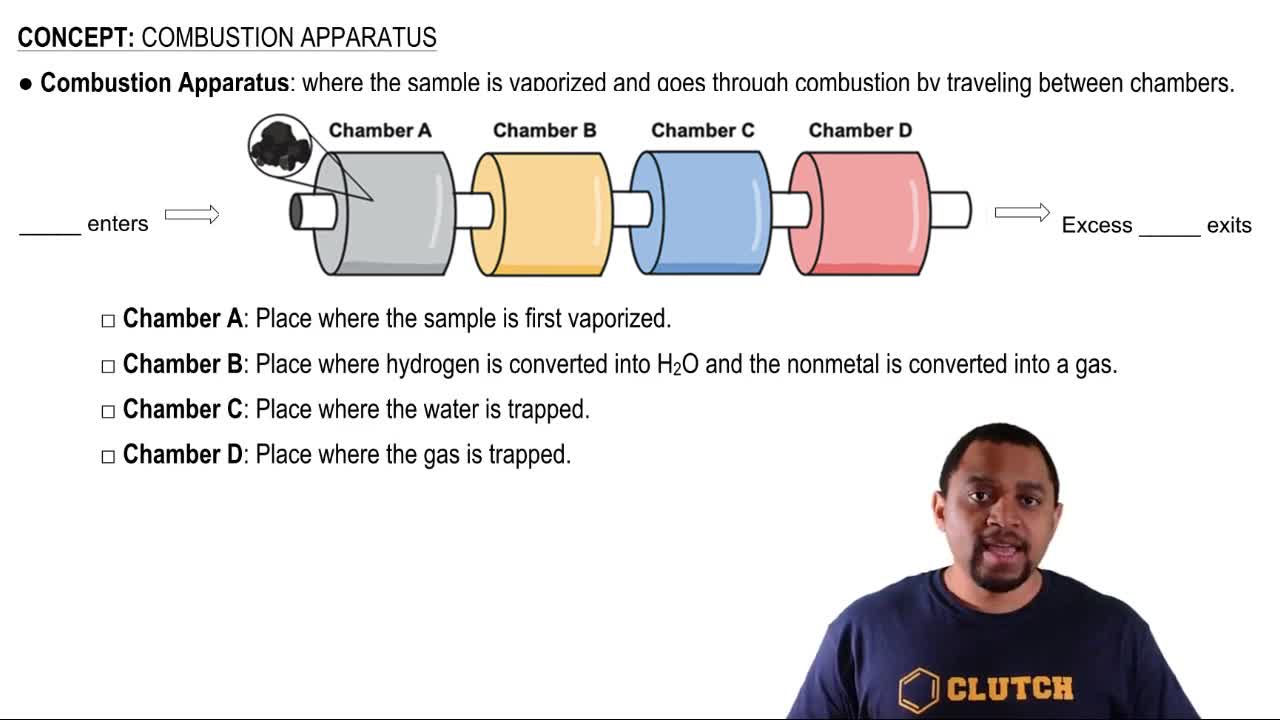
A combustion reaction is a chemical process in which a substance reacts rapidly with oxygen, producing heat and light. In the case of ethanol, the balanced equation for its combustion is C2H5OH + 3O2 → 2CO2 + 3H2O. Understanding this reaction is crucial for determining the stoichiometry involved and the theoretical yield of products.
Recommended video:
Guided course
02:24
Combustion Apparatus

Stoichiometry

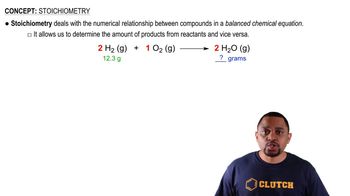
Stoichiometry involves the calculation of reactants and products in chemical reactions based on the balanced equation. It allows us to determine how much of each substance is consumed or produced. In this question, stoichiometry is essential for calculating the theoretical yield of water produced from the combustion of ethanol, which is then compared to the actual yield to find the percent yield.
Recommended video:
Guided course
01:16
Stoichiometry Concept

Percent Yield

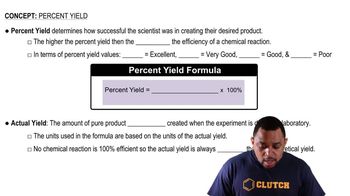
Percent yield is a measure of the efficiency of a chemical reaction, calculated by comparing the actual yield of a product to the theoretical yield. It is expressed as a percentage using the formula: (actual yield / theoretical yield) × 100%. In this scenario, calculating the percent yield of water produced from the combustion of ethanol will provide insight into the reaction's efficiency.
Recommended video:
Guided course
03:09
Percent Yield in Reactions