
Which of the following are redox reactions? For those that are, indicate which element is oxidized and which is reduced. For those that are not, indicate whether they are precipitation or neutralization reactions. (a) P4(s) + 10 HClO(aq) + 6 H2O(l) → 4 H3PO4(aq) + 10 HCl(aq) (b) Br2(l) + 2 K(s)→ 2 KBr(s) (c) CH3CH2OH(l) + 3 O2(g) → 3 H2O(l) + 2 CO2(g) (d) ZnCl2(aq) + 2 NaOH(aq) → Zn(OH)2(s) + 2 NaCl(aq)
Ch.4 - Reactions in Aqueous Solution

Brown15th EditionChemistry: The Central ScienceISBN: 9780137542970Not the one you use?Change textbook
Chapter 4, Problem 50f
Determine the oxidation number for the indicated element in each of the following substances: f. Cr in BaCrO4.
Verified step by step guidance1
Identify the oxidation number of each element in the compound BaCrO4, starting with known values: Ba is in Group 2, so its oxidation number is +2, and O is typically -2.
Set up an equation to represent the sum of the oxidation numbers in the compound. For BaCrO4, the sum of the oxidation numbers must equal 0 because it is a neutral compound.
Assign the oxidation number of oxygen as -2. Since there are four oxygen atoms, the total contribution from oxygen is 4(-2) = -8.
Let the oxidation number of Cr be x. Write the equation for the sum of oxidation numbers: (+2) + x + 4(-2) = 0.
Solve the equation for x to find the oxidation number of Cr.

Verified video answer for a similar problem:
This video solution was recommended by our tutors as helpful for the problem above.
Video duration:
1mWas this helpful?
Key Concepts
Here are the essential concepts you must grasp in order to answer the question correctly.
Oxidation Number
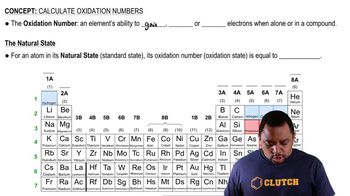
The oxidation number, or oxidation state, is a value assigned to an element in a compound that reflects its degree of oxidation or reduction. It indicates the number of electrons an atom gains, loses, or shares when forming chemical bonds. Oxidation numbers are crucial for understanding redox reactions and balancing chemical equations.
Recommended video:
Guided course
Oxidation Numbers
Rules for Assigning Oxidation Numbers
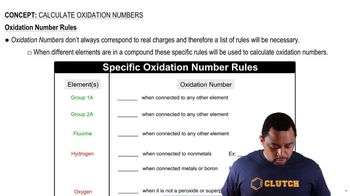
There are specific rules for assigning oxidation numbers, such as the fact that the oxidation number of an element in its elemental form is zero, and for monoatomic ions, it equals the charge of the ion. In compounds, the sum of the oxidation numbers must equal the overall charge of the compound. These rules help in determining the oxidation state of elements in various compounds.
Recommended video:
Guided course
Oxidation Number Rules
Chromate Ion (CrO4^2-)
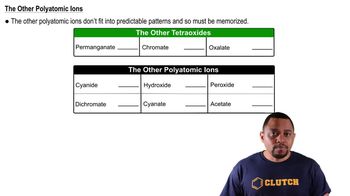
The chromate ion (CrO4^2-) is a polyatomic ion where chromium is in a specific oxidation state. In this ion, the oxidation state of chromium can be determined by considering the known oxidation states of oxygen, which is typically -2. The overall charge of the chromate ion helps in calculating the oxidation state of chromium, which is essential for solving the question regarding BaCrO4.
Recommended video:
Guided course
Other Polyatomic Ions
Related Practice
Textbook Question
657
views
Textbook Question
Which element is oxidized, and which is reduced in the following reactions? (a) N2(g) + 3 H2(g) → 2 NH3(g)
458
views
Textbook Question
Determine the oxidation number for the indicated element in each of the following substances: d. Br in HBrO
2
views
Textbook Question
Determine the oxidation number for the indicated element in each of the following substances: e. Cl in HClO2
5
views
Textbook Question
Which element is oxidized, and which is reduced in the following reactions? (c) Cl2(aq) + 2 NaI(aq) → I2(aq) + 2 NaCl(aq) (d) PbS(s) + 4 H2O2(aq) → PbSO4(s) + 4 H2O(l)
718
views
Textbook Question
Determine the oxidation number for the indicated element in each of the following substances: c. Mn in KMnO4,
2
views
