
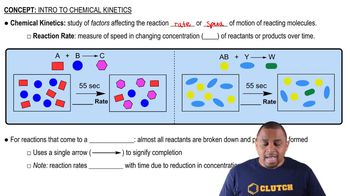
The desorption (leaving of the surface) of a single molecular layer of n-butane from a single crystal of aluminum oxide is found to be first order with a rate constant of 0.128/s at 150 K. b. If the surface is initially completely covered with n-butane at 150 K, how long will it take for 25% of the molecules to desorb (leave the surface)? For 50% to desorb?
The kinetics of this reaction were studied as a function of temperature. (The reaction is first order in each reactant and second order overall.)
C2H5Br(aq) + OH- (aq) → C2H5OH(l) + Br- (aq)
Temperature (°C) k (L,mol •s)
25 8.81⨉10-5
35 0.000285
45 0.000854
55 0.00239
65 0.00633
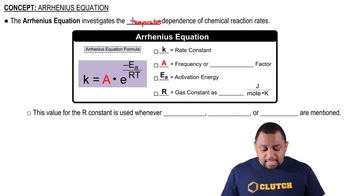
a. Determine the activation energy and frequency factor for the reaction.
Verified step by step guidance
Verified video answer for a similar problem:
Key Concepts
Reaction Kinetics
Arrhenius Equation
Activation Energy
The kinetics of this reaction were studied as a function of temperature. (The reaction is first order in each reactant and second order overall.)
C2H5Br(aq) + OH- (aq) → C2H5OH(l) + Br- (aq)
Temperature (°C) k (L,mol •s)
25 8.81⨉10-5
35 0.000285
45 0.000854
55 0.00239
65 0.00633
b. Determine the rate constant at 15 °C.
The kinetics of this reaction were studied as a function of temperature. (The reaction is first order in each reactant and second order overall.)
C2H5Br(aq) + OH- (aq) → C2H5OH(l) + Br- (aq)
Temperature (°C) k (L,mol •s)
25 8.81⨉10-5
35 0.000285
45 0.000854
55 0.00239
65 0.00633
c. If a reaction mixture is 0.155 M in C2H5Brand 0.250 M in OH-, what is the initial rate of the reaction at 75 °C?
Consider the two reactions:
O + N2 → NO + N Ea = 315 kJ/mol
Cl + H2 → HCl + H Ea = 23 kJ/mol
a. Why is the activation barrier for the first reaction so much higher than that for the second?
The evaporation of a 120-nm film of n-pentane from a single crystal of aluminum oxide is zero order with a rate constant of 1.92⨉1013 molecules/cm2•s at 120 K. a. If the initial surface coverage is 8.9⨉1016 molecules/cm2, how long will it take for one-half of the film to evaporate?
