Ch.16 - Aqueous Equilibria: Acids & Bases
McMurry - Chemistry 8th Edition
McMurry8th EditionChemistryISBN: 9781292336145Not the one you use?Change textbook
Chapter 16, Problem 158a

A 1.000 L sample of HF gas at 20.0 °C and 0.601 atm pressure was dissolved in enough water to make 50.0 mL of hydrofluoric acid. (a) What is the pH of the solution?

Verified step by step guidance
1
Convert the initial conditions of HF gas to moles using the ideal gas law: \( PV = nRT \).
Calculate the concentration of HF in the solution by dividing the moles of HF by the volume of the solution in liters.
Use the expression for the ionization of HF in water: \( HF \rightleftharpoons H^+ + F^- \) and set up an ICE table to find the equilibrium concentrations.
Apply the expression for the acid dissociation constant \( K_a \) of HF to solve for \([H^+]\) at equilibrium.
Calculate the pH of the solution using the formula \( \text{pH} = -\log[H^+] \).

Key Concepts

Here are the essential concepts you must grasp in order to answer the question correctly.

Acid-Base Chemistry

Acid-base chemistry involves the study of acids, bases, and their reactions. Acids are substances that donate protons (H+) in solution, while bases accept protons. The strength of an acid is often measured by its dissociation constant (Ka), which indicates how completely it ionizes in water. Understanding these principles is essential for calculating pH and determining the behavior of hydrofluoric acid (HF) in solution.
Recommended video:
Guided course
02:00
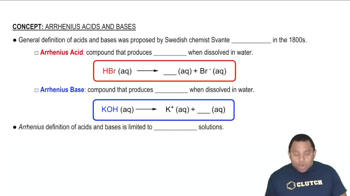
Arrhenius Acids and Bases

pH Scale

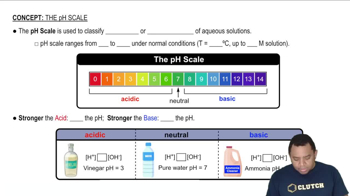
The pH scale quantifies the acidity or basicity of a solution, ranging from 0 to 14. A pH of 7 is neutral, while values below 7 indicate acidic solutions and values above 7 indicate basic solutions. The pH is calculated using the formula pH = -log[H+], where [H+] is the concentration of hydrogen ions in the solution. This concept is crucial for determining the pH of the hydrofluoric acid solution formed from the HF gas.
Recommended video:

Dilution and Concentration

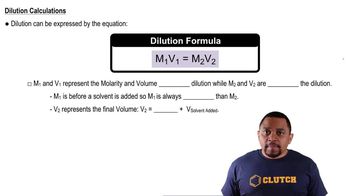
Dilution refers to the process of reducing the concentration of a solute in a solution, typically by adding more solvent. The relationship between the initial and final concentrations and volumes can be described by the equation C1V1 = C2V2, where C is concentration and V is volume. In this question, understanding how the concentration of HF changes when it is dissolved in water is vital for calculating the resulting pH of the solution.
Recommended video:
Guided course
00:58
Dilution Equation