Textbook Question
What is the systematic name for each of the following coordination compounds?
(a) Cs[FeCl4]
(b) [V(H2O)6](NO3)3
162
views

 McMurry 8th EditionCh.21 - Transition Elements and Coordination ChemistryProblem 21.85a
 Verified step by step guidance
 3:33
3:33
 2:14
2:14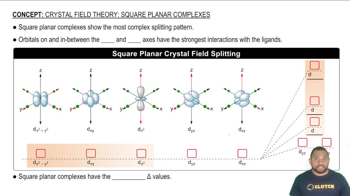 02:07
02:07What is the systematic name for each of the following coordination compounds?
(a) Cs[FeCl4]
(b) [V(H2O)6](NO3)3
What is the systematic name for each of the following ions?
(a) [MnCl4]2-
(b) [Ni(NH3)6]2+
Two first-series transition metals have three unpaired electrons in complex ions of the type [MCl4]2-.
(a) What are the oxidation state and the identity of M in these complexes?
(b) Draw valence bond orbital diagrams for the two possible ions.
(c) Based on common oxidation states of first-series transition metals (Figure 21.6), which ion is more likely to exist?
<QUESTION REFERENCES FIGURE 21.6>
Assign a systematic name to each of the following ions.
(c) [Fe(H2O)5NCS]2+
(d) [Cr(NH3)2(C2O4)2]-
There are two possible [M(OH)4]- complexes of first-series transition metals that have three unpaired electrons.
(a) What are the oxidation state and the identity of M in these complexes?
(b) Using orbital diagrams, give a valence bond description of the bonding in each complex.
(c) Based on common oxidation states of first-series transition metals (Figure 21.6), which [M(OH)4]- complex is more likely to exist?
<QUESTION REFERENCES FIGURE 21.6>-
For each of the following complexes, draw a crystal field energy-level diagram, assign the electrons to orbitals, and predict the number of unpaired electrons.
(a) [Pt(NH3)4]2+ (square planar)