
Ch.5 - Thermochemistry
Brown - Chemistry: The Central Science 14th Edition
Brown14th EditionChemistry: The Central ScienceISBN: 9780134414232Not the one you use?Change textbook
Chapter 5, Problem 62a

Consider the following hypothetical reactions: A → B ΔHI = +60 kJ B → C ΔHII = -90 kJ (a) Use Hess’s law to calculate the enthalpy change for the reaction A → C.

Verified step by step guidance
1
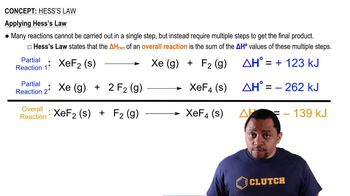
Understand Hess's Law: It states that the total enthalpy change for a reaction is the same, no matter how many steps the reaction is carried out in. This means we can add the enthalpy changes of individual steps to find the overall enthalpy change.
Identify the given reactions and their enthalpy changes: The first reaction is A → B with ΔH = +60 kJ, and the second reaction is B → C with ΔH = -90 kJ.
Write the target reaction: We need to find the enthalpy change for the reaction A → C.
Apply Hess's Law: Add the enthalpy changes of the given reactions to find the enthalpy change for the target reaction. This involves summing the enthalpy changes: ΔH (A → C) = ΔH (A → B) + ΔH (B → C).
Substitute the given values into the equation: ΔH (A → C) = +60 kJ + (-90 kJ). Calculate the sum to find the overall enthalpy change for the reaction A → C.

Verified video answer for a similar problem:

This video solution was recommended by our tutors as helpful for the problem above.
Video duration:
2m
Was this helpful?

Key Concepts

Here are the essential concepts you must grasp in order to answer the question correctly.

Hess's Law

Hess's Law states that the total enthalpy change for a chemical reaction is the sum of the enthalpy changes for the individual steps of the reaction, regardless of the pathway taken. This principle allows us to calculate the enthalpy change for a reaction by combining the enthalpy changes of related reactions, making it a powerful tool in thermochemistry.
Recommended video:

Enthalpy Change (ΔH)

Enthalpy change (ΔH) is a measure of the heat content of a system at constant pressure. It indicates whether a reaction is exothermic (releases heat, ΔH < 0) or endothermic (absorbs heat, ΔH > 0). Understanding the sign and magnitude of ΔH is crucial for predicting the energy changes associated with chemical reactions.

Thermochemical Equations

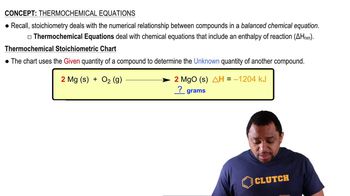
Thermochemical equations represent chemical reactions along with their associated enthalpy changes. These equations provide essential information about the energy changes that occur during reactions, allowing chemists to analyze and predict the heat exchange involved in various processes. Properly balancing these equations is vital for accurate calculations using Hess's Law.
Recommended video:
Guided course
01:13
Thermochemical Equations
Related Practice
Textbook Question

Under constant-volume conditions, the heat of combustion of benzoic acid (C6H5O6) is 15.57 kJ/g. A 3.500-g sample of sucrose is burned in a bomb calorimeter. The temperature of the calorimeter increases from 20.94 to 24.72 °C. (a) What is the total heat capacity of the calorimeter?

1939
views
Textbook Question

Under constant-volume conditions, the heat of combustion of benzoic acid (C6H5O6) is 15.57 kJ/g. A 3.500-g sample of sucrose is burned in a bomb calorimeter. The temperature of the calorimeter increases from 20.94 to 24.72 °C. (b) If the size of the sucrose sample had been exactly twice as large, what would the temperature change of the calorimeter have been?

1040
views
Textbook Question

From the enthalpies of reaction H2(g) + F2(g) → 2 HF(g) ΔH = -537 kJ C(s) + 2 F2(g) → CF4(g) ΔH = -680 kJ 2 C(s) + 2 H2(g) → C2H4(g) ΔH = +52.3 kJ Calculate H for the reaction of ethylene with F2: C2H4(g) + 6 F2(g) → 2 CF4(g) + 4 HF(g)

971
views
Textbook Question

Under constant-volume conditions, the heat of combustion of naphthalene (C10H8) is 40.18 kJ/g. A 2.50-g sample of naphthalene is burned in a bomb calorimeter. The temperature of the calorimeter increases from 21.50 to 28.83 °C. (c) Suppose that in changing samples, a portion of the water in the calorimeter were lost. In what way, if any, would this change the heat capacity of the calorimeter?

1165
views
Textbook Question

Consider the following hypothetical reactions: A → B ΔHI = +60 kJ B → C ΔHII = -90 kJ (b) Construct an enthalpy diagram for substances A, B, and C, and show how Hess's law applies.

1311
views
Textbook Question

Calculate the enthalpy change for the reaction P4O6(s) + 2 O2(g) → P4O10(s) given the following enthalpies of reaction: P4(s) + 3 O2(g) → P4O6(s) ΔH = -1640.1 kJ P4(s) + 5 O2(g) → P4O10(s) ΔH = -2940.1 kJ

1298
views