Ch.5 - Gases
Tro - Chemistry: A Molecular Approach 4th Edition
Tro4th EditionChemistry: A Molecular ApproachISBN: 9780134112831Not the one you use?Change textbook
Chapter 5, Problem 121

Determine the temperature on the second day, assuming that the pressure and amount of gas in a natural gas storage tank have not changed, where the tank is a cylinder with a moveable top and a fixed radius. The height of the cylinder is 22.6 m at 22 °C, and the next day the height increases to 23.8 m due to a heat wave.

Verified step by step guidance
1
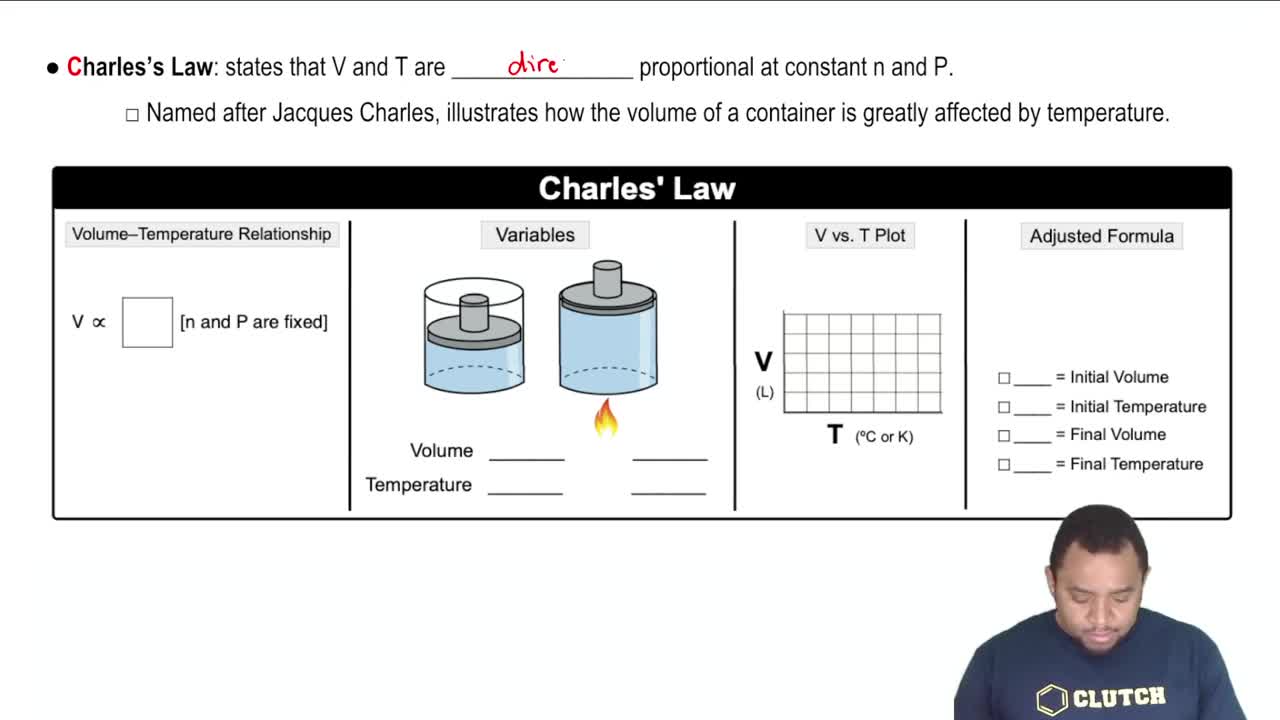
Identify the relationship between the volume of the gas and temperature using Charles's Law, which states that the volume of a gas is directly proportional to its temperature when pressure and the amount of gas are constant.
Express Charles's Law mathematically as \( \frac{V_1}{T_1} = \frac{V_2}{T_2} \), where \( V_1 \) and \( V_2 \) are the initial and final volumes, and \( T_1 \) and \( T_2 \) are the initial and final temperatures in Kelvin.
Calculate the initial volume \( V_1 \) using the formula for the volume of a cylinder: \( V_1 = \pi r^2 h_1 \), where \( h_1 = 22.6 \) m.
Calculate the final volume \( V_2 \) using the formula for the volume of a cylinder: \( V_2 = \pi r^2 h_2 \), where \( h_2 = 23.8 \) m.
Convert the initial temperature from Celsius to Kelvin by adding 273.15 to 22 °C, then use Charles's Law to solve for the final temperature \( T_2 \) in Kelvin, and convert it back to Celsius if needed.

Key Concepts

Here are the essential concepts you must grasp in order to answer the question correctly.

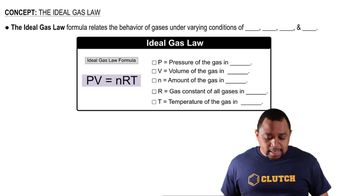
Ideal Gas Law

The Ideal Gas Law relates the pressure, volume, temperature, and amount of gas in a system through the equation PV = nRT. In this scenario, since pressure and the amount of gas remain constant, changes in temperature can be inferred from changes in volume, which is represented by the height of the gas in the cylinder.
Recommended video:
Guided course
01:15
Ideal Gas Law Formula

Charles's Law

Charles's Law states that the volume of a gas is directly proportional to its temperature when pressure is held constant. This principle is crucial for understanding how the increase in height of the gas in the cylinder corresponds to an increase in temperature, allowing us to calculate the new temperature based on the change in volume.
Recommended video:
Guided course
02:06
Charles's Law

Temperature Conversion

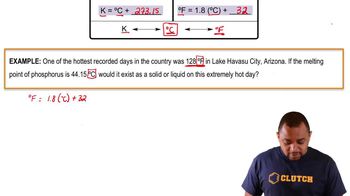
Temperature in gas law calculations is typically measured in Kelvin. To convert Celsius to Kelvin, one must add 273.15 to the Celsius temperature. This conversion is essential for accurately applying gas laws, as they require absolute temperature values to ensure correct proportional relationships.
Recommended video:
Guided course
02:10
Temperature Conversion Example
Related Practice
Textbook Question

A mixture of 8.0 g CH4 and 8.0 g Xe is placed in a container and the total pressure is found to be 0.44 atm. Determine the partial pressure of CH4.

1042
views
1
rank

Textbook Question

A mixture of CO(g) and O2(g) in a 1.0-L container at 1.0×10³ K has a total pressure of 2.2 atm. After some time, the total pressure falls to 1.9 atm as the result of the formation of CO2. Determine the mass (in grams) of CO2 that forms.

1477
views
Textbook Question

A catalytic converter in an automobile uses a palladium or platinum catalyst (a substance that increases the rate of a reaction without being consumed by the reaction) to convert carbon monoxide gas to carbon dioxide according to the reaction: 2 CO(g) + O2(g) → 2 CO2(g) A chemist researching the effectiveness of a new catalyst combines a 2.0:1.0 mole ratio mixture of carbon monoxide and oxygen gas (respectively) over the catalyst in a 2.45-L flask at a total pressure of 745 torr and a temperature of 552 °C. When the reaction is complete, the pressure in the flask has dropped to 552 torr. What percentage of the carbon monoxide was converted to carbon dioxide?

3208
views
Textbook Question

In a given diffusion apparatus, 15.0 mL of HBr gas diffuses in 1.0 min. In the same apparatus and under the same conditions, 20.3 mL of an unknown gas diffuses in 1.0 min. The unknown gas is a hydrocarbon. Find its molecular formula.

2094
views
Textbook Question

Binary compounds of alkali metals and hydrogen react with water to liberate H2(g). The H2 from the reaction of a sample of NaH with an excess of water fills a volume of 0.490 L above the water. The temperature of the gas is 35 °C and the total pressure is 758 mmHg. Determine the mass of H2 liberated and the mass of NaH that reacted.

1042
views