
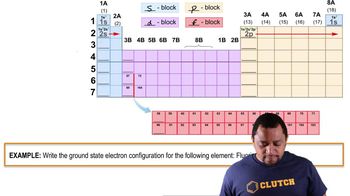
Consider the noble gas xenon. (a) Write the electron configuration of xenon using the abbreviation of the previous noble gas.
Verified step by step guidance
Verified video answer for a similar problem:
Key Concepts
Electron Configuration
Noble Gases
Abbreviated Electron Configuration
An energetically excited hydrogen atom has its electron in a 5f subshell. The electron drops down to the 3d subshell, releasing a photon in the process. (c) The hydrogen atom now has a single electron in the 3d subshell. What is the energy in kJ/mol required to remove this electron?
Consider the noble gas xenon. (c) The energy required to completely remove the outermost electron from the excited xenon atom is 369 kJ/mol, almost identical to that of cesium (376 kJ/mol). Explain.
A minimum energy of 7.21⨉10-19 J is required to produce the photoelectric effect in chromium metal. (b) Light with a wavelength of 2.50⨉10-7 m falls on a piece of chromium in an evacuated glass tube. What is the minimum de Broglie wavelength of the emitted electrons? (Note that the energy of the incident light must be conserved; that is, the photon's energy must equal the sum of the energy needed to eject the electron plus the kinetic energy of the electron.)
