
Ch.20 - Electrochemistry
Brown - Chemistry: The Central Science 15th Edition
Brown15th EditionChemistry: The Central ScienceISBN: 9780137542970Not the one you use?Change textbook
Chapter 20, Problem 25c

Complete and balance the following half-reactions in basic solution. In each case, indicate whether the half-reaction is an oxidation or a reduction. c. Cr(OH)3(𝑠)⟢CrO42βˆ’(π‘Žπ‘ž)

Verified step by step guidance
1
Identify the oxidation states of chromium in Cr(OH)_3 and CrO_4^{2-}.
Determine whether the half-reaction is an oxidation or a reduction by comparing the oxidation states.
Balance the chromium atoms on both sides of the equation.
Balance the oxygen atoms by adding H_2O molecules to the appropriate side.
Balance the hydrogen atoms by adding OH^- ions to the appropriate side and ensure the charge is balanced.

Verified video answer for a similar problem:

This video solution was recommended by our tutors as helpful for the problem above.
Video duration:
4m
Was this helpful?

Key Concepts

Here are the essential concepts you must grasp in order to answer the question correctly.

Half-Reactions

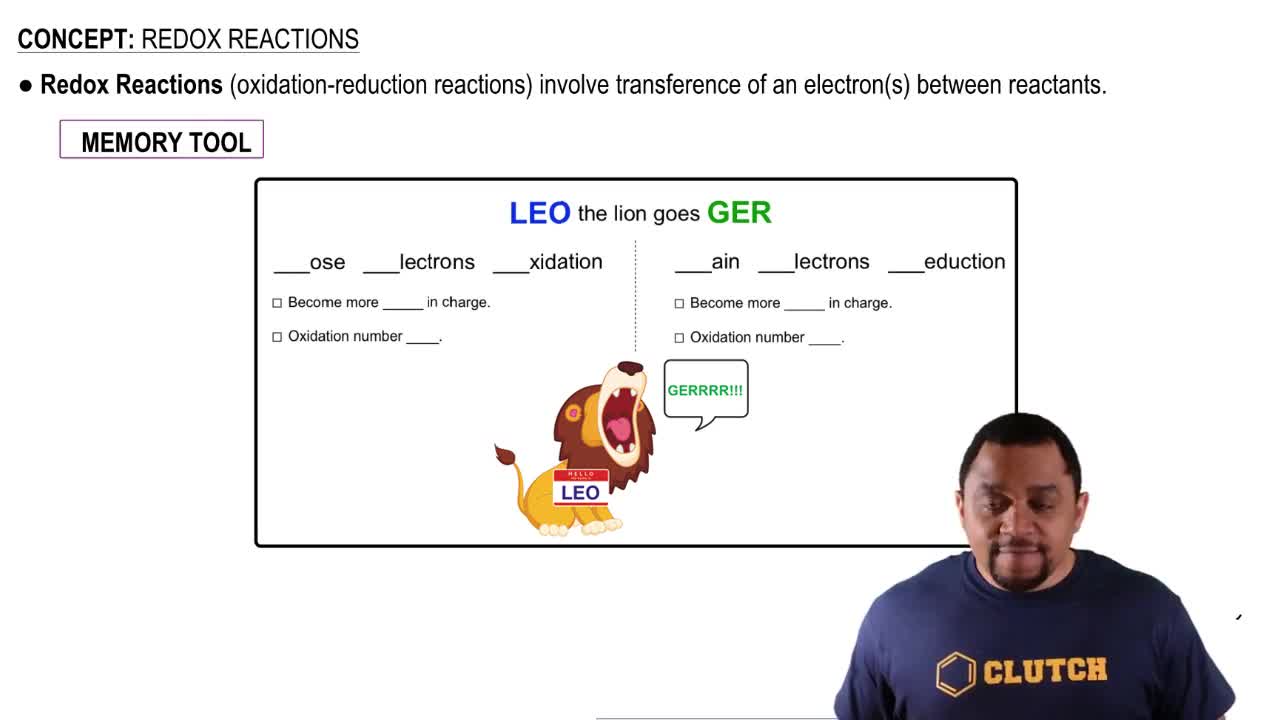
Half-reactions are equations that show either the oxidation or reduction process occurring in a redox reaction. They represent the transfer of electrons, with oxidation involving the loss of electrons and reduction involving the gain of electrons. In this context, balancing half-reactions is essential to ensure that both mass and charge are conserved.

Oxidation and Reduction

Oxidation is defined as the process where a substance loses electrons, resulting in an increase in oxidation state, while reduction is the gain of electrons, leading to a decrease in oxidation state. Identifying whether a half-reaction is an oxidation or reduction is crucial for understanding the overall redox process and for balancing the reaction correctly.
Recommended video:
Guided course
01:53
Oxidation and Reduction Reactions

Basic Solution Conditions

In basic solutions, the presence of hydroxide ions (OH⁻) influences the balancing of half-reactions. When balancing in basic conditions, it is often necessary to add OH⁻ ions to neutralize any H⁺ ions that may appear during the balancing process. This ensures that the final balanced equation accurately reflects the conditions of the reaction.
Related Practice
Textbook Question

Complete and balance the following equations, and identify the oxidizing and reducing agents:


a. MnO4βˆ’(π‘Žπ‘ž)+CH3OH(π‘Žπ‘ž)⟢Mn2+(π‘Žπ‘ž)+HCOOH(π‘Žπ‘ž)(acidic solution)

b. As2O3(𝑠)+NO3βˆ’(π‘Žπ‘ž)⟢H3AsO4(π‘Žπ‘ž)+N2O3(π‘Žπ‘ž)(acidic solution)

c. Pb(OH)42βˆ’(π‘Žπ‘ž)+ClOβˆ’(π‘Žπ‘ž)⟢PbO2(𝑠)+Clβˆ’(π‘Žπ‘ž)(basic solution)

Textbook Question

Complete and balance the following half-reactions. In each case, indicate whether the half-reaction is an oxidation or a reduction. (a) Sn2+(aq) β†’ Sn4+(aq) (acidic solution) (b) TiO2(s) β†’ Ti2+(aq) (acidic solution) (c) ClO3-(aq) β†’ Cl-(aq) (acidic solution) (d) N2(g) β†’ NH4+(aq) (acidic solution)

666
views
Textbook Question

Complete and balance the following equations, and identify the oxidizing and reducing agents: (a) Cr2O72-(aq) + I-(aq) β†’ Cr3+(aq) + IO3-(aq) (acidic solution) (b) MnO4-(aq) + CH3O(1aq) β†’ Mn2+(aq) + HCOOH(aq) (acidic solution) (c) I2(s) + OCl-(aq) β†’ IO3-(aq) + Cl-(aq) (acidic solution)

771
views
Textbook Question

Complete and balance the following half-reactions in basic solution. In each case, indicate whether the half-reaction is an oxidation or a reduction.


a. OHβˆ’(π‘Žπ‘ž)⟢O2(𝑔)

b. SO32βˆ’(π‘Žπ‘ž)⟢SO42βˆ’(π‘Žπ‘ž)

c. N2(𝑔)⟢NH3(𝑔)

d. HO2βˆ’(π‘Žπ‘ž)⟢OHβˆ’(π‘Žπ‘ž)

Textbook Question

Complete and balance the following equations, and identify the oxidizing and reducing agents: MnO4-(aq) + Br-(aq) β†’ MnO2(s) + BrO3-(aq) (basic solution)

703
views
Textbook Question

Complete and balance the following half-reactions in basic solution. In each case, indicate whether the half-reaction is an oxidation or a reduction.

a. O2(𝑔)⟢H2O(𝑙)

b. Mn2+(π‘Žπ‘ž)⟢MnO2(𝑠)

c. Cr(OH)3(𝑠)⟢CrO42βˆ’(π‘Žπ‘ž)

d. N2H4(π‘Žπ‘ž)⟢N2(𝑔)