
Ch.14 - Chemical Kinetics
McMurry - Chemistry 8th Edition
McMurry8th EditionChemistryISBN: 9781292336145Not the one you use?Change textbook
Chapter 14, Problem 9

Chlorine monoxide (ClO) decomposes at room temperature according to the reaction 2 ClO1g2¡Cl21g2 + O21g2 The concentration of ClO was monitored over time, and three graphs were made:Graph showing concentration of ClO over time, decreasing from 0.03 to 0.015 mol/L.
Graph showing the natural logarithm of ClO concentration over time, linear decline indicating first-order reaction.
What is the rate law for the reaction? (LO 14.9) (a) Rate = k (b) Rate = k3ClO4 (c) Rate = k3ClO42 (d) Rate = k3ClO43 M14_MCMU6230_

Verified step by step guidance
1
Examine the first graph, which shows the concentration of ClO over time. Notice that the concentration decreases over time.
Examine the second graph, which shows the natural logarithm of the ClO concentration over time. Notice that this graph is a straight line.
Recall that a straight line in a plot of ln[ClO] versus time indicates a first-order reaction.
For a first-order reaction, the rate law is given by Rate = k[ClO].
Therefore, the rate law for the decomposition of ClO is Rate = k[ClO].

Verified video answer for a similar problem:

This video solution was recommended by our tutors as helpful for the problem above.
Video duration:
3m
Was this helpful?

Key Concepts

Here are the essential concepts you must grasp in order to answer the question correctly.

Reaction Order

The reaction order refers to the power to which the concentration of a reactant is raised in the rate law of a chemical reaction. It indicates how the rate of reaction depends on the concentration of reactants. For example, a first-order reaction means that the rate is directly proportional to the concentration of one reactant, while a second-order reaction involves the square of the concentration. Understanding the reaction order is crucial for determining the rate law.
Recommended video:
Guided course
00:36
Average Bond Order

Rate Law

The rate law is an equation that relates the rate of a chemical reaction to the concentration of its reactants. It is typically expressed in the form Rate = k[A]^m[B]^n, where k is the rate constant, and m and n are the orders of the reaction with respect to reactants A and B, respectively. The rate law provides insight into the mechanism of the reaction and is determined experimentally, often through concentration vs. time data.
Recommended video:
Guided course
01:52
Rate Law Fundamentals

First-Order Reactions

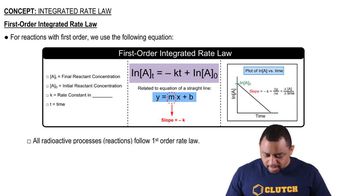
First-order reactions are characterized by a linear relationship between the natural logarithm of the concentration of a reactant and time. This means that as the concentration decreases, the rate of reaction remains proportional to the concentration of the reactant. The provided graph of the natural logarithm of ClO concentration over time indicates a straight line, confirming that the decomposition of ClO follows first-order kinetics, which is essential for determining the correct rate law.
Recommended video:
Guided course
02:29
First-Order Reactions