Ch.8 - Covalent Compounds: Bonding Theories and Molecular Structure
McMurry - Chemistry 8th Edition
McMurry8th EditionChemistryISBN: 9781292336145Not the one you use?Change textbook
Chapter 8, Problem 137

Values of Ea = 6.3 kJ>mol and A = 6.0 * 108>1M # s2 have been measured for the bimolecular reaction: NO1g2 + F21g2S NOF1g2 + F1g2 (b) The product of the reaction is nitrosyl fluoride. Its formula is usually written as NOF, but its structure is actually ONF. Is the ONF molecule linear or bent?

Verified step by step guidance
1
Identify the central atom in the ONF molecule, which is nitrogen (N).
Determine the number of electron groups around the central atom. In ONF, nitrogen has one single bond with oxygen, one single bond with fluorine, and one lone pair of electrons.
Apply the VSEPR (Valence Shell Electron Pair Repulsion) theory to predict the molecular geometry. According to VSEPR, electron groups around the central atom will arrange themselves to minimize repulsion.
Count the total number of electron groups around nitrogen. There are three groups: two bonding pairs (N-O and N-F) and one lone pair.
Based on VSEPR, with three electron groups where one is a lone pair, the molecular geometry is trigonal planar with a bent shape due to the presence of the lone pair which causes the bonds to bend away from it.

Verified video answer for a similar problem:

This video solution was recommended by our tutors as helpful for the problem above.
Video duration:
5m
Was this helpful?

Key Concepts

Here are the essential concepts you must grasp in order to answer the question correctly.

Activation Energy (Ea)

Activation energy (Ea) is the minimum energy required for a chemical reaction to occur. It represents the energy barrier that reactants must overcome to transform into products. In this context, a low Ea value, such as 6.3 kJ/mol, suggests that the reaction can proceed relatively easily, influencing the reaction rate and the conditions under which the reaction occurs.
Recommended video:
Guided course
02:02
Activity Series Chart

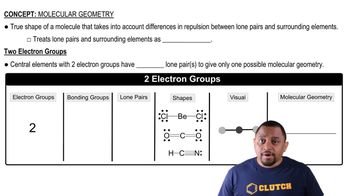
Molecular Geometry

Molecular geometry refers to the three-dimensional arrangement of atoms within a molecule. The shape of a molecule, such as whether it is linear or bent, is determined by the number of bonding pairs and lone pairs of electrons around the central atom. For the ONF molecule, understanding its geometry is crucial for predicting its physical and chemical properties, including polarity and reactivity.
Recommended video:
Guided course
01:33
Molecular Geometry with Two Electron Groups

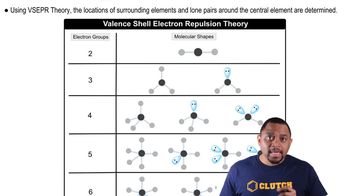
VSEPR Theory

Valence Shell Electron Pair Repulsion (VSEPR) theory is a model used to predict the geometry of molecules based on the repulsion between electron pairs. According to VSEPR, electron pairs will arrange themselves to minimize repulsion, leading to specific molecular shapes. In the case of ONF, the presence of lone pairs on the nitrogen atom influences the molecular shape, determining whether it is linear or bent.
Recommended video:
Guided course
02:13
Molecular Shapes and VSEPR