(b) An AB4 molecule has two lone pairs of electrons on the A atom (in addition to the four B atoms). What is the electron-domain geometry around the A atom?
Ch.9 - Molecular Geometry and Bonding Theories
Brown14th EditionChemistry: The Central ScienceISBN: 9780134414232Not the one you use?Change textbook
Chapter 9, Problem 14b
(b) The PCl3 molecule is trigonal pyramidal, while ICl3 is T-shaped. Which of these molecules is flat?
Verified step by step guidance1
Identify the molecular geometry of each molecule: PCl3 is trigonal pyramidal and ICl3 is T-shaped.
Understand the spatial arrangement of atoms in each geometry: Trigonal pyramidal has a three-dimensional structure with a central atom at the apex, whereas T-shaped is a planar geometry with three atoms in the same plane.
Recall that a molecule is considered flat if all its atoms lie in a single plane.
Compare the two geometries: Trigonal pyramidal has a vertical component due to the lone pair pushing down the bonding pairs, making it non-planar.
Conclude which molecule is flat by evaluating the planarity of the T-shaped geometry, which indicates that all atoms in ICl3 lie in the same plane.

Verified video answer for a similar problem:
This video solution was recommended by our tutors as helpful for the problem above.
Video duration:
2mWas this helpful?
Key Concepts
Here are the essential concepts you must grasp in order to answer the question correctly.
Molecular Geometry
Molecular geometry refers to the three-dimensional arrangement of atoms within a molecule. It is determined by the number of bonding pairs and lone pairs of electrons around the central atom, which influence the shape. For example, PCl3 has a trigonal pyramidal shape due to one lone pair, while ICl3 has a T-shaped geometry due to three lone pairs.
Recommended video:
Guided course
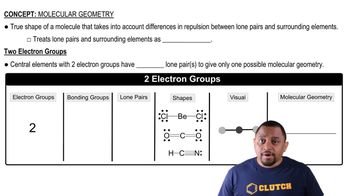
Molecular Geometry with Two Electron Groups
VSEPR Theory
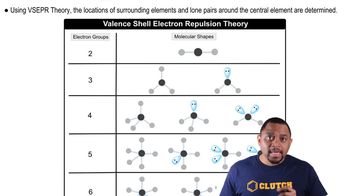
Valence Shell Electron Pair Repulsion (VSEPR) theory is a model used to predict the geometry of molecules based on the repulsion between electron pairs. According to VSEPR, electron pairs will arrange themselves to minimize repulsion, leading to specific molecular shapes. This theory helps explain why PCl3 is trigonal pyramidal and ICl3 is T-shaped.
Recommended video:
Guided course
Molecular Shapes and VSEPR
Planarity in Molecules
Planarity in molecules refers to the arrangement of atoms in a single plane. A molecule is considered flat if all its atoms lie in the same plane, which is often the case for molecules with specific geometries like trigonal planar or linear. In this context, ICl3 is T-shaped and has a flat arrangement, while PCl3 is not flat due to its trigonal pyramidal shape.
Recommended video:
Guided course
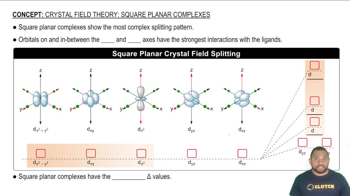
Square planar complexes show the most complex splitting pattern.
Related Practice
Textbook Question
1283
views
Textbook Question
(a) An AB2 molecule is linear. How many nonbonding electron pairs are around the A atom from this information?
880
views
Textbook Question
Describe the bond angles to be found in each of the following molecular structures: (a) trigonal planar, (b) tetrahedral, (c) octahedral, (d) linear.
1071
views
Textbook Question
(b) How many nonbonding electrons surround the Xe in XeF2?
592
views
Textbook Question
(a) An AB6 molecule has no lone pairs of electrons on the A atom. What is its molecular geometry? (c) For the AB4 molecule in part (b), predict the molecular geometry.
Textbook Question
(a) Boron trichloride 1BCl32 and the carbonate ion 1CO3 2- 2 are both described as trigonal. What does this indicate about their bond angles?
407
views