
Ch.9 - Thermochemistry: Chemical Energy
McMurry - Chemistry 8th Edition
McMurry8th EditionChemistryISBN: 9781292336145Not the one you use?Change textbook
Chapter 9, Problem 153c

(c) Assume that a chunk of potassium weighing 7.55 g is dropped into 400.0 g of water at 25.0 °C. What is the final temperature of the water if all the heat released is used to warm the water?

Verified step by step guidance
1
Calculate the moles of potassium (K) using its molar mass. The molar mass of K is approximately 39.10 g/mol. Use the formula: \( \text{moles of K} = \frac{\text{mass of K}}{\text{molar mass of K}} \).
Write the balanced chemical equation for the reaction of potassium with water: \( 2\text{K} + 2\text{H}_2\text{O} \rightarrow 2\text{KOH} + \text{H}_2 \). This reaction is exothermic, meaning it releases heat.
Determine the amount of heat released by the reaction. Use the enthalpy change for the reaction, which can be found in a reference source. Multiply the moles of K by the enthalpy change per mole of K to find the total heat released.
Use the specific heat capacity formula to find the change in temperature of the water. The formula is \( q = m \cdot c \cdot \Delta T \), where \( q \) is the heat absorbed by the water, \( m \) is the mass of the water, \( c \) is the specific heat capacity of water (4.18 J/g°C), and \( \Delta T \) is the change in temperature.
Solve for the final temperature of the water by rearranging the formula to \( \Delta T = \frac{q}{m \cdot c} \) and adding the initial temperature of the water to \( \Delta T \).

Verified video answer for a similar problem:

This video solution was recommended by our tutors as helpful for the problem above.
Video duration:
5m
Was this helpful?

Key Concepts

Here are the essential concepts you must grasp in order to answer the question correctly.

Heat Transfer

Heat transfer is the process by which thermal energy moves from one object or substance to another due to a temperature difference. In this scenario, the heat released by the potassium as it reacts with water will be absorbed by the water, leading to an increase in its temperature. Understanding this concept is crucial for calculating the final temperature of the water.
Recommended video:
Guided course
02:19
Heat Capacity

Specific Heat Capacity

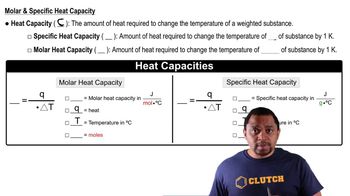
Specific heat capacity is the amount of heat required to raise the temperature of one gram of a substance by one degree Celsius. Each substance has a unique specific heat capacity, which influences how much its temperature will change when heat is added or removed. For water, the specific heat capacity is approximately 4.18 J/g°C, which is essential for determining how much the temperature of the water will increase in response to the heat from the potassium.
Recommended video:
Guided course
02:19
Heat Capacity

Calorimetry

Calorimetry is the science of measuring the heat of chemical reactions or physical changes. In this problem, calorimetry principles can be applied to calculate the final temperature of the water by equating the heat lost by the potassium to the heat gained by the water. This involves using the formula Q = mcΔT, where Q is the heat exchanged, m is the mass, c is the specific heat capacity, and ΔT is the change in temperature.
Recommended video:
Guided course
00:50
Constant-Volume Calorimetry