Back

Clausius-Clapeyron Equation quiz

Control buttons has been changed to "navigation" mode.
1/15
  • What does the Clausius-Clapeyron equation describe?

    It describes the relationship between the vapor pressure of liquids and temperature, showing that vapor pressure increases as temperature increases.
  • What is vapor pressure in the context of phase equilibrium?

    Vapor pressure is the equilibrium pressure between condensation (gas to liquid) and vaporization (liquid to gas) in a closed system.
  • How does vapor pressure change with increasing temperature?

    Vapor pressure increases as temperature increases.
  • What is the linear form of the Clausius-Clapeyron equation?

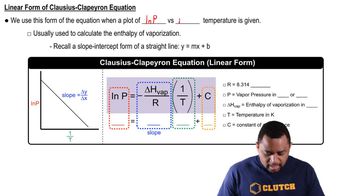
    The linear form is ln P = -ΔHvap/R (1/T) + C, where ln P is the natural log of vapor pressure, T is temperature in Kelvin, and C is a constant.
  • When do you use the linear form of the Clausius-Clapeyron equation?

    You use it when you have a plot of ln P (natural log of pressure) versus 1/T (inverse temperature).
  • What does the slope of a ln P versus 1/T plot represent in the Clausius-Clapeyron equation?

    The slope is equal to -ΔHvap/R, linking the slope to the enthalpy of vaporization.
  • What is the value and unit of the gas constant R in the Clausius-Clapeyron equation?

    R is 8.314 J/(mol·K).
  • In what units should vapor pressure (P) be expressed when using the Clausius-Clapeyron equation?

    Vapor pressure should be in torr or millimeters of mercury (mmHg).
  • What are the units for enthalpy of vaporization (ΔHvap) in the Clausius-Clapeyron equation?

    ΔHvap is usually in joules per mole (J/mol), but sometimes in kilojoules per mole (kJ/mol) if units are consistent.
  • What is the two-point form of the Clausius-Clapeyron equation?

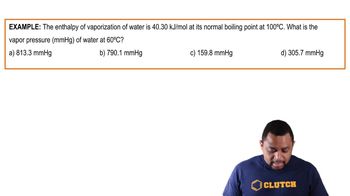
    The two-point form is ln(P2/P1) = -ΔHvap/R (1/T2 - 1/T1), where P1 and P2 are vapor pressures at temperatures T1 and T2 (in Kelvin).
  • When should you use the two-point form of the Clausius-Clapeyron equation?

    Use it when you are given two temperatures and/or two vapor pressures.
  • What temperature unit must be used in the Clausius-Clapeyron equation?

    Temperature must be in Kelvin.
  • What is the normal boiling point in terms of vapor pressure?

    The normal boiling point is when the vapor pressure equals 760 torr or 760 mmHg.
  • What does the constant C represent in the linear form of the Clausius-Clapeyron equation?

    C is a constant specific to the substance being studied.
  • Why is it important to match the units of ΔHvap and R in calculations?

    Because R is in joules, ΔHvap should also be in joules to ensure unit consistency in the equation.