Pearson+ LogoPearson+ Logo

Density quiz #2 Flashcards

Density quiz #2
Control buttons has been changed to "navigation" mode.
1/40
  • Which term describes the amount of mass contained per unit volume?

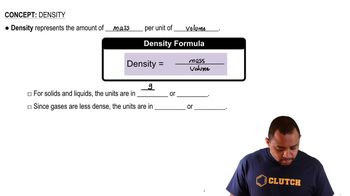
    Density describes the amount of mass per unit volume.
  • Which is the correct formula to determine density?

    Density = mass / volume.
  • How do you calculate the density of an object?

    Divide the object's mass by its volume.
  • What is the density of a solid object that is weighed and submerged in water?

    Density = mass of the object / volume displaced in water.
  • What is a curved surface in a graduated cylinder called?

    It is called the meniscus.
  • What is the mass of a substance divided by the volume of the substance?

    This is the definition of density.
  • Density is the relationship between which two quantities?

    Density relates mass and volume.
  • You have a sample with a mass of 25 g and a volume of 2.8 mL. What is the density of this sample?

    Density = 25 g / 2.8 mL ≈ 8.93 g/mL.
  • What is the difference between density and mass?

    Mass is the amount of matter; density is mass per unit volume.
  • Which formula listed below correctly finds density?

    Density = mass / volume.
  • What two quantities must be known to calculate the density of a sample of matter?

    Mass and volume must be known.
  • How can you use the density of an object to predict whether it will sink or float?

    If its density is less than the fluid, it will float; if greater, it will sink.
  • What device is used to test the specific gravity of a cell?

    A hydrometer is used to test specific gravity.
  • At what temperature is water at its densest?

    Water is densest at about 4°C.
  • How is the density of an object calculated?

    Density is calculated by dividing mass by volume.
  • An unknown diatomic gas has a density of 3.164 g/L at STP. What is the identity of the gas?

    The gas is likely oxygen (O₂), which has a density close to this value at STP.
  • Why is understanding density important in identifying unknown substances?

    Density is a characteristic property that helps identify substances.
  • Which of the following represents a concept of density?

    Density is mass divided by volume.
  • Which of the following gases would be expected to have the highest density at STP?

    Gases with higher molar mass, like xenon, have higher density at STP.
  • What is the relationship between mass and density?

    Density is mass per unit volume.
  • Which will have a higher density: 1.00 g of pure gold or 1.00 kg of pure gold?

    Both have the same density; density is independent of amount.
  • What is the density of silver?

    Silver has a density of about 10.5 g/cm³.
  • What is the density of lead?

    Lead has a density of about 11.3 g/cm³.
  • The density of water is 1.00 g/cm³. What is the density of the block?

    The block's density must be calculated from its mass and volume.
  • If the mass is 22 g and the volume is 11 mL, what is the density?

    Density = 22 g / 11 mL = 2 g/mL.
  • How do you determine the density of a substance or object?

    Measure its mass and volume, then divide mass by volume.
  • If the density of gold is 19.3 g/cm³, what does this mean?

    Each cubic centimeter of gold has a mass of 19.3 grams.
  • Which is denser?

    The substance with more mass in the same volume is denser.
  • Why does ice float on top of water?

    Ice floats because its density is less than that of liquid water.
  • Which phase of water has the highest density?

    Liquid water has the highest density.
  • Which liquid is the least dense?

    Liquids like oil or alcohol are less dense than water.
  • What is the volume (in cm³) of a 43.6 g piece of metal with a density of 2.71 g/cm³?

    Volume = mass / density = 43.6 g / 2.71 g/cm³ ≈ 16.1 cm³.
  • What are the steps to find density of an object?

    Measure mass, measure volume, divide mass by volume.
  • What determines the density of an object?

    Density is determined by the object's mass and volume.
  • How can ice float?

    Ice floats because its density is less than that of liquid water.
  • What is the density of water in g/mL?

    The density of water is 1.0 g/mL.
  • What is the density of SF₆ gas (in g/L) at 1.00 atm and 25°C?

    The density of SF₆ at these conditions is about 6.17 g/L.
  • Why is density a characteristic property of an object?

    Density is unique to each substance and does not depend on sample size.
  • Density is what type of property?

    Density is a physical and characteristic property.
  • Which element has the greatest density at STP?

    Osmium has the greatest density at STP.