Back

Diprotic Acids and Bases quiz

Control buttons has been changed to "navigation" mode.
1/15
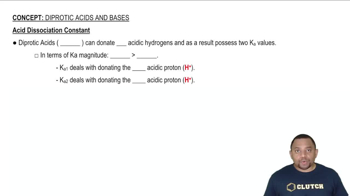
  • What is the general formula for a diprotic acid?

    The general formula for a diprotic acid is H2A, where the acid can donate two H+ ions.
  • Which dissociation constant is always larger in a diprotic acid, Ka1 or Ka2?

    Ka1 is always larger than Ka2 in a diprotic acid.
  • What does Ka1 represent in the dissociation of a diprotic acid?

    Ka1 represents the loss of the first acidic hydrogen ion (H+) from the diprotic acid.
  • What is the intermediate form of a diprotic acid after it donates one H+ ion?

    The intermediate form is an anion (e.g., HCO3−) that has lost one H+ ion but can still donate another.
  • After both H+ ions are donated from a diprotic acid, what is the resulting species?

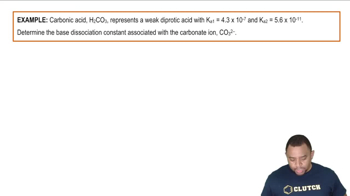
    The resulting species is a fully realized base, such as CO3^2−.
  • How are Ka1 and Kb2 related for a diprotic acid?

    Ka1 and Kb2 are paired such that their product equals the ion product constant for water (Kw).
  • How are Ka2 and Kb1 related for a diprotic acid?

    Ka2 and Kb1 are paired such that their product also equals Kw.
  • What does Kb1 represent in the context of a diprotic acid?

    Kb1 represents the acceptance of the first H+ ion by the base form of the diprotic acid.
  • What does Kb2 represent in the context of a diprotic acid?

    Kb2 represents the acceptance of the second H+ ion by the intermediate anion form.
  • What is the equilibrium expression for the first dissociation of carbonic acid (H2CO3)?

    The equilibrium expression is [HCO3−][H3O+]/[H2CO3].
  • What is the equilibrium expression for the second dissociation of carbonic acid (HCO3−)?

    The equilibrium expression is [CO3^2−][H3O+]/[HCO3−].
  • Why must you pay attention to which Ka or Kb is involved with diprotic acids?

    Because diprotic acids can donate two H+ ions, each step has its own Ka and Kb, affecting equilibrium calculations.
  • What happens to the magnitude of Ka values as more H+ ions are donated from a diprotic acid?

    The magnitude decreases; Ka1 is always greater than Ka2.
  • In the dissociation of a diprotic acid, what does the term 'products over reactants' refer to?

    It refers to the equilibrium expression, which is the concentration of products divided by the concentration of reactants.
  • What is the significance of the ion product constant for water (Kw) in relation to Ka and Kb?

    The product of the appropriate Ka and Kb for each step equals Kw, linking acid and base strengths.