Back

Factors Influencing Rates quiz

Control buttons has been changed to "navigation" mode.
1/15
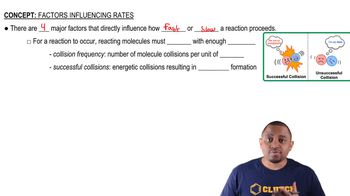
  • What are the four major factors that influence the rate of a chemical reaction?

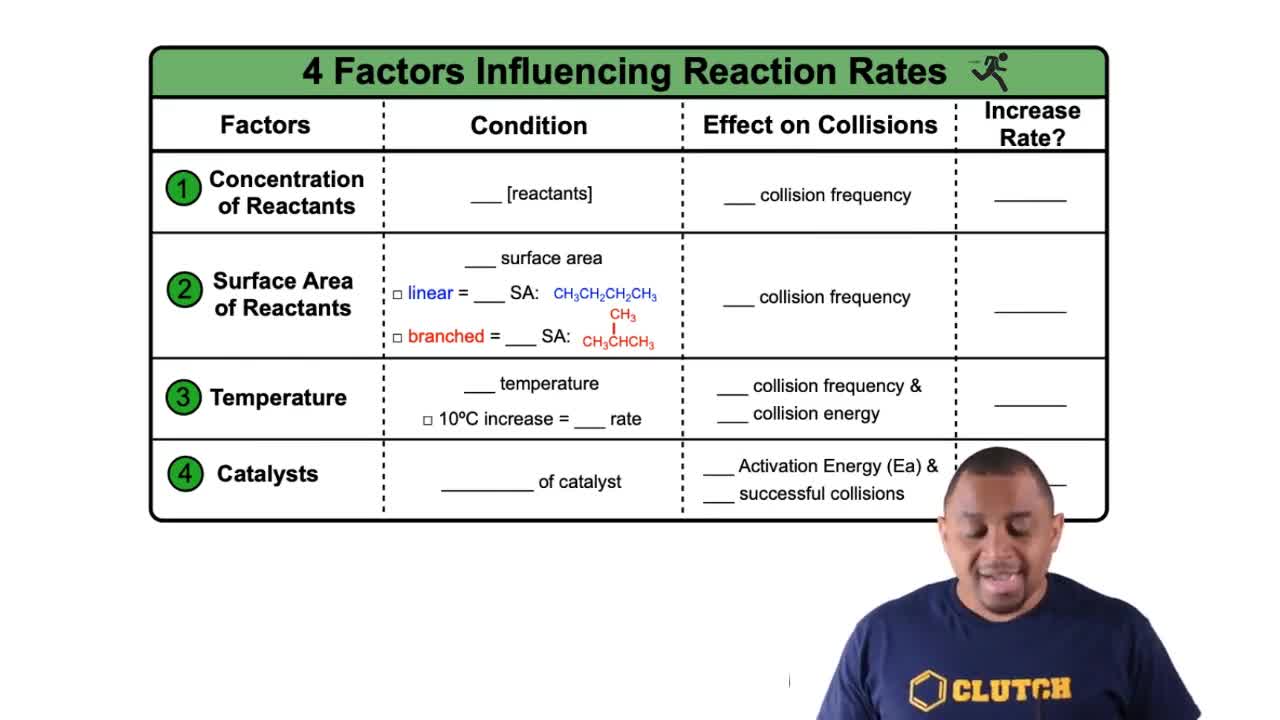
    The four major factors are reactant concentration, reactant surface area, temperature, and catalysts.
  • How does increasing the concentration of reactants affect the rate of a reaction?

    Increasing reactant concentration raises collision frequency, which increases the reaction rate.
  • What is collision frequency in the context of chemical reactions?

    Collision frequency is the number of molecular collisions per unit of time.
  • What is a successful collision in a chemical reaction?

    A successful collision is one where molecules collide with enough energy to form products.
  • How does increasing the surface area of reactants affect reaction rate?

    Increasing surface area enhances collision frequency, leading to a higher reaction rate.
  • Why do linear compounds have higher surface areas than branched compounds?

    Linear compounds have more exposed surface for collisions, while branching reduces surface area.
  • What effect does increasing temperature have on the movement of reactant molecules?

    Increasing temperature causes molecules to move faster and with greater energy.
  • By how much does the reaction rate typically increase for every 10°C rise in temperature?

    The reaction rate typically doubles for every 10°C increase in temperature.
  • How does a catalyst affect the activation energy of a reaction?

    A catalyst lowers the activation energy required for the reaction to occur.
  • Why does lowering activation energy increase the reaction rate?

    Lower activation energy means more collisions have enough energy to form products, increasing the rate.
  • What happens if molecules collide without enough energy?

    If molecules lack enough energy, they do not form products and simply bounce off each other.
  • How does increasing temperature affect collision frequency and energy?

    Increasing temperature raises both the frequency and energy of molecular collisions.
  • What is the relationship between successful collisions and reaction rate?

    More successful collisions lead to a higher reaction rate.
  • How does branching in a molecule affect its surface area and reaction rate?

    Branching decreases surface area, which reduces collision frequency and slows the reaction rate.
  • What is the overall effect of adding a catalyst to a chemical reaction?

    Adding a catalyst increases the reaction rate by lowering activation energy and increasing successful collisions.