Back

Mole Fraction of Gases quiz

Control buttons has been changed to "navigation" mode.
1/15
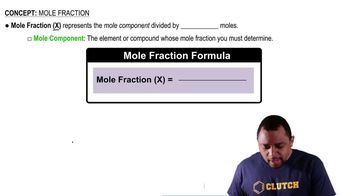
  • What is the formula for calculating the mole fraction of a component in a mixture?

    Mole fraction (X) is calculated by dividing the moles of the component by the total moles in the mixture.
  • What does the variable 'X' represent in the context of mole fractions?

    'X' represents the mole fraction of a component in a mixture.
  • Is the mole fraction a dimensionless quantity?

    Yes, the mole fraction is dimensionless and has no units.
  • Why is the mole fraction useful for comparing concentrations in different mixtures?

    Because it is unitless, the mole fraction allows for easy comparison of concentrations between different substances or mixtures.
  • How do you determine the 'mole component' in a mole fraction calculation?

    The 'mole component' is the number of moles of the specific element or compound whose mole fraction you are calculating.
  • What is the denominator in the mole fraction formula?

    The denominator is the total number of moles of all components in the mixture.
  • How does the mole fraction relate to solution properties like boiling point elevation?

    Mole fraction helps predict solution behaviors such as boiling point elevation and freezing point depression.
  • If a solution contains 2 moles of A and 3 moles of B, what is the mole fraction of A?

    The mole fraction of A is 2 divided by (2 + 3), which equals 0.4.
  • Can the mole fraction of a component ever be greater than 1?

    No, the mole fraction of a component is always between 0 and 1.
  • What does the sum of all mole fractions in a mixture equal?

    The sum of all mole fractions in a mixture equals 1.
  • Why is the mole fraction independent of the total amount of mixture?

    Because it is a ratio of moles, the mole fraction does not depend on the total quantity of the mixture.
  • What is the symbol commonly used for mole fraction?

    The symbol commonly used for mole fraction is a capital X.
  • How would you express the concentration of a solute in a solution using mole fraction?

    You would divide the moles of the solute by the total moles in the solution.
  • What is the main advantage of using mole fraction over other concentration units?

    Mole fraction is unitless, making it convenient for calculations and comparisons.
  • In what types of chemical calculations is mole fraction especially important?

    Mole fraction is especially important in calculations involving solution properties like boiling point elevation and freezing point depression.