Back

Molecular Orbital Theory quiz

Control buttons has been changed to "navigation" mode.
1/15
  • What principle dictates the order in which electrons fill atomic orbitals?

    The Aufbau principle dictates that electrons fill orbitals in order of increasing energy.
  • What is the maximum number of electrons an orbital can hold according to the Pauli Exclusion Principle?

    An orbital can hold a maximum of two electrons with opposite spins.
  • How are degenerate orbitals filled according to Hund's Rule?

    Degenerate orbitals are filled singly first before any pairing occurs.
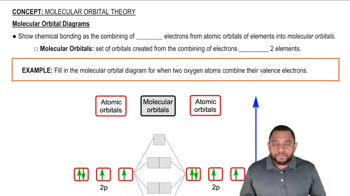
  • What is the main difference between atomic and molecular orbitals?

    Atomic orbitals are localized around individual atoms, while molecular orbitals are delocalized across the entire molecule.
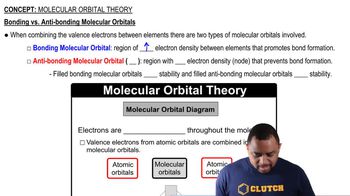
  • What symbol is used to represent a bonding molecular orbital?

    A bonding molecular orbital is represented by the sigma (σ) sign.
  • What does the sigma star (σ*) symbol indicate in molecular orbital theory?

    The sigma star (σ*) symbol indicates an antibonding molecular orbital.
  • What effect do filled bonding molecular orbitals have on molecular stability?

    Filled bonding molecular orbitals increase molecular stability.
  • What effect do filled antibonding molecular orbitals have on molecular stability?

    Filled antibonding molecular orbitals decrease molecular stability.
  • Where are valence electrons found in hydrogen and helium atoms?

    Valence electrons in hydrogen and helium are found in the 1s atomic orbitals.
  • How are electrons distributed into molecular orbitals from atomic orbitals?

    Electrons from atomic orbitals are distributed into molecular orbitals following the Aufbau principle, Pauli Exclusion Principle, and Hund's Rule.
  • What is a node in the context of molecular orbitals?

    A node is a region of low electron density in an antibonding molecular orbital.
  • What does it mean for electrons to be delocalized in a molecule?

    Delocalized electrons are spread out across the entire molecule rather than being confined to a single atom.
  • What promotes bond formation in molecular orbital theory?

    High electron density in bonding molecular orbitals promotes bond formation.
  • What prevents bond formation in molecular orbital theory?

    Low electron density, or a node, in antibonding molecular orbitals prevents bond formation.
  • How are molecular orbitals formed from atomic orbitals?

    Molecular orbitals are formed by combining the valence electrons from atomic orbitals of different atoms.