What does spontaneity in a chemical reaction determine?
Spontaneity determines whether a reaction or process can occur naturally under certain conditions without continuous external energy.
What is a spontaneous reaction?
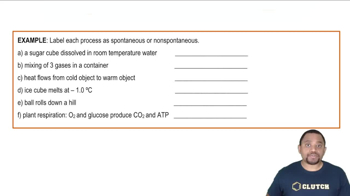
A spontaneous reaction is a natural process that does not require a constant outside energy source and favors the formation of products at equilibrium.
What is a non-spontaneous reaction?
A non-spontaneous reaction is an unnatural process that requires a constant outside energy source and does not favor the formation of products at equilibrium.
Does spontaneity indicate how fast a reaction occurs?
No, spontaneity does not determine the speed of a reaction; it only indicates if the reaction can occur naturally.
What is the difference between thermodynamics and kinetics in chemistry?
Thermodynamics deals with whether a reaction can occur (spontaneity), while kinetics deals with the speed of the reaction.
Give an example of a spontaneous reaction involving carbon.
The conversion of diamond to graphite is a spontaneous reaction, though it occurs very slowly over millions of years.
Why is the conversion of graphite to diamond considered non-spontaneous?
It is non-spontaneous because it requires significant energy input, such as heat and pressure, and does not occur naturally.
What is required for a non-spontaneous reaction to occur?
A non-spontaneous reaction requires a constant flow of external energy to proceed.
Is photosynthesis a spontaneous or non-spontaneous reaction, and why?
Photosynthesis is non-spontaneous because it requires sunlight as an external energy source to convert CO2 and water into glucose.
Is cellular respiration spontaneous or non-spontaneous?
Cellular respiration is spontaneous because it naturally converts glucose and oxygen into CO2 and water without needing external energy.
If a reaction is spontaneous in one direction, what can be said about the reverse reaction?
If a reaction is spontaneous in one direction, the reverse reaction is non-spontaneous.
Can a spontaneous reaction be slow? Give an example.
Yes, a spontaneous reaction can be slow; for example, the conversion of diamond to graphite takes millions of years.
What happens to the formation of products at equilibrium in a spontaneous reaction?
A spontaneous reaction favors the formation of products at equilibrium.
What happens to the formation of products at equilibrium in a non-spontaneous reaction?
A non-spontaneous reaction does not favor the formation of products at equilibrium and tends to remain as reactants.
Why are diamonds considered precious in terms of spontaneity?
Diamonds are precious because their formation from graphite is non-spontaneous and requires extreme conditions, making them rare.
 Back
Back
 03:05
03:05