 Back
BackAcids and Bases: Concepts, Ionization, and Calculations
Study Guide - Smart Notes
 Tailored notes based on your materials, expanded with key definitions, examples, and context.
Acids and Bases
Introduction to Acid–Base Chemistry
Acids and bases are fundamental concepts in chemistry, with broad applications in environmental science, biology, and industry. Many chemical reactions can be classified as acid–base reactions, and understanding their behavior is essential for predicting reaction outcomes and properties of solutions.
Acids are substances that donate protons (H+ ions) in chemical reactions.
Bases are substances that accept protons.
Common examples include citric acid in citrus fruits and acetic acid in vinegar.
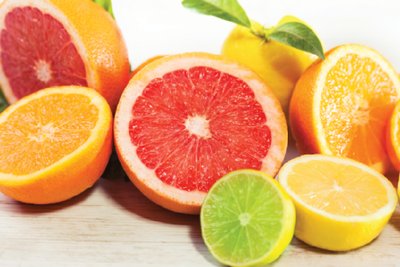
Additional info: The sour taste of citrus fruits is due to the presence of citric acid, a polyprotic acid.
Brønsted–Lowry Theory of Acids and Bases
Definition and Conjugate Acid–Base Pairs
The Brønsted–Lowry theory defines acids as proton donors and bases as proton acceptors. This theory is more general than the Arrhenius definition and applies to reactions in any solvent, not just water.
Acid: Proton donor (e.g., CH3COOH)
Base: Proton acceptor (e.g., H2O)
Conjugate acid–base pair: Two species that differ by one proton (e.g., CH3COOH/CH3COO−)
Amphiprotic substances: Can act as either acid or base (e.g., H2O)
Example: The ionization of acetic acid in water:
Here, CH3COOH is the acid, H2O is the base, CH3COO− is the conjugate base, and H3O+ is the conjugate acid.
Self-Ionization of Water and the pH Scale
Self-Ionization of Water
Water can act as both an acid and a base, leading to its self-ionization:
The equilibrium constant for this reaction is called the ion product of water ():
at 25 °C
In pure water, M$
The pH and pOH Scales
The pH scale is a logarithmic measure of hydronium ion concentration:
Similarly,
At 25 °C,
Solutions are classified as:
Acidic: pH < 7,
Neutral: pH = 7,
Basic: pH > 7,
Ionization of Acids and Bases in Water
Strong and Weak Acids/Bases
The strength of an acid or base is determined by its degree of ionization in water.
Strong acids/bases: Completely ionize in solution (e.g., HCl, NaOH)
Weak acids/bases: Partially ionize in solution (e.g., CH3COOH, NH3)
The equilibrium constant for acid ionization is :
For bases, the equilibrium constant is :
The and values are defined as:
Degree and Percent Ionization
The degree of ionization () is the fraction of acid or base molecules that ionize:
Percent ionization is .
For weak acids and bases, the degree of ionization increases as the solution becomes more dilute.
Visualizing Acid–Base Behavior
Indicators and pH Measurement
Acid–base indicators and pH meters are used to determine the pH of solutions. Indicators change color depending on the pH, while pH meters provide quantitative measurements.
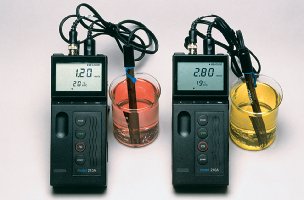
Additional info: The image shows that strong acids (left) produce a lower pH (higher [H3O+]) than weak acids (right) at similar concentrations.
Structure and Examples of Weak Acids and Bases
Carboxylic Acids and Amines
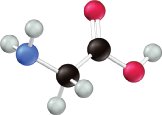
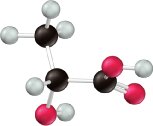
Many weak acids are carboxylic acids (contain the –COOH group), and many weak bases are amines (contain nitrogen atoms).
Glycine: An amino acid with both acidic and basic groups.
Lactic acid: A carboxylic acid found in muscles and sour milk.
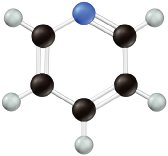
Pyridine: A weak base with a nitrogen atom in a six-membered ring.
Polyprotic Acids
Ionization in Multiple Steps
Polyprotic acids have more than one ionizable hydrogen atom and ionize in successive steps, each with its own value. For example, phosphoric acid () is a triprotic acid:
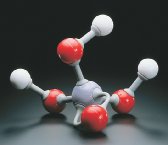
Each successive ionization is less favorable, so .
Summary Table: Classification of Solutions by pH and Ion Concentrations
Type of Solution | [H3O+] | [OH−] | pH |
|---|---|---|---|
Neutral | 1.0 × 10⁻⁷ M | 1.0 × 10⁻⁷ M | 7.00 |
Acidic | > 1.0 × 10⁻⁷ M | < 1.0 × 10⁻⁷ M | < 7.00 |
Basic | < 1.0 × 10⁻⁷ M | > 1.0 × 10⁻⁷ M | > 7.00 |
Key Equations and Concepts
at 25 °C
at 25 °C
Degree of ionization ():
Percent ionization:
