 Back
BackAcids and Bases: Properties, Definitions, Equilibria, and pH Calculations
Study Guide - Smart Notes
 Tailored notes based on your materials, expanded with key definitions, examples, and context.
Acids and Bases
Properties of Acids and Bases
Acids and bases are fundamental chemical species with distinct properties that are easily observed in laboratory and everyday contexts.
Acids: Sour taste, ability to dissolve metals, turn litmus paper red, neutralize bases.
Bases: Bitter taste, slippery feel, turn litmus paper blue, neutralize acids.
Definitions of Acids and Bases
There are several definitions for acids and bases, each with its own scope and application:
Arrhenius Definition: An acid produces H+ ions in aqueous solution; a base produces OH– ions in aqueous solution.
Brønsted–Lowry Definition: An acid donates H+ in a chemical reaction; a base accepts H+. This definition is more broadly applicable.
Lewis Definition: (To be covered later) Focuses on electron pair donation and acceptance.
Acid Dissociation and Conjugate Pairs
Acids dissociate in water, forming conjugate acid-base pairs. For example:
CH3COOH(aq) + H2O(l) → CH3COO–(aq) + H3O+(aq)
Acid (donates H+): CH3COOH
Base (accepts H+): H2O
Conjugate base: CH3COO–
Conjugate acid: H3O+
The weaker the acid, the stronger its conjugate base.
Acid and Base Strength
Acid Ionization Constant (Ka)
The equilibrium constant for acid dissociation is called the acid ionization constant (Ka):
General reaction: HA(aq) + H2O(l) → A–(aq) + H3O+(aq)
Ka expression:
The stronger the acid, the larger the Ka value, and the equilibrium favors products.
Strong vs. Weak Acids
Strong acids: Dissociate completely in water; equilibrium lies far to the right. Example: HCl(aq) + H2O(l) → Cl–(aq) + H3O+(aq)
Weak acids: Partially dissociate; equilibrium exists and Ka is used to quantify strength.
Base Ionization Constant (Kb)
For bases, the equilibrium constant is called Kb:
General reaction: B(aq) + H2O(l) → BH+(aq) + OH–(aq)
Kb expression:
The larger the Kb, the stronger the base.
Relationship Between Ka and Kb
For a conjugate acid-base pair:
At 25°C,
If Ka is known, Kb can be calculated for the conjugate base, and vice versa.
Autoionization of Water and the Ion-Product Constant (Kw)
Autoionization Reaction
Water can act as both an acid and a base (amphoteric). The autoionization reaction is:
2H2O(l) → H3O+(aq) + OH–(aq)
Equilibrium constant:
At 25°C,
Acidic, Basic, and Neutral Solutions
If [H3O+] > [OH–], the solution is acidic.
If [H3O+] < [OH–], the solution is basic.
If [H3O+] = [OH–], the solution is neutral.
Concentrations in Pure Water
In pure water at 25°C: M
The pH and pOH Scales
Definition and Calculation
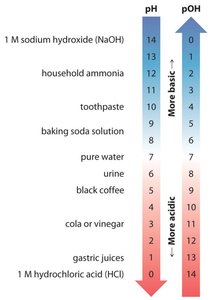
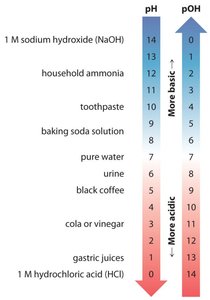
The pH scale is a logarithmic scale used to quantify acidity:
At 25°C: pH < 7.0 is acidic, pH = 7.0 is neutral, pH > 7.0 is basic.

pOH Scale
pOH is defined similarly:
Relationship Between pH and pOH
At 25°C:
General relationship:
pKa and pKb
Percent Ionization of Weak Acids
Definition and Calculation
Percent ionization quantifies the fraction of a weak acid that dissociates in water:
Example: For Ka = , [HA]in = 0.600 M, [H3O+]eq = M:
Effect of Concentration
As the concentration of a weak acid increases, percent ionization typically decreases.
Calculating pH from Ka
Procedure
To find the pH of a weak acid solution:
Write the balanced dissociation reaction.
Write the Ka expression.
Create an equilibrium table (ICE table).
Solve for [H3O+] using the Ka expression.
Check approximation validity or use the quadratic formula if necessary.
Calculate pH:
Example: For HNO2 with Ka = and [HNO2]initial = 0.200 M, pH = 2.02.
Summary Table: Acid/Base Strength and Equilibrium Constants
Type | Equilibrium Constant | Strength Indicator |
|---|---|---|
Acid | Ka | Larger Ka = Stronger Acid |
Base | Kb | Larger Kb = Stronger Base |
Conjugate Pair | Kw = Ka × Kb | Kw = 1.0 × 10⁻¹⁴ at 25°C |
Additional info: The notes above expand on the original lecture slides, providing full academic context, definitions, and stepwise procedures for calculations. All equations are formatted in LaTeX as required.
