 Back
BackAcids, Bases, and Aqueous Equilibria: A Comprehensive Study Guide
Study Guide - Smart Notes
 Tailored notes based on your materials, expanded with key definitions, examples, and context.
Acids and Bases: Fundamental Concepts
Introduction to Acids and Bases
Acids and bases are two fundamental categories of compounds in chemistry, each with distinct properties and behaviors in aqueous solutions. Understanding their definitions, properties, and reactions is essential for mastering general chemistry.
Acids are substances that produce H+ ions in aqueous solution (Arrhenius definition) or donate protons (Bronsted-Lowry definition).
Bases are substances that produce OH- ions in aqueous solution (Arrhenius) or accept protons (Bronsted-Lowry).
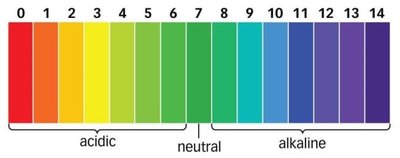
The pH scale is used to quantify the acidity or basicity of a solution, ranging from 0 (most acidic) to 14 (most basic), with 7 being neutral.
Properties and Examples of Acids and Bases
Acids typically have a sour taste, can dissolve metals, turn blue litmus paper red, and neutralize bases.
Bases have a bitter taste, slippery feel, turn red litmus paper blue, and neutralize acids.
Name | Occurrence/Uses |
|---|---|
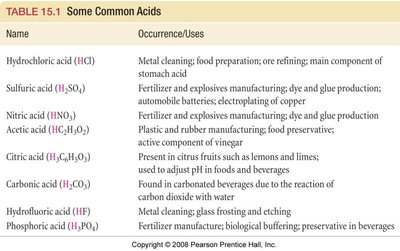
Hydrochloric acid (HCl) | Metal cleaning; food preparation; ore refining; main component of stomach acid |
Sulfuric acid (H2SO4) | Fertilizer and explosives manufacturing; dye and glue production; automobile batteries; electroplating of copper |
Nitric acid (HNO3) | Fertilizer and explosives manufacturing; dye and glue production |
Acetic acid (HC2H3O2) | Plastic and rubber manufacturing; food preservative; active component of vinegar |
Citric acid (H3C6H5O7) | Present in citrus fruits such as lemons and limes |
Carbonic acid (H2CO3) | Found in carbonated beverages due to the reaction of carbon dioxide with water |
Hydrofluoric acid (HF) | Metal cleaning; glass frosting and etching |
Phosphoric acid (H3PO4) | Fertilizer manufacture; biological buffering; preservative in beverages |
Name | Occurrence/Uses |
|---|---|
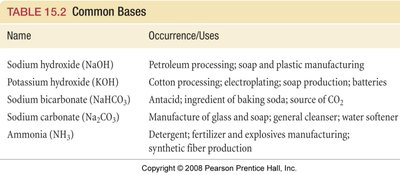
Sodium hydroxide (NaOH) | Petroleum processing; soap and plastic manufacturing |
Potassium hydroxide (KOH) | Cotton processing; electroplating; soap production; batteries |
Sodium bicarbonate (NaHCO3) | Antacid; ingredient of baking soda; source of CO2 |
Sodium carbonate (Na2CO3) | Manufacture of glass and soap; general cleanser; water softener |
Ammonia (NH3) | Detergent; fertilizer and explosives manufacturing; synthetic fiber production |
pH, pOH, and Calculations
The pH and pOH Relationship
The pH and pOH of a solution are related to the concentrations of hydronium and hydroxide ions, respectively. Their sum at 25°C is always 14 due to the ionization constant of water.
pH is defined as $pH = -\log[H^+]$
pOH is defined as $pOH = -\log[OH^-]$
The relationship: $pH + pOH = 14$ at 25°C
The ion product of water: $K_w = [H^+][OH^-] = 1.0 \times 10^{-14}$ at 25°C
![Diagram showing the relationships between pH, pOH, [H+], and [OH-]](https://static.studychannel.pearsonprd.tech/study_guide_files/general-chemistry/sub_images/0fde2417_image_4.png)
Practice with pH and pOH Calculations
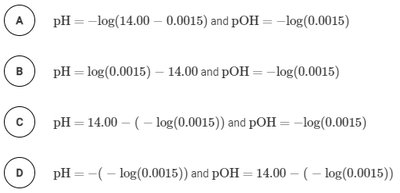
When calculating pH and pOH, it is important to use the correct mathematical expressions. For example, for a 0.0015 M KOH solution:
pOH = $-\log(0.0015)$
pH = $14.00 - (-\log(0.0015))$
Understanding Strong Acids and Bases
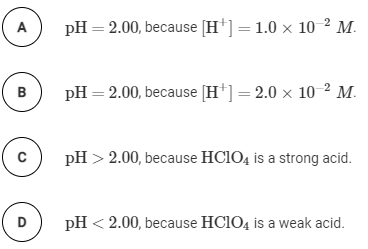
Strong acids and bases completely dissociate in water, making their pH or pOH calculations straightforward. For example, the pH of a 0.010 M HClO4 solution is 2.00 because it is a strong acid and fully dissociates.
Comparing Acid Strengths
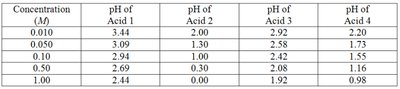
The strength of an acid is determined by its degree of ionization in water. Strong acids ionize completely, while weak acids only partially ionize. The table below shows the pH values of four acids at various concentrations, which can be used to identify strong and weak acids.
Concentration (M) | pH of Acid 1 | pH of Acid 2 | pH of Acid 3 | pH of Acid 4 |
|---|---|---|---|---|
0.010 | 3.44 | 2.00 | 2.92 | 2.20 |
0.050 | 3.09 | 1.30 | 2.58 | 1.73 |
0.10 | 2.94 | 1.00 | 2.42 | 1.55 |
0.50 | 2.69 | 0.30 | 2.08 | 1.16 |
1.00 | 2.44 | 0.00 | 1.92 | 0.98 |
Acid and Base Strength: Ka and pKa
Acid Dissociation Constant (Ka) and pKa
The strength of a weak acid is quantified by its acid dissociation constant, Ka. The smaller the Ka, the weaker the acid. The pKa is the negative logarithm of Ka and provides a convenient way to compare acid strengths.
$K_a = \frac{[H_3O^+][A^-]}{[HA]}$
$pK_a = -\log K_a$
Lower pKa values indicate stronger acids.

Acid-Base Equilibria and Buffer Solutions
Buffer Solutions
A buffer is a solution that resists changes in pH upon the addition of small amounts of acid or base. Buffers are typically made from a weak acid and its conjugate base or a weak base and its conjugate acid.
Buffers maintain pH by neutralizing added acids or bases.
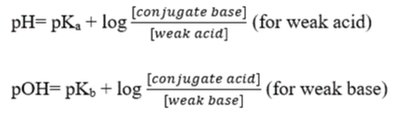
The Henderson-Hasselbalch equation is used to estimate the pH of a buffer:
$pH = pK_a + \log \frac{[\text{Base}]}{[\text{Acid}]}$
Acid-Base Titrations
Titration Curves and Equivalence Points
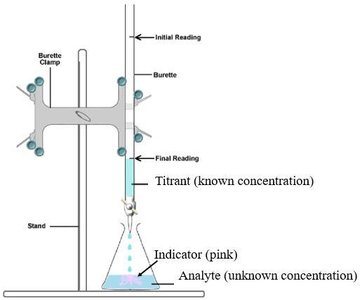
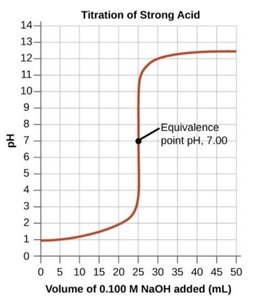
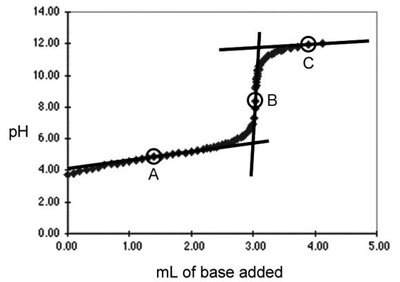
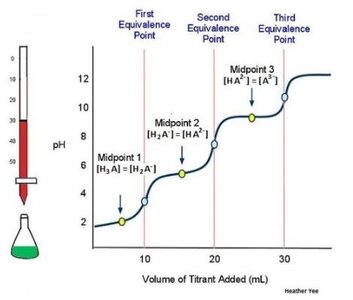
Titration is a technique used to determine the concentration of an unknown acid or base by reacting it with a solution of known concentration. The titration curve plots pH versus the volume of titrant added, and the equivalence point is where the amount of acid equals the amount of base.
Monoprotic acids have one equivalence point; polyprotic acids have multiple equivalence points.
The half-equivalence point occurs when [HA] = [A-], and at this point, pH = pKa.
Indicators and Buffer Capacity
Acid-Base Indicators
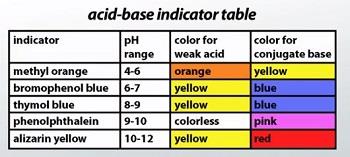
Indicators are substances that change color depending on the pH of the solution, allowing for the detection of the endpoint in titrations. Each indicator has a specific pH range over which it changes color.
Indicator | pH Range | Color for Weak Acid | Color for Conjugate Base |
|---|---|---|---|
Methyl orange | 4-6 | orange | yellow |
Bromophenol blue | 6-7 | yellow | blue |
Thymol blue | 8-9 | yellow | blue |
Phenolphthalein | 9-10 | colorless | pink |
Alizarin yellow | 10-12 | yellow | red |
Buffer Capacity
Buffer capacity refers to the amount of acid or base a buffer can neutralize before the pH begins to change significantly. Increasing the concentration of buffer components increases buffer capacity, while the ratio of acid to base determines the direction of maximum capacity.
Molecular Structure and Acid/Base Strength
Binary and Oxyacids
The molecular structure of acids and bases influences their strength. For binary acids (H-X), bond polarity and bond strength are key factors. For oxyacids (H-O-Y), the electronegativity of Y and the number of oxygen atoms bonded to Y affect acidity.
Stronger H-X bonds result in weaker acids.
Greater electronegativity of Y in oxyacids increases acidity.
More oxygen atoms bonded to Y increase acidity due to electron withdrawal.
Summary Table: Key Equations and Relationships
Equation | Description |
|---|---|
$pH = -\log[H^+]$ | Definition of pH |
$pOH = -\log[OH^-]$ | Definition of pOH |
$pH + pOH = 14$ | Relationship at 25°C |
$K_w = [H^+][OH^-] = 1.0 \times 10^{-14}$ | Ion product of water |
$K_a = \frac{[H_3O^+][A^-]}{[HA]}$ | Acid dissociation constant |
$pK_a = -\log K_a$ | pKa definition |
$pH = pK_a + \log \frac{[\text{Base}]}{[\text{Acid}]}$ | Henderson-Hasselbalch equation |
Additional info: This guide covers the essential concepts of acids, bases, pH, pOH, acid/base strength, buffer solutions, titrations, indicators, and the molecular structure of acids and bases, as relevant to a general chemistry college course.
