 Back
BackAcids, Bases, and Buffer Systems: Equilibrium and pH in Aqueous Solutions
Study Guide - Smart Notes
 Tailored notes based on your materials, expanded with key definitions, examples, and context.
Acids and Bases: Fundamental Concepts
Definitions and Theories of Acids and Bases
Acids and bases are central to understanding chemical equilibrium in aqueous solutions. Several definitions exist to describe their behavior:
Arrhenius Definition: An acid produces H+ ions in aqueous solution, while a base produces OH- ions.
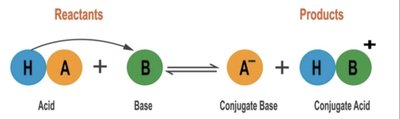
Brønsted-Lowry Definition: An acid is a proton (H+) donor, and a base is a proton acceptor.
Lewis Definition: An acid accepts an electron pair, and a base donates an electron pair.
These definitions help classify substances and predict their behavior in chemical reactions.
Conjugate Acid-Base Pairs
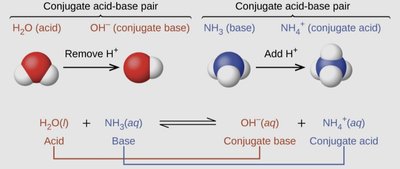
When an acid donates a proton, it forms its conjugate base. When a base accepts a proton, it forms its conjugate acid. These pairs differ by one proton (H+).
Example: H2O (acid) + NH3 (base) → OH- (conjugate base) + NH4+ (conjugate acid)
Acid Strength, Ionization, and Equilibrium
Strong vs. Weak Acids
The strength of an acid is determined by its degree of ionization in water:
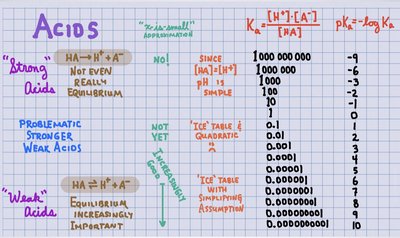
Strong acids ionize completely, producing a high concentration of H+ ions.
Weak acids only partially ionize, establishing an equilibrium between the acid and its ions.
The acid dissociation constant (Ka) quantifies the extent of ionization:
The pKa is the negative logarithm of Ka:
Relationship Between pH, pOH, and Ion Concentrations
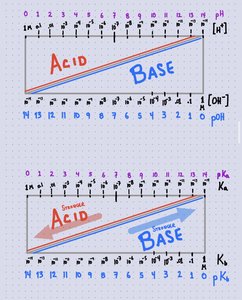
The pH of a solution is a measure of its acidity:
(at 25°C)
For weak acids and bases, the degree of ionization is important for calculating pH and equilibrium concentrations.
Weak Acids and Bases: Equilibrium Calculations
ICE Tables and Approximations
For weak acids and bases, equilibrium calculations often use an ICE (Initial, Change, Equilibrium) table to track concentrations:
Set up initial concentrations.
Define changes using a variable (usually x).
Write the equilibrium expression and solve for x.
For very weak acids, the change in concentration may be small enough to approximate .
Buffer Solutions
Definition and Function
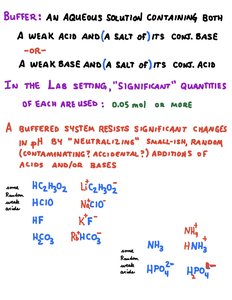
A buffer is an aqueous solution containing a weak acid and its conjugate base (or a weak base and its conjugate acid). Buffers resist significant changes in pH when small amounts of acid or base are added.
Common buffer systems include acetic acid/acetate and ammonia/ammonium.
Henderson-Hasselbalch Equation
The pH of a buffer can be calculated using the Henderson-Hasselbalch equation:
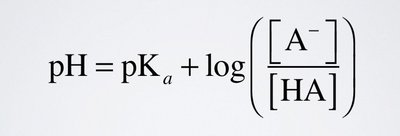
This equation relates the pH of the buffer to the ratio of conjugate base to acid and the acid's pKa.
Buffer Capacity and Applications
Buffer capacity depends on the concentrations of the acid and conjugate base. In laboratory settings, significant quantities (e.g., 0.05 mol or more) are used to ensure effective buffering.
Buffers are essential in biological systems (e.g., blood plasma) and analytical chemistry (e.g., titrations).
Titrations and Buffer Regions
Titration Curves
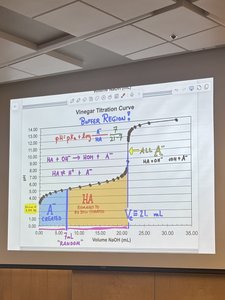
Titration curves plot pH versus the volume of titrant added. Key regions include:
Initial region: Only the original acid or base is present.
Buffer region: Both acid and conjugate base are present; pH changes slowly.
Equivalence point: All acid has been neutralized; only conjugate base remains.
Buffer Region and pH Calculation
At the midpoint of the buffer region, , so . The buffer region is where the solution best resists changes in pH.
Visualizing Acid and Buffer Systems
Concentration and Ionization of Weak Acids
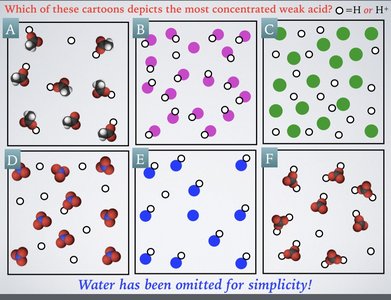
Visual representations (cartoons) can help distinguish between concentrated and dilute solutions, as well as strong and weak acids. The most concentrated weak acid will have the highest number of HA molecules with only a small fraction ionized.
Summary Table: Common Buffer Systems
Buffer System | Acid | Conjugate Base |
|---|---|---|
Acetic acid/acetate | CH3COOH | CH3COO- |
Ammonia/ammonium | NH4+ | NH3 |
Carbonic acid/bicarbonate | H2CO3 | HCO3- |
Dihydrogen phosphate/hydrogen phosphate | H2PO4- | HPO42- |
Key Equations
(at 25°C)
Additional info:
Buffer solutions are crucial for maintaining pH stability in chemical and biological systems.
The effectiveness of a buffer is greatest when the concentrations of acid and conjugate base are similar and high.
