 Back
BackAcids, Bases, and the Properties of Salt Solutions
Study Guide - Smart Notes
 Tailored notes based on your materials, expanded with key definitions, examples, and context.
Acids and Bases: Weak Acids and Bases, Conjugate Pairs, and Salt Solutions
Weak Acids: Acid Dissociation Constant (Ka), % Ionization, and pH Calculations
Weak acids only partially ionize in aqueous solution. The extent of ionization is quantified by the acid dissociation constant, Ka. Calculating the pH of a weak acid solution involves setting up an equilibrium expression and, if necessary, solving a quadratic equation.
Acid Dissociation Constant (Ka): For a monoprotic weak acid, HA, the equilibrium is:
% Ionization: The percentage of acid molecules that ionize:
pH Calculation:
Quadratic Equation: If % ionization > 5%, the quadratic equation must be used to solve for .
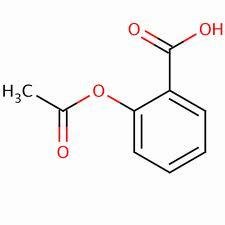
Example: Calculating the pH of a solution prepared by dissolving three aspirin tablets (acetylsalicylic acid, ) in water to make 356 mL of solution. The equilibrium and calculation steps are shown, including the use of the quadratic formula when % ionization exceeds 5%.
Weak Bases: Base Dissociation Constant (Kb), % Ionization, pOH, and pH Calculations
Weak bases only partially accept protons in water. The base dissociation constant, Kb, quantifies this equilibrium. Calculations for weak bases mirror those for weak acids, with pOH and pH determined from .
Base Dissociation Constant (Kb): For a generic weak base, B:
% Ionization:
pOH and pH:
pKb:
Example: Calculating the pH of 0.30 M dimethylamine () solution, including the use of the % ionization rule to validate the approximation.
Conjugate Acids and Bases: Relationships Between Ka and Kb
Every weak base has a conjugate acid, and every weak acid has a conjugate base. The strengths of these conjugate pairs are related through the ion product of water, .
Relationship: at 25°C
Conjugate Acid of a Weak Base: The cation (e.g., ) is a weak acid. Example: solution is acidic because $NH_4^+$ hydrolyzes to produce .
Conjugate Base of a Weak Acid: The anion (e.g., , , ) is a weak base. Example: solution is basic because $F^-$ hydrolyzes to produce .
Calculation: If of a base is known, of its conjugate acid can be found by , and vice versa.
Example: Calculating for methylammonium ion () given for methylamine ().
Evaluating the Acid-Base Properties of Salt Solutions
The pH of a salt solution depends on the acid-base properties of the cation and anion. Four main cases are considered:
Case 1: Neutral Salts – Cation is from a strong base, anion is from a strong acid (e.g., ). Solution is neutral.
Case 2: Basic Salts – Cation is from a strong base, anion is the conjugate base of a weak acid (e.g., ). Solution is basic.
Case 3: Acidic Salts – Cation is the conjugate acid of a weak base or a small, highly charged metal ion; anion is from a strong acid (e.g., , ). Solution is acidic.
Case 4: Salts with Both Weak Acid and Weak Base Components – The pH depends on the relative strengths ( and ) of the cation and anion. If , solution is acidic; if , solution is basic; if , solution is neutral.
Example: solution: hydrolyzes to produce (acidic), hydrolyzes to produce (basic). Since , the solution is slightly acidic.
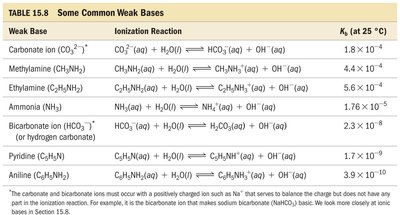
Summary Table: Common Weak Bases
The following table summarizes some common weak bases, their ionization reactions, and their values at 25°C.
Weak Base | Ionization Reaction | (at 25°C) |
|---|---|---|
Carbonate ion () | ||
Methylamine () | ||
Ethylamine () | ||
Ammonia () | ||
Bicarbonate ion () | ||
Pyridine () | ||
Aniline () |
Additional info:
ICE tables (Initial, Change, Equilibrium) are used throughout to organize equilibrium calculations for acids and bases.
When the assumption that x is negligible is not valid (i.e., % ionization > 5%), the quadratic formula must be used to solve for equilibrium concentrations.
