 Back
BackLesson 1.4: Alcohols, Ethers, and Thiols: Structure, Properties, and Reactions
Study Guide - Smart Notes
 Tailored notes based on your materials, expanded with key definitions, examples, and context.
Alcohols, Ethers, and Thiols
Alcohols: Structure, Classification, and Nomenclature
Alcohols are a class of organic compounds characterized by the presence of a hydroxyl group (–OH) attached to a saturated carbon atom. Their physical and chemical properties are influenced by the polarity of the hydroxyl group and the structure of the carbon chain.
Primary alcohol: The –OH group is bonded to a terminal carbon atom (a carbon attached to only one other carbon).
Secondary alcohol: The –OH group is bonded to a carbon atom attached to two other carbons.
Tertiary alcohol: The –OH group is bonded to a carbon atom attached to three other carbons.
Example: Butan-1-ol is a primary alcohol, butan-2-ol is a secondary alcohol, and 2-methylpropan-2-ol is a tertiary alcohol.
Naming Alcohols (IUPAC):
Replace the final -e of the parent hydrocarbon with -ol.
Number the chain to give the –OH group the lowest possible number.
For multiple –OH groups, use suffixes -diol or -triol.
For cyclic alcohols, the –OH group takes precedence in numbering.
Aromatic alcohols (e.g., phenol) have the –OH group attached to a benzene ring.
Example: Propan-2-ol (isopropyl alcohol) is used as an antiseptic; ethane-1,2-diol (ethylene glycol) is used as antifreeze.
Physical Properties of Alcohols
The presence of the electronegative oxygen atom in the –OH group makes alcohols polar molecules. This polarity leads to strong intermolecular forces, particularly hydrogen bonding, which significantly increases their boiling points compared to alkanes of similar molecular mass.
Hydrogen bonding: Occurs between the hydrogen atom of one alcohol's –OH group and the oxygen atom of another.
Boiling points: Alcohols have much higher boiling points than corresponding alkanes (e.g., methanol: 65°C vs. methane: –162°C).
Solubility: Short-chain alcohols are highly soluble in water due to their polarity; solubility decreases as the non-polar hydrocarbon chain length increases.
Solvent properties: Alcohols can dissolve both polar and non-polar substances, making them versatile solvents.
Chemical Reactions of Alcohols
Hydration of Alkenes (Addition Reaction): Alkenes react with water (in the presence of acid) to form alcohols, following Markovnikov’s rule.
Dehydration (Elimination Reaction): Alcohols can lose a water molecule (with acid catalyst) to form alkenes.
Combustion: Alcohols combust in oxygen to produce carbon dioxide and water.
Example Equations:
Hydration:
Dehydration:
Combustion:
Ethers: Structure, Properties, and Nomenclature
Ethers are organic compounds in which an oxygen atom is bonded to two carbon atoms. They are generally less reactive than alcohols and are widely used as solvents.
General formula: R–O–R'
Preparation: Ethers are synthesized by the condensation of two alcohols, producing water as a byproduct.
Physical properties: Ethers have boiling points higher than alkanes but lower than alcohols of similar molecular mass. They are somewhat polar but do not form hydrogen bonds between molecules.
Naming: The IUPAC name is formed by naming the smaller alkyl group as an alkoxy substituent on the larger alkane (e.g., methoxyethane). The common name lists the two alkyl groups alphabetically followed by "ether" (e.g., ethyl methyl ether).
Thiols: Structure, Properties, and Nomenclature
Thiols are organic compounds containing the sulfhydryl (–SH) group. They are structurally similar to alcohols but contain sulfur instead of oxygen.
Odour: Thiols typically have strong, often unpleasant odours (e.g., garlic, skunk spray).
Naming: The suffix -thiol is added to the alkane name (e.g., methanethiol).
Applications: Thiols are added to natural gas for leak detection due to their strong smell.
Summary Table: Comparison of Alcohols, Ethers, and Thiols
Class | Functional Group | General Formula | Key Properties | Example |
|---|---|---|---|---|
Alcohol | –OH | R–OH | Polar, hydrogen bonding, high boiling point | Ethanol (C2H5OH) |
Ether | –O– | R–O–R' | Somewhat polar, lower boiling point than alcohols, good solvent | Diethyl ether (C2H5OC2H5) |
Thiol | –SH | R–SH | Strong odour, less polar than alcohols | Methanethiol (CH3SH) |
Applications and Examples
Alcohols: Used in beverages (ethanol), antifreeze (ethylene glycol), and pharmaceuticals (glycerol).
Ethers: Used as solvents and formerly as anesthetics (diethyl ether).
Thiols: Used as odorants in natural gas and found in biological systems.
Alcohol Flammability and Everyday Applications
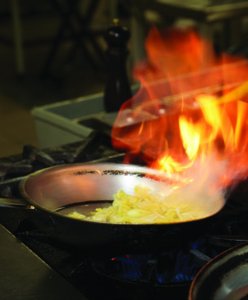
The flammability of alcohols, especially ethanol, has historical and practical significance. In the past, the ability of a beverage to ignite gunpowder was used as a test for alcohol content ("proof"). Today, the flammability of ethanol is commonly used in culinary techniques such as flambé, where alcohol is added to food and ignited for dramatic effect and flavor enhancement.
Practice Problems
Name and classify alcohols, ethers, and thiols from structural formulas.
Draw structural formulas from IUPAC names.
Predict products of hydration, dehydration, and combustion reactions involving alcohols.
Compare physical properties (boiling point, solubility) of alcohols, ethers, and thiols.
Additional info: The notes above include expanded academic context on intermolecular forces, nomenclature, and practical applications to ensure completeness and clarity for general chemistry students.
