 Back
BackLesson 3.6: Applications of Quantum Mechanics in Modern Technology
Study Guide - Smart Notes
 Tailored notes based on your materials, expanded with key definitions, examples, and context.
Applications of Quantum Mechanics
Introduction to Quantum Technologies
Quantum mechanics is a fundamental theory in physics that describes the behavior of matter and energy at the atomic and subatomic levels. Its principles are the foundation for many modern technologies, including lasers, microchips, and medical imaging devices. As technology advances, quantum mechanics continues to drive innovation in various fields, from communications to medicine.
Laser Technology
Principles and Operation of Lasers
Lasers are devices that produce intense beams of light of a single wavelength, with all light waves traveling in parallel and in phase (coherent). The operation of lasers is based on quantum theory, specifically the excitation and relaxation of electrons in atoms:
Stimulated Emission: An electron absorbs a photon of specific energy and is excited to a higher energy level. When it returns to its ground state, it emits a photon of the same energy.
Photon Amplification: Emitted photons can stimulate other excited electrons to emit more photons, leading to a cascade effect and amplification of light.
Laser Construction: Lasers typically contain a gain medium (such as a ruby rod), mirrors to reflect photons, and a power source to excite electrons.
Applications: Lasers are used in communications, medical procedures, manufacturing, and consumer electronics. Their ability to produce focused, high-energy beams makes them valuable in cutting, scanning, and data storage.
Safety: Lasers are classified by power, from Class 1 (safe for most uses) to Class 4 (industrial and medical lasers requiring special precautions).
Bose–Einstein Condensate (BEC): Another State of Matter
Discovery and Properties
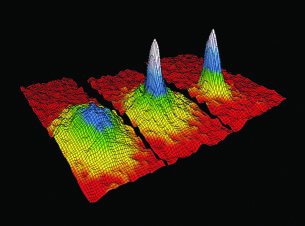
The Bose–Einstein condensate (BEC) is a state of matter predicted by Satyendra Nath Bose and Albert Einstein in the 1920s. It occurs when a group of atoms is cooled to temperatures near absolute zero (0 K or −273.15 °C), causing all atoms to occupy the lowest quantum energy state and behave as a single quantum entity.
Unique Properties: In a BEC, atoms lose their individual identities and act as one 'super-atom,' exhibiting quantum phenomena on a macroscopic scale.
Experimental Realization: The first BEC was created in a laboratory in 1995, after advances in cooling technology made it possible to reach the required temperatures.
Scientific Importance: BECs provide insight into quantum mechanics and have potential applications in precision measurement and quantum computing.
Quantum Analysis and Diagnostic Technologies
Magnetic Resonance Imaging (MRI)
Magnetic resonance imaging (MRI) is a medical diagnostic tool that uses quantum principles to produce detailed images of soft tissues in the body. MRI relies on the behavior of hydrogen atoms in a strong magnetic field:
Alignment: Hydrogen nuclei align with the external magnetic field.
Radio Pulse: A radio-frequency pulse flips the alignment of some nuclei.
Signal Detection: When the pulse is removed, nuclei return to their original alignment, releasing energy detected by sensors.
Image Construction: A computer processes the signals to create detailed, three-dimensional images.
Advantages: MRI does not use ionizing radiation, making it safer than X-rays or CT scans for repeated use.


Summary Table: Applications of Quantum Mechanics
Application | Principle | Example/Use |
|---|---|---|
Lasers | Stimulated emission and photon amplification | Medical surgery, communications, DVD players |
Bose–Einstein Condensate | Atoms in lowest quantum state at near absolute zero | Quantum research, precision measurement |
Magnetic Resonance Imaging (MRI) | Alignment and flipping of hydrogen nuclei in magnetic fields | Medical imaging of soft tissues |
Key Terms and Concepts
Laser: Device producing coherent light by stimulated emission of radiation.
Bose–Einstein Condensate (BEC): State of matter where atoms occupy the same quantum state.
Magnetic Resonance Imaging (MRI): Imaging technique using magnetic fields and radio waves to visualize internal structures.
Further Applications and Future Directions
Quantum mechanics underpins emerging technologies such as quantum computing and quantum cryptography. These fields promise advances in computational power, secure communications, and new materials. As research continues, quantum theory will play an increasingly important role in technology and society.
