 Back
BackAqueous Equilibria: Buffers, Titrations, and Solubility
Study Guide - Smart Notes
 Tailored notes based on your materials, expanded with key definitions, examples, and context.
Buffer Solutions
Definition and Importance
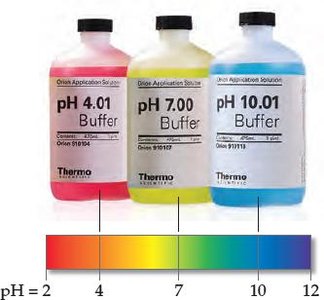
Buffer solutions are aqueous systems that resist significant changes in pH when small amounts of acid or base are added. They are composed of a weak acid and its conjugate base, or a weak base and its conjugate acid. Buffers are essential in many biological and chemical processes where maintaining a stable pH is crucial.
Buffer Components: Must contain both a weak acid (to neutralize added base) and a weak base (to neutralize added acid).
Conjugate Pair: The acid and base must not react with each other directly.
Example: Acetic acid (CH3COOH) and sodium acetate (CH3COONa) form a common buffer system.
Buffer Action
Buffers work by neutralizing added acids or bases through equilibrium reactions. When a strong acid is added, the conjugate base component of the buffer reacts with the acid, minimizing the pH change. Conversely, when a strong base is added, the weak acid component reacts with the base.
Blood Buffer System: The primary buffer in blood is the carbonic acid/bicarbonate system, which maintains blood pH around 7.40.
Biological Relevance: Deviations from normal blood pH can lead to acidosis or alkalosis, affecting oxygen transport and muscle function.
The pH of Buffer Solutions
Henderson-Hasselbalch Equation
The pH of a buffer solution depends on the ratio of the concentrations of the conjugate base to the weak acid, not their absolute amounts. The Henderson-Hasselbalch equation provides a convenient way to calculate buffer pH:
Equation:
Where: is the concentration of the conjugate base, is the concentration of the weak acid, and .
Buffer Range: Buffers are most effective when .
Buffer Capacity
Buffer capacity is the amount of acid or base a buffer can neutralize before the pH changes significantly. It depends on the absolute concentrations of the buffer components.
Base Addition: Buffer capacity for base addition equals the number of moles of conjugate acid present.
Acid Addition: Buffer capacity for acid addition equals the number of moles of conjugate base present.
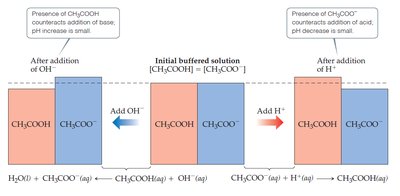
Addition of Acid or Base to a Buffer
Stoichiometry and Equilibrium Calculations
When a strong acid or base is added to a buffer, the buffer components react to minimize pH changes. The process involves two steps: a stoichiometry calculation to determine the new amounts of acid and base, followed by an equilibrium calculation to find the new pH.
Example Reaction: For a buffer of acetic acid and acetate:

Acid-Base Titrations
Principles of Titration
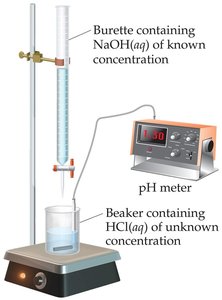
Acid-base titrations are analytical techniques used to determine the concentration of an acid or base in solution. A titrant of known concentration is added to the analyte until the reaction reaches the equivalence point, where stoichiometric amounts of acid and base have reacted.
Equivalence Point: The point at which the amount of titrant added is stoichiometrically equivalent to the amount of analyte present.
End Point: The point at which an indicator changes color, signaling the completion of the titration (should be close to the equivalence point).
Indicators: Weak acids or bases that change color at specific pH values, used to detect the end point.
Titration Curves
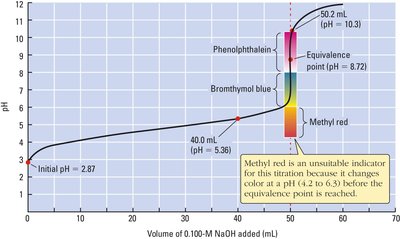
Titration curves plot pH versus the volume of titrant added. The shape of the curve depends on the strengths of the acid and base involved.
Strong Acid with Strong Base: Sharp rise in pH at the equivalence point (pH = 7 for monoprotic acids).
Weak Acid with Strong Base: The equivalence point occurs at pH > 7 due to the formation of a weak conjugate base.
Indicators: The choice of indicator depends on the expected pH at the equivalence point.
Solubility Equilibria and Ksp
Solubility Product Constant (Ksp)
The solubility product constant, , describes the equilibrium between a solid ionic compound and its dissolved ions in a saturated solution. It is specific for each compound at a given temperature.
General Expression:
Example: For AgCl,
Calculating Solubility: Set up an ICE table and solve for the molar solubility (S).

Common Ion Effect
The common ion effect occurs when a compound is less soluble in a solution that already contains one of its ions. Adding a common ion shifts the dissolution equilibrium to the left, decreasing solubility.
Example: AgCl is less soluble in NaCl solution than in pure water due to the presence of Cl-.
Factors Affecting Solubility
Solubility can be affected by pH, the presence of complexing agents, and the common ion effect.
pH: Salts with basic anions are more soluble in acidic solutions.
Complex Ion Formation: Metal ions can react with ligands to form complex ions, increasing solubility.
Precipitation and Selective Precipitation
Precipitation occurs when the ionic product (Q) exceeds . Selective precipitation is used to separate ions based on their differing solubilities.
Q > Ksp: Precipitation occurs.
Q = Ksp: Solution is saturated (at equilibrium).
Q < Ksp: More solid can dissolve.
Summary Table: Buffer and Solubility Concepts
Concept | Key Equation | Application |
|---|---|---|
Buffer pH | Calculate pH of buffer solutions | |
Buffer Capacity | Depends on [acid] and [base] | Amount of acid/base a buffer can neutralize |
Solubility Product | Predict solubility and precipitation | |
Common Ion Effect | Le Chatelier's Principle | Decreases solubility in presence of common ion |
