 Back
BackAssigning Formal Charges in Resonance Structures (HNO3 Example)
Study Guide - Smart Notes
 Tailored notes based on your materials, expanded with key definitions, examples, and context.
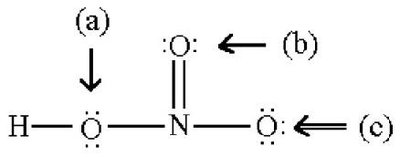
Q8. Assign formal charges to all atoms in the following resonance form for HNO3:
Background
Topic: Formal Charge and Resonance Structures
This question tests your understanding of how to assign formal charges to atoms in a molecule, specifically in a resonance structure. Formal charge helps chemists determine the most stable resonance form and predict reactivity.
Key Terms and Formulas
Formal Charge (FC): The charge assigned to an atom in a molecule, assuming equal sharing of electrons in bonds.
Formula for Formal Charge:
Valence electrons: Number of electrons in the neutral atom (from the periodic table).
Nonbonding electrons: Lone pairs on the atom.
Bonding electrons: Electrons shared in bonds (count all, then divide by 2).
Step-by-Step Guidance
Identify the number of valence electrons for each atom: H (1), O (6), N (5).
For each atom (H, O(a), O(b), N, O(c)), count the number of nonbonding electrons (lone pairs) and bonding electrons (shared in bonds).
Apply the formal charge formula to each atom. For example, for O(a):
Repeat the calculation for N and each O atom (O(a), O(b), O(c)), making sure to use the correct number of lone pairs and bonds for each.
Compare the calculated formal charges to the answer choices to determine which matches the structure.
Try solving on your own before revealing the answer!
Final Answer: +1 for N, -1 for oxygen (c), 0 for all other atoms
By applying the formal charge formula to each atom, you find that nitrogen has a formal charge of +1, oxygen (c) has -1, and the other atoms are neutral.
