 Back
BackLesson 3.2: Bohr’s Model of the Atom and Atomic Spectra
Study Guide - Smart Notes
 Tailored notes based on your materials, expanded with key definitions, examples, and context.
Bohr’s Model of the Atom
Limits of the Rutherford Model of the Atom
The Rutherford model described electrons orbiting the nucleus like planets around the Sun. However, this model could not explain atomic stability. According to classical physics, an orbiting electron should emit electromagnetic radiation, lose energy, and spiral into the nucleus, causing the atom to collapse. Real-world observations show that atoms are stable, indicating that electrons do not lose energy in this way.
Key Point: Rutherford’s model failed to explain why atoms are stable and do not collapse.
Key Point: Electrons in orbit should emit energy, but this is not observed.
Atomic Spectra and Spectroscopy
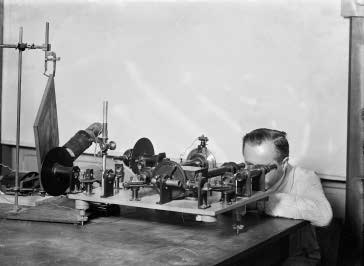
Spectroscopy is the scientific study of spectra to determine properties of their source. Spectrometers and spectrophotometers measure the intensity of light at different wavelengths. When light passes through a sample and is dispersed by a prism or diffraction grating, a spectrum is formed. Early spectroscopes and modern spectrophotometers are used to analyze these spectra.
Key Point: Spectroscopy allows scientists to analyze the light emitted or absorbed by substances.
Key Point: Each element produces a unique line spectrum, acting as a fingerprint for identification.
Example: Astronomers use line spectra to identify the composition of stars.

The Atomic Spectrum of the Hydrogen Atom
The hydrogen atom’s emission spectrum was crucial in advancing atomic theory. When hydrogen gas is excited, it emits light at specific wavelengths, forming a line spectrum. This spectrum contains only certain wavelengths, unlike a continuous spectrum which contains all wavelengths in a region.
Emission Spectrum: The spectrum of electromagnetic radiation emitted by an atom as it returns to a lower energy state.
Continuous Spectrum: Contains all wavelengths in a specific region (e.g., white light through a prism).
Line Spectrum: Contains only specific wavelengths characteristic of the element.
Key Point: The line spectrum of hydrogen shows that electrons exist at discrete energy levels.
Additional info: The quantization of energy levels is consistent with Planck’s quantum theory.
The Bohr Model of the Atom
Bohr’s Quantum Model
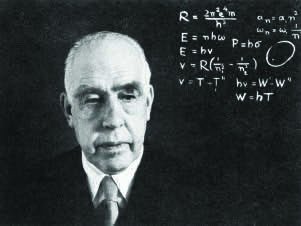
Niels Bohr developed a quantum model for the hydrogen atom in 1913. He proposed that electrons move only in specific orbits around the nucleus, each with a distinct energy level. The energy of an orbit increases with its distance from the nucleus. When an electron gains energy, it moves to a higher orbit; when it loses energy, it emits a photon and moves to a lower orbit.
Key Point: Electrons can only occupy certain energy levels (quantized orbits).
Key Point: Electron transitions between energy levels produce the observed line spectra.
Example: The visible lines in the hydrogen spectrum correspond to transitions from higher levels to level 2.
Electron Transitions and Energy Levels
The movement of an electron from one energy level to another is called a transition. During a transition to a higher energy level, an electron absorbs energy (often from a photon). During a transition to a lower energy level, it emits a photon. The lowest energy state is called the ground state.
Key Point: Electron transitions are responsible for the emission and absorption of light.
Key Point: The energy difference between levels determines the wavelength of emitted or absorbed light.
Additional info: The analogy of a ball on stairs helps visualize quantized energy levels: the ball can only be on specific steps, just as electrons can only be at specific energy levels.
Successes and Failures of the Bohr Model
The Bohr model successfully explained the hydrogen atom’s spectrum and introduced the concept of quantized energy levels. For the first 18 elements, it predicted the maximum number of electrons in each orbit (2, 8, and 18). However, it failed to accurately describe atoms with more than one electron and did not explain why electrons behave as they do. Modern atomic theory has moved beyond Bohr’s model, but it remains historically important.
Success: Explained hydrogen’s line spectrum and quantization of energy.
Failure: Did not accurately predict electron energies for multi-electron atoms.
Key Point: Bohr–Rutherford diagrams are useful for the first 20 elements but not beyond.
Summary Table: Comparison of Atomic Models
Model | Main Features | Successes | Failures |
|---|---|---|---|
Rutherford | Electrons orbit nucleus | Explained nuclear structure | Could not explain atomic stability |
Bohr | Electrons in quantized orbits | Explained hydrogen spectrum | Failed for multi-electron atoms |
Key Terms and Concepts
Spectroscopy: Analysis of spectra to determine properties of their source.
Emission Spectrum: Spectrum of electromagnetic radiation emitted by an atom.
Continuous Spectrum: Contains all wavelengths in a region.
Line Spectrum: Contains only specific wavelengths characteristic of an element.
Transition: Movement of an electron between energy levels.
Ground State: Lowest energy state for an atom.
Important Equations
The energy of a photon emitted or absorbed during a transition is given by:
where is energy, is Planck’s constant, and is frequency.
The energy difference between two levels in the Bohr model:
where is the Rydberg constant, and , are principal quantum numbers.
Applications and Real-Life Examples
Element Identification: Line spectra are used to identify elements in unknown samples.
Astronomy: Line spectra help determine the composition of stars.
Qualitative Analysis: Emission spectra are used for qualitative identification of elements.
Summary
Spectroscopy studies light emitted by excited sources.
Line spectra are unique to specific atoms and elements.
Bohr’s model introduced quantized energy levels and explained hydrogen’s spectrum.
Electrons travel in quantized orbits around the nucleus in the Bohr model.
