Back
BackCalculating the Energy Change for Formation of LiCl(s) Using Hess's Law
Study Guide - Smart Notes
 Tailored notes based on your materials, expanded with key definitions, examples, and context.
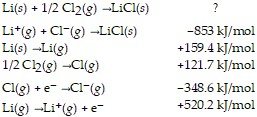
Q15. Calculate the energy change for the formation of LiCl(s) from its elements in their standard states using the provided tabulated information.
Background
Topic: Thermochemistry & Hess's Law
This question tests your ability to use Hess's Law to determine the enthalpy change for the formation of an ionic compound (LiCl) from its elements. You are given a series of reactions and their enthalpy changes, and you must combine them to find the overall energy change for the target reaction.
Key Terms and Formulas
Hess's Law: The total enthalpy change for a reaction is the sum of the enthalpy changes for the individual steps that lead to the overall reaction.
Enthalpy Change (): The heat absorbed or released during a chemical reaction at constant pressure.
Target Reaction:
Step-by-Step Guidance
Identify the target reaction:
List the provided reactions and their enthalpy changes. Make sure to note which reactions need to be reversed or multiplied to match the target reaction.
kJ/mol
kJ/mol
kJ/mol
kJ/mol
kJ/mol
Arrange the reactions so that when combined, they yield the target reaction. This may involve reversing some reactions and/or multiplying by appropriate coefficients.
Add up the enthalpy changes for each step, making sure to account for any changes in sign or coefficients.
Try solving on your own before revealing the answer!