 Back
BackCh.9 - Thermochemistry: Energy, Heat, and Chemical Reactions
Study Guide - Smart Notes
 Tailored notes based on your materials, expanded with key definitions, examples, and context.
Thermochemistry: The Nature of Energy
Definition and Classification of Energy
Thermochemistry is the study of energy changes, particularly heat, that accompany chemical reactions and physical changes. Energy is defined as the capacity to do work or produce heat. Energy can be classified into several types:
Kinetic Energy: Energy due to motion of atoms or molecules.
Potential Energy: Energy due to position or arrangement of atoms.
Chemical Energy: A form of potential energy stored in chemical bonds.
Thermal Energy: Energy associated with the temperature of an object, arising from the motion of its atoms or molecules.
The SI unit for energy is the joule (J). Other common units include the calorie (cal), kilocalorie (kcal), and kilowatt-hour (kWh).
1 calorie (cal) = 4.184 J
1 Calorie (Cal) = 1 kcal = 4184 J
1 kilowatt-hour (kWh) = 3.60 × 10⁶ J
Examples of Energy Types
Kinetic Energy Example: A car traveling at a certain velocity possesses kinetic energy.
Potential Energy Example: A book resting on a table has potential energy due to its position above the ground.
Chemical Energy Example: A chunk of coal contains chemical energy that is released when burned.
Thermal Energy Example: The warmth from a campfire is thermal energy.
Kinetic and Potential Energy
Mechanical Energy
Mechanical energy is the sum of kinetic and potential energy in a system. It can be converted from one form to another:
Kinetic Energy (K.E.):
Potential Energy (P.E.):
Where:
m = mass (kg)
v = velocity (m/s)
g = acceleration due to gravity (9.8 m/s2)
h = height (m)
Mechanical energy can be interconverted, such as when an object falls and its potential energy is converted to kinetic energy.
First Law of Thermodynamics
Law Statement and System Definitions
The First Law of Thermodynamics states that energy cannot be created or destroyed, only transferred between a system and its surroundings.
System: The part of the universe being studied (e.g., the contents of a beaker).
Surroundings: Everything outside the system.
Heat and Work
Heat (q): Transfer of thermal energy from a hotter object to a cooler one.
Work (w): Energy transfer when an object is moved by a force.
Signs of q and w:
If the system loses heat (exothermic), q is negative.
If the system does work on the surroundings, w is negative.

Internal Energy and Enthalpy
Internal Energy (E)
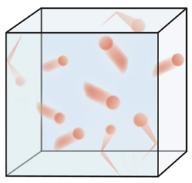
Internal energy (E) is the total energy (kinetic + potential) of a system. The change in internal energy is given by:
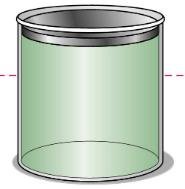
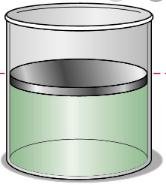
Work done by a gas at constant pressure (pressure-volume work):
Where P is pressure and ΔV is the change in volume. If work is in L·atm, convert to joules: 1 L·atm = 101.3 J.
Enthalpy (H)
Enthalpy (H) is the heat content of a system at constant pressure. For most chemical reactions at constant pressure:
Where is the heat at constant pressure.
Endothermic and Exothermic Reactions
Endothermic Reactions
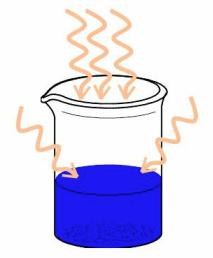
Endothermic reactions absorb heat from the surroundings. The system gains energy, and the surroundings feel cold.
Example: Water boiling is endothermic.
Exothermic Reactions
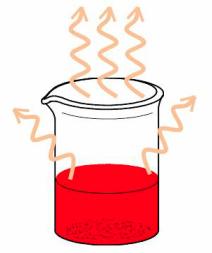
Exothermic reactions release heat to the surroundings. The system loses energy, and the surroundings feel warm.
Example: Combustion of propane is exothermic.
Heat Capacity and Calorimetry
Heat Capacity
Heat capacity (C) is the amount of heat required to change the temperature of an object by 1 K (or 1 °C).
Specific Heat Capacity (c): Heat required to raise 1 g of a substance by 1 K.
Molar Heat Capacity (Cm): Heat required to raise 1 mol of a substance by 1 K.
The amount of heat (q) absorbed or released is calculated by:
Where m is mass, c is specific heat, and ΔT is the temperature change.
Constant-Pressure Calorimetry
A coffee-cup calorimeter is used to measure heat changes at constant pressure. The heat lost by the hot object equals the heat gained by the water and calorimeter:
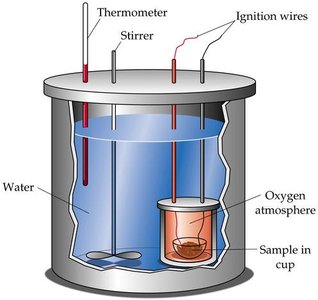
Constant-Volume Calorimetry (Bomb Calorimeter)
A bomb calorimeter measures heat changes at constant volume, typically for combustion reactions. The heat of combustion is calculated as:
Thermal Equilibrium
Definition and Application
Thermal equilibrium is reached when two substances in contact reach the same temperature and no further heat is exchanged. Heat always flows from the hotter object to the cooler one until equilibrium is achieved.
Standard States and Formation Equations
Standard State
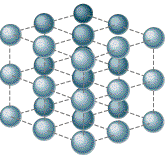
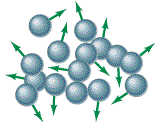
The standard state of an element is its most stable physical form at 25°C and 1 atm pressure. Elements can exist as solids, liquids, or gases in their standard states.
State | Example |
|---|---|
Solid |
|
Liquid |
|
Gas |
|

Formation Equations
A formation equation shows the formation of one mole of a compound from its elements in their standard states. The product always has a coefficient of one, and reactant coefficients may be fractions.
Enthalpy of Formation and Hess's Law
Standard Enthalpy of Formation (ΔHf°)
The standard enthalpy of formation is the enthalpy change when one mole of a compound forms from its elements in their standard states. For an element in its standard state, ΔHf° = 0.
The standard enthalpy of reaction is calculated as:
Hess's Law
Hess's Law states that the enthalpy change for a reaction is the same, no matter how many steps the reaction is carried out in. The overall ΔH is the sum of the ΔH values for the individual steps.
If a reaction is reversed, the sign of ΔH is reversed.
If a reaction is multiplied by a factor, ΔH is multiplied by the same factor.
By combining known reactions, you can calculate the enthalpy change for a new reaction.
