Back
BackChapter 1: Matter, Measurement, and Problem Solving – Study Guide
Study Guide - Smart Notes
 Tailored notes based on your materials, expanded with key definitions, examples, and context.
Chapter 1: Matter, Measurement, and Problem Solving
Introduction to Chemistry
Chemistry is the science that seeks to understand the behavior of matter by studying the properties and interactions of atoms and molecules. The central idea is that the properties of matter are determined by the properties of its constituent atoms and molecules.
Atoms are the fundamental building blocks of matter.
Molecules are groups of atoms bonded together in specific arrangements.
Understanding matter at the molecular level allows for control and manipulation of substances.
Example: The properties of water are determined by the arrangement and bonding of hydrogen and oxygen atoms in water molecules.

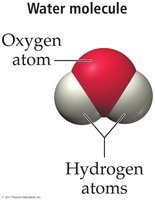
Atoms and Molecules: Structure and Properties
Atoms rarely exist as free particles; they usually form molecules with specific geometric arrangements. Small differences in atomic arrangement can lead to large differences in properties.
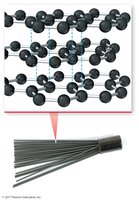
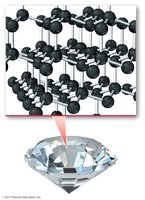
Example: Graphite and diamond are both made of carbon, but their atomic arrangements differ, resulting in distinct properties.
The Scientific Method
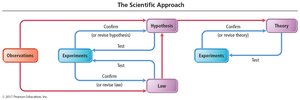
The scientific method is an empirical approach to understanding nature, based on observation, hypothesis formation, experimentation, and the development of laws and theories.
Observation: Gathering data about nature.
Hypothesis: A tentative explanation for observations; must be falsifiable.
Law: A summary of many observations, e.g., the law of conservation of mass. (WHAT happens, usually math relationship)
Theory: A model explaining why nature behaves as it does; validated by experiments but never absolutely proven. (WHY IT HAPPENS, EXPLANATIONS AND MODELS)
Matter and Its Classification
States of Matter
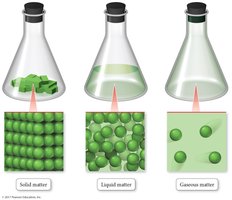
Matter can exist in three primary states: solid, liquid, and gas. The arrangement and movement of atoms or molecules differ in each state, leading to distinct properties.
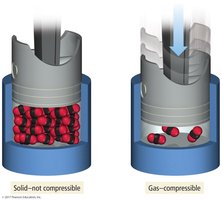
Solid: Fixed volume and shape; atoms/molecules are closely packed and vibrate in place. VERY LOW COMPRESSIBILITY
Liquid: Fixed volume but variable shape; atoms/molecules are close but can move past each other. LOW COMPRESSIBILITY
Gas: Variable volume and shape; atoms/molecules are far apart and move freely, making gases HIGHLY COMPRESSIBLE
Plasma: very far apast and highly compressed like like gas.
Crystalline vs. Amorphous Solids
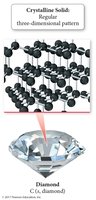
Solids can be classified as crystalline or amorphous based on atomic arrangement.
Crystalline: Atoms/molecules arranged in a repeating pattern (e.g., diamond, table salt).
Amorphous: No long-range order (e.g., glass, plastic).
Classification of Matter by Composition
Matter is classified as pure substances or mixtures, based on composition.
Pure Substance: Made of one component; composition is invariant. (Mixture & Elements)
Elements: Cannot be chemically broken down; basic building blocks.
Compounds: Composed of two or more elements in fixed proportions. (water, salt)
Mixture: Composed of two or more components; composition can vary.
Heterogeneous Mixture: Composition varies throughout (e.g., sand and salt, plate of spagetti).
Homogeneous Mixture: Uniform composition (e.g., sweetened tea, salt water).
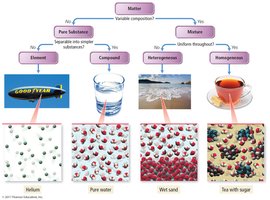
Separation of Mixtures
Mixtures can be separated by exploiting differences in physical or chemical properties.
Decanting: Pouring off liquid from a solid. (Sand and salt, oil and water)
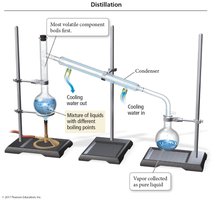
Distillation: Separating liquids by boiling and condensing the more volatile component.
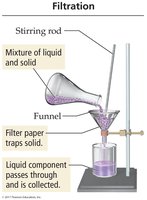
Filtration: Separating solids from liquids using filter paper.
Physical and Chemical Changes
Physical Changes
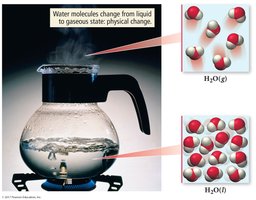
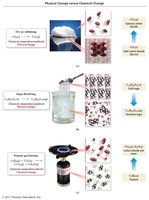
Physical changes alter only the state or appearance of a substance, not its composition. The identity of atoms or molecules remains unchanged.
Example: Boiling water changes it from liquid to gas, but the molecules remain H2O.
Chemical Changes
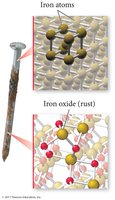
Chemical changes alter the composition of matter, resulting in the formation of new substances.
Example: Rusting of iron forms iron oxide, changing the chemical identity.
Physical and Chemical Properties
Properties are classified as physical or chemical based on whether composition changes during observation.
Physical Property: Observed without changing composition (e.g., odor, color, density).
Chemical Property: Observed only by changing composition (e.g., flammability, acidity).
Energy in Chemistry
Types of Energy
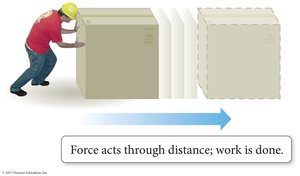
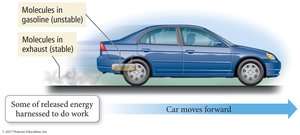
Energy is the capacity to do work, defined as the action of a force through a distance. It is fundamental to physical and chemical changes.
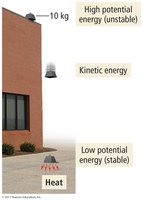
Kinetic Energy: Energy of motion.
Potential Energy: Energy due to position or composition.
Thermal Energy: Energy associated with temperature; a form of kinetic energy.
Law of Conservation of Energy
Energy is always conserved in physical and chemical changes; it is neither created nor destroyed. Systems with high potential energy tend to change to lower potential energy, releasing energy to the surroundings.
Measurement and Units
SI Units and Measurement
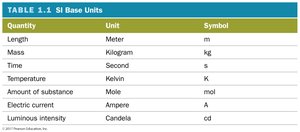
Measurements in chemistry use standard units. The International System of Units (SI) is based on the metric system and is used worldwide.
Length: Meter (m)
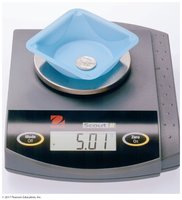
Mass: Kilogram (kg)
Time: Second (s)
Temperature: Kelvin (K)
Amount of substance: Mole (mol)

Temperature Scales
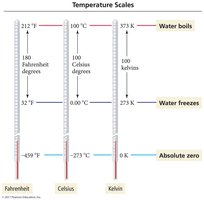
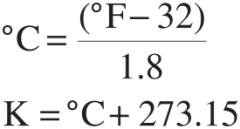
Temperature is measured in Kelvin, Celsius, or Fahrenheit. The Kelvin scale is absolute, with 0 K as the lowest possible temperature (absolute zero).
Conversion formulas:
SI Prefix Multipliers
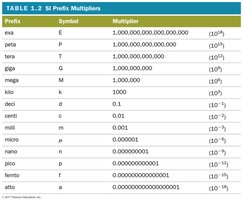
SI units use prefix multipliers to indicate powers of ten, making it easier to express very large or small quantities.
Prefix | Symbol | Multiplier |
|---|---|---|
kilo | k | 1,000 |
centi | c | 0.01 |
milli | m | 0.001 |
micro | μ | 0.000001 |
nano | n | 0.000000001 |
Additional info: See image for full list of prefixes. |
Derived Units: Volume and Density
Derived units are combinations of base units. Volume is measured in cubic centimeters (cm3) or liters (L), and density is mass per unit volume.
Density formula: if units match you don't need to convert
Intensive property: Independent of amount (e.g., density, Color, Temp, Boiling Point, Melting Point).
Extensive property: Dependent on amount (e.g., mass, volume, amounts of energy).
Significant Figures and Calculations
Counting Significant Figures
Significant figures reflect the precision of a measurement. Rules for counting significant figures:
All nonzero digits are significant.
Interior zeroes (between nonzero digits) are significant.
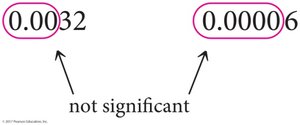
Leading zeroes (before the first nonzero digit) are not significant.
Trailing zeroes after a decimal point are significant.
Trailing zeroes before an implied decimal point are ambiguous; use scientific notation to clarify.
Exact Numbers
Exact numbers have an unlimited number of significant figures. These include counted objects, defined quantities, and integral numbers in equations.
Significant Figures in Calculations
Results of calculations must reflect the precision of the measured quantities.
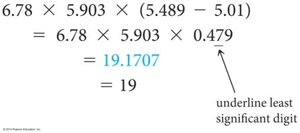
Multiplication/Division: Result has the same number of significant figures as the factor with the fewest.
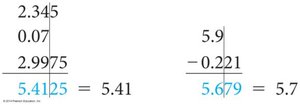
Addition/Subtraction: Result has the same number of decimal places as the quantity with the fewest decimal places.

Rounding Rules
Round down if the digit dropped is four or less; round up if it is five or more. Only round the final answer in multistep calculations.
Accuracy and Precision
Definitions
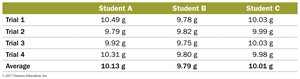
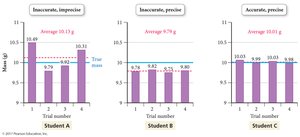
Accuracy is how close a measurement is to the true value. Precision is how close repeated measurements are to each other.
Random error: Equal probability of being too high or too low.
Systematic error: Consistently too high or too low.
Dimensional Analysis and Unit Conversion
Dimensional Analysis
Dimensional analysis uses units as a guide to solving problems. Units are multiplied, divided, and canceled like algebraic quantities.
Unit equation: Statement of two equivalent quantities (e.g., 2.54 cm = 1 in).
Conversion factor: Fractional quantity used to convert between units.

Units Raised to a Power
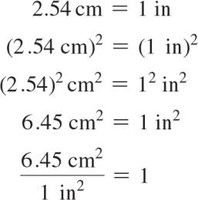
When converting units raised to a power, raise both the number and the unit to the power.
Example: To convert in2 to cm2, use as the conversion factor.