 Back
BackChapter 14: Chemical Kinetics and Reaction Rates
Study Guide - Smart Notes
 Tailored notes based on your materials, expanded with key definitions, examples, and context.
Thermochemistry and Chemical Kinetics
Introduction to Reaction Rates
Chemical kinetics is the study of the speed or rate at which chemical reactions occur and the factors that affect these rates. Understanding reaction rates is crucial for controlling industrial processes, biological systems, and environmental phenomena.
Reaction Rate: The change in concentration of a reactant or product per unit time, typically expressed in M/s (molarity per second).
Average Rate: Calculated over a time interval using the formula for reactants or for products.
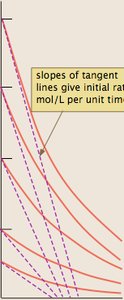
Instantaneous Rate: The rate at a specific moment, found as the slope of the tangent to the concentration vs. time curve.
Factors Affecting Rate: Concentration, temperature, surface area, presence of a catalyst, and the nature of reactants.
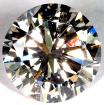
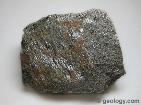
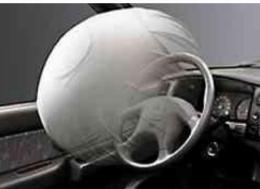

Example: The conversion of diamond to graphite is extremely slow, while the decomposition of sodium azide in airbags is very fast.
Measuring and Calculating Reaction Rates
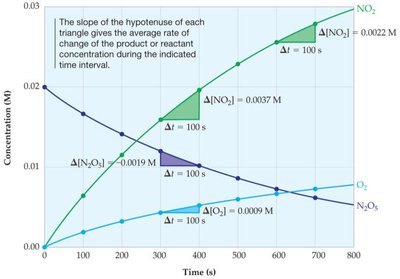
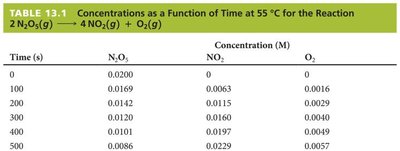
Reaction rates are determined by monitoring the change in concentration of reactants or products over time. Data can be presented in tables or graphs.
Concentration vs. Time Graphs: Show how reactant and product concentrations change during a reaction.
Average Rate Calculation: Use concentration data at two time points to find the average rate.
Stoichiometry and Rate: For a reaction , the rate can be related to each species by .
Rate Laws and Reaction Order
The rate law expresses the relationship between the rate of a reaction and the concentration of its reactants. The form of the rate law must be determined experimentally.
General Rate Law:
Order of Reaction: The exponents m and n indicate the order with respect to each reactant; the sum is the overall order.
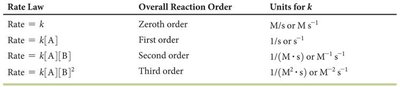
Units of Rate Constant (k): Depend on the overall order of the reaction.
Rate Law | Overall Reaction Order | Units for k |
|---|---|---|
Rate = k | Zeroth order | M/s or M s-1 |
Rate = k[A] | First order | 1/s or s-1 |
Rate = k[A][B] | Second order | 1/(M·s) or M-1 s-1 |
Rate = k[A][B]2 | Third order | 1/(M2·s) or M-2 s-1 |
Experimental Determination of Rate Laws
Rate laws are determined by measuring initial rates with varying reactant concentrations (method of initial rates).
Initial Rate: The rate measured immediately after reactants are mixed.
Procedure: Compare rates from experiments with different initial concentrations to deduce the order with respect to each reactant.
Example: If doubling [A] doubles the rate, the reaction is first order in A.
Integrated Rate Laws
Integrated rate laws relate the concentration of reactants to time and are used to determine how much reactant remains after a given time or how long it takes to reach a certain concentration.
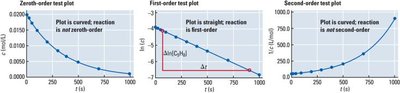
Zero-Order:
First-Order: or
Second-Order:
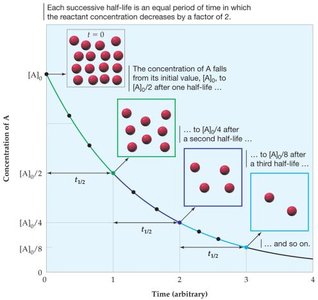
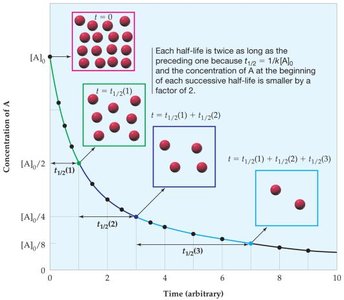
Half-Life (t1/2): The time required for the concentration of a reactant to decrease by half.
Temperature and Reaction Rates
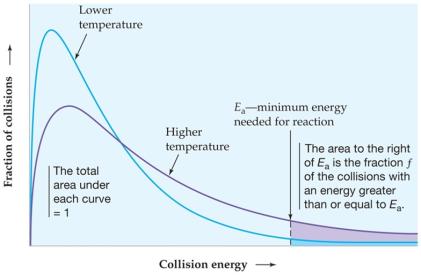
Temperature has a profound effect on reaction rates, as described by collision theory and the Arrhenius equation.
Collision Theory: Molecules must collide with sufficient energy and proper orientation to react.
Activation Energy (Ea): The minimum energy required for a reaction to occur.
Arrhenius Equation: , where k is the rate constant, A is the frequency factor, Ea is activation energy, R is the gas constant, and T is temperature in Kelvin.
Effect of Temperature: Increasing temperature increases the fraction of molecules with enough energy to overcome Ea, thus increasing the rate.

Reaction Mechanisms
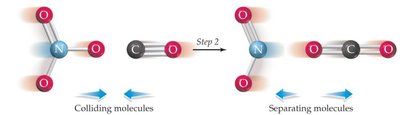
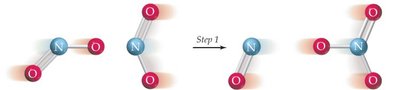
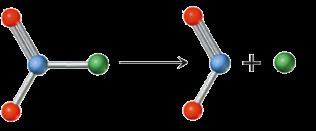
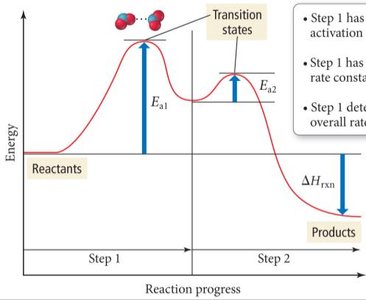
A reaction mechanism is a sequence of elementary steps that describes the pathway from reactants to products. Each step can be unimolecular, bimolecular, or termolecular.
Elementary Step: A single molecular event, such as a collision or decomposition.
Molecularity: The number of reactant particles involved in an elementary step (unimolecular, bimolecular, termolecular).
Intermediates: Species produced in one step and consumed in another; do not appear in the overall reaction.
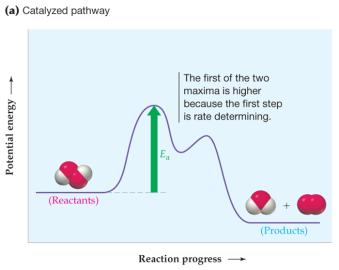
Rate-Determining Step: The slowest step in the mechanism, which controls the overall rate.
Valid Mechanism: Must sum to the overall reaction and have a rate law consistent with experimental data.


Catalysis
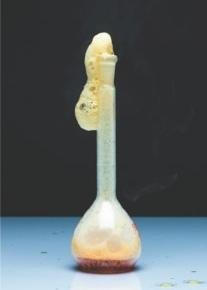
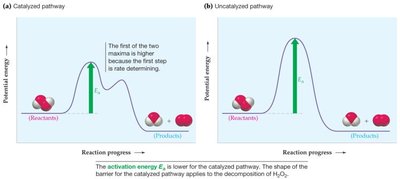
Catalysts increase the rate of a chemical reaction by providing an alternative pathway with a lower activation energy. They are not consumed in the reaction and can be identified in a mechanism as substances that appear in the initial step and are regenerated in a later step.
Effect on Energy Diagram: Catalysts lower the activation energy, making it easier for reactants to be converted to products.
Homogeneous Catalysis: Catalyst is in the same phase as the reactants.
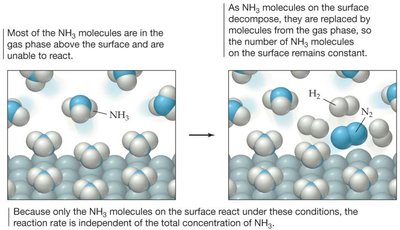
Heterogeneous Catalysis: Catalyst is in a different phase, often a solid surface.
Summary Table: Integrated Rate Laws
Order | Integrated Rate Law | Plot for Straight Line | Half-life Expression |
|---|---|---|---|
Zero | vs. | ||
First | vs. | ||
Second | vs. |
Additional info: This summary includes expanded explanations, definitions, and examples to ensure a self-contained, exam-ready study guide for general chemistry students.
