 Back
BackChapter 6: Electronic Structure of Atoms – Mini-Textbook Study Notes
Study Guide - Smart Notes
 Tailored notes based on your materials, expanded with key definitions, examples, and context.
Electronic Structure of Atoms
The Wave Nature of Light
Electromagnetic radiation, also known as radiant energy, exhibits wave-like properties. Examples include visible light, radio waves, and infrared radiation. Understanding the wave nature of light is fundamental to the study of atomic structure.
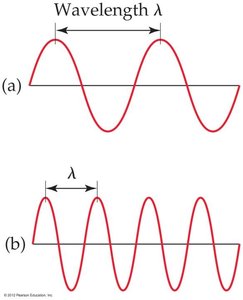
Wavelength (\(\lambda\)): The distance between two adjacent peaks (or troughs) of a wave.
Frequency (\(\nu\)): The number of complete wavelengths that pass a given point each second, measured in hertz (Hz, s-1).
Speed of Light (\(c\)): All electromagnetic radiation travels through a vacuum at \(3.00 \times 10^8\) m/s.

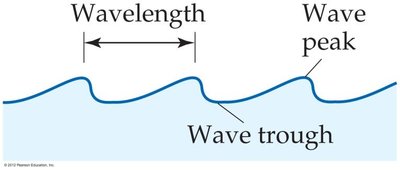
The relationship between wavelength and frequency is inverse:
Equation:
High frequency corresponds to short wavelength, and vice versa.
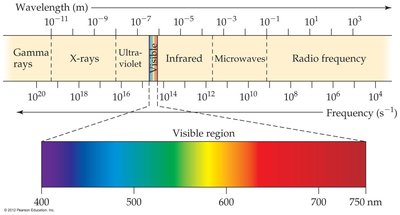
The electromagnetic spectrum encompasses all types of electromagnetic radiation, from gamma rays to radio waves. The visible region is a small portion of this spectrum.
Energy, frequency, and wavelength: Energy is directly proportional to frequency and inversely proportional to wavelength.
Quantized Energy and Photons
The wave model of light cannot explain certain phenomena, such as the quantization of energy and the photoelectric effect.
Quantization of Energy (Planck): Electromagnetic energy can be absorbed or released only in fixed amounts (quanta).
Equation: Where is energy, is Planck's constant ( J·s), and is frequency.
Photoelectric Effect (Einstein): Light energy is quantized in photons. When photons of sufficient energy strike a metal, electrons are emitted.
Equation:
Line Spectra and the Bohr Model
When light is separated into its component wavelengths, a spectrum is produced. Radiation can be monochromatic (single wavelength) or polychromatic (multiple wavelengths).
Continuous Spectrum: Contains all wavelengths of light.
Line Spectrum: Contains only specific wavelengths, characteristic of the element.

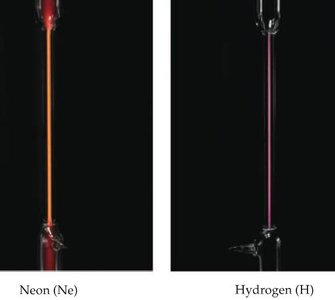


The Bohr model explains the line spectra of hydrogen by proposing quantized energy levels for electrons. Electrons can only occupy certain orbits with specific energies.
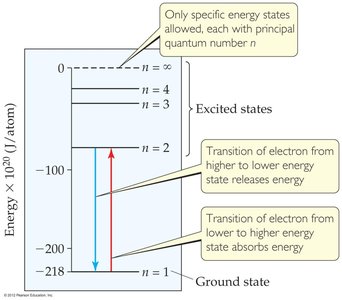
Energy Emission/Absorption: Energy is emitted or absorbed when an electron transitions between energy levels.
Equation for energy levels: (Joules)
Change in energy:
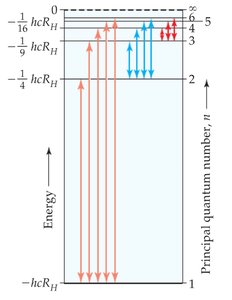
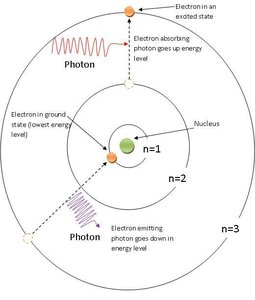
If is negative, energy is emitted; if positive, energy is absorbed.
The Rydberg Equation
The Rydberg equation allows calculation of the wavelength of spectral lines for hydrogen:
Equation: Where m-1, .

The Wave Behavior of Matter
Louis de Broglie proposed that particles such as electrons exhibit wave-like properties. The wavelength of a particle depends on its mass and velocity:
Equation:
For ordinary-sized objects, the wavelength is too small to observe.
Quantum Mechanics and Atomic Orbitals
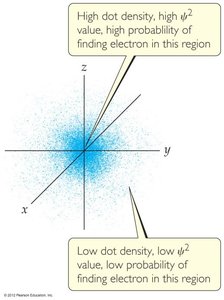
Quantum mechanics, developed by Erwin Schrödinger, describes electrons as wave functions (\(\psi\)). The square of the wave function (\(\psi^2\)) gives the probability density of finding an electron at a particular location.
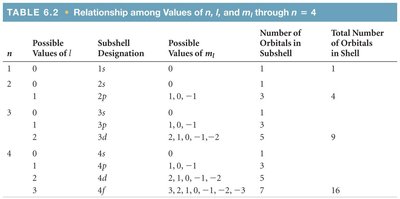
Principal quantum number (n): Indicates the size and energy of the orbital (n = 1, 2, 3, ...).
Angular momentum quantum number (l): Defines the shape of the orbital (l = 0 to n-1; s, p, d, f).
Magnetic quantum number (ml): Describes the orientation of the orbital (-l to +l).
Spin quantum number (ms): Describes the spin of the electron (+1/2 or -1/2).
Representations of Orbitals
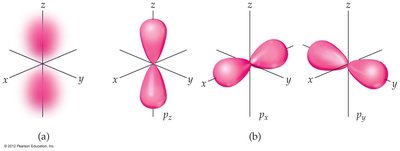
Orbitals are regions in space where the probability of finding an electron is high. The radial probability function describes the likelihood of finding an electron at a certain distance from the nucleus.
s Orbitals: Spherical shape.
p Orbitals: Dumbbell shape, oriented along x, y, or z axes.
d Orbitals: More complex shapes.
Quantum Numbers and Allowed Orbitals
Quantum numbers define the properties and arrangement of electrons in atoms. Each orbital can hold two electrons with opposite spins.
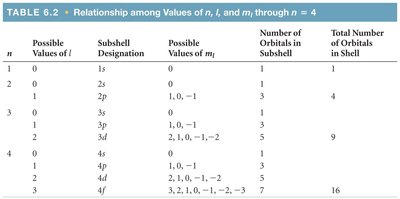
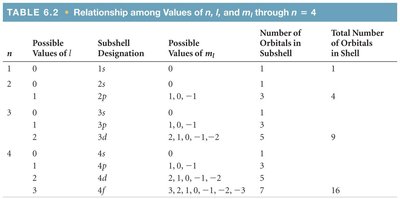
n | Possible Values of l | Subshell Designation | Possible Values of ml | Number of Orbitals in Subshell | Total Number of Orbitals in Shell |
|---|---|---|---|---|---|
1 | 0 | 1s | 0 | 1 | 1 |
2 | 0, 1 | 2s, 2p | 0; -1, 0, 1 | 1; 3 | 4 |
3 | 0, 1, 2 | 3s, 3p, 3d | 0; -1, 0, 1; -2, -1, 0, 1, 2 | 1; 3; 5 | 9 |
4 | 0, 1, 2, 3 | 4s, 4p, 4d, 4f | 0; -1, 0, 1; -2, -1, 0, 1, 2; -3, -2, -1, 0, 1, 2, 3 | 1; 3; 5; 7 | 16 |
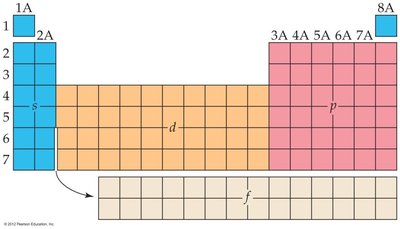
Electron Configurations
Electron configuration describes the arrangement of electrons in an atom's orbitals. The Aufbau principle states that orbitals are filled in order of increasing energy. The Pauli exclusion principle states that no more than two electrons can occupy the same orbital, and they must have opposite spins. Orbitals with the same energy are degenerate.
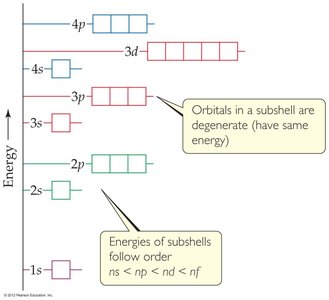
Hund's Rule: Electrons occupy empty degenerate orbitals with the same spin to minimize repulsion.
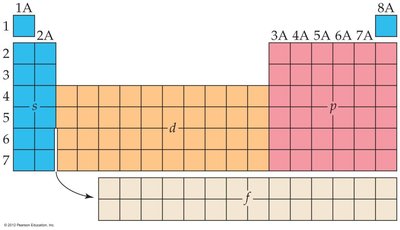
Noble-Gas Notation and Electron Configuration of Ions
Electron configurations can be condensed using noble-gas notation, which highlights the valence electrons. For ions, electrons are removed from the highest energy orbital (for cations) or added to the lowest energy orbital (for anions).
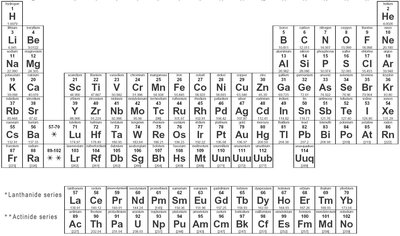
Core and Valence Electrons
Valence electrons are the outermost electrons involved in bonding, while core electrons are inner electrons that do not participate in bonding. For s- and p-block elements, filled d- or f-shell electrons are not considered valence electrons. For d-block elements, filled f-shell electrons are not considered valence electrons.
Isoelectronic Series
An isoelectronic series consists of atoms and ions with identical electron configurations. For example, N3-, O2-, F-, Na+, Mg2+, and Al3+ all have the configuration [Ne].
Additional info: These notes cover the fundamental concepts of Chapter 6: Electronic Structure of Atoms, including the wave nature of light, quantization of energy, atomic spectra, quantum numbers, and electron configurations. The included images directly reinforce the explanations of wave behavior, atomic spectra, quantum numbers, and electron configurations.
