 Back
BackChapter 6: Thermochemistry – Energy and Chemical Reactions
Study Guide - Smart Notes
 Tailored notes based on your materials, expanded with key definitions, examples, and context.
Thermochemistry: The Study of Energy in Chemistry
Introduction to Thermochemistry
Thermochemistry is the branch of chemistry that studies the relationships between chemical reactions and energy changes, particularly the exchange of energy as heat and work. Understanding thermochemistry allows us to quantify and predict the energy changes that accompany chemical processes.
Energy: Forms and Definitions
What is Energy?
Energy is defined as the capacity to do work or produce heat. In chemistry, energy is central to understanding how and why reactions occur.
Kinetic Energy: The energy associated with the motion of objects. In chemistry, this includes the movement of atoms and molecules.
Thermal Energy: A type of kinetic energy related to the temperature of a substance.
Potential Energy: The energy stored due to the position or composition of an object or substance.



Examples of Energy Forms
Kinetic Energy: A rotating molecule, a vibrating string, or a moving car.
Potential Energy: A stretched spring, a rock at the top of a hill, or chemical bonds in molecules.
Law of Conservation of Energy
Fundamental Principle
The Law of Conservation of Energy states that energy cannot be created or destroyed, only transformed from one form to another. The total energy of the universe remains constant during any process.
Energy Transfer: Heat and Work
Mechanisms of Energy Transfer
Energy can be transferred between a system and its surroundings in two main ways:
Heat (q): Energy transferred due to a temperature difference.
Work (w): Energy transferred when a force moves an object over a distance.
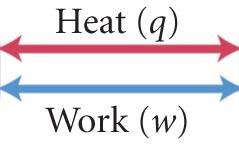

System and Surroundings
In thermochemistry, we define a system (the part of the universe under study) and its surroundings (everything else). Energy exchanges are tracked between these two.
Units of Energy
Joule and Calorie
Joule (J): The SI unit of energy. 1 J = 1 kg·m2/s2.
Calorie (cal): The amount of energy required to raise the temperature of 1 g of water by 1°C. 1 cal = 4.184 J.
The formula for kinetic energy is:
$KE = \frac{1}{2}mv^2$
Thermodynamics and Internal Energy
First Law of Thermodynamics
The First Law of Thermodynamics states that the total energy of the universe is constant. For a system, the change in internal energy (ΔU) is the sum of heat (q) and work (w):
$\Delta U = q + w$
Internal Energy (U)
Internal energy is the sum of all kinetic and potential energies of the particles in a system. It is a state function, meaning its value depends only on the current state of the system, not the path taken to reach that state.
Sign Conventions
It is important to use the correct sign conventions for heat, work, and internal energy:
q > 0: System gains heat
q < 0: System loses heat
w > 0: Work done on the system
w < 0: Work done by the system
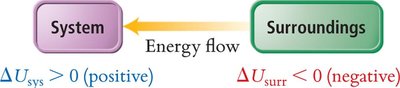
ΔU > 0: Energy flows into the system
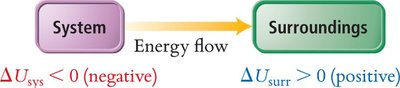
ΔU < 0: Energy flows out of the system
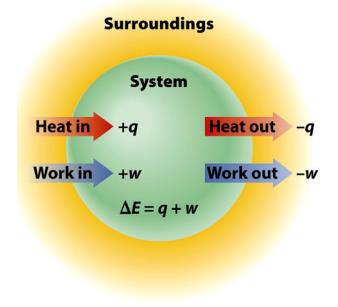

Energy Diagrams and Energy Flow
Visualizing Energy Changes
Energy diagrams help visualize the direction and magnitude of energy flow during chemical reactions. For example, in the combustion of hydrogen:
ΔU < 0: Energy is released to the surroundings (exothermic)
ΔU > 0: Energy is absorbed from the surroundings (endothermic)
Heat and Temperature
Heat Transfer and Thermal Equilibrium
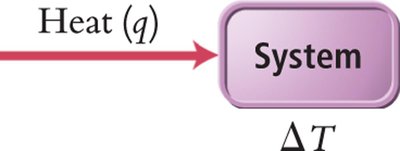
Heat is the transfer of thermal energy due to a temperature difference. Heat transfer continues until thermal equilibrium is reached, meaning the system and surroundings are at the same temperature.
Heat Capacity and Specific Heat
Heat capacity (C) is the amount of heat required to raise the temperature of an object by 1°C. It is an extensive property, depending on the amount of substance present.
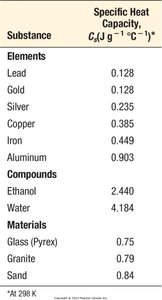
Specific heat capacity (cs) is the amount of heat required to raise the temperature of 1 g of a substance by 1°C. It is an intensive property, depending only on the type of substance.

Calculating Heat Transfer
The amount of heat transferred to or from a substance can be calculated using:
$q = m c_s \Delta T$
q = heat (J)
m = mass (g)
cs = specific heat capacity (J/g·°C)
ΔT = change in temperature (°C)
Thermal Energy Transfer and Calorimetry
Thermal Equilibrium
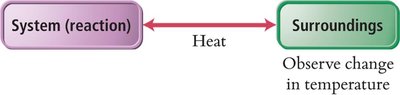
When two substances at different temperatures are brought into contact, heat flows from the hotter to the cooler substance until both reach the same temperature.
Calorimetry
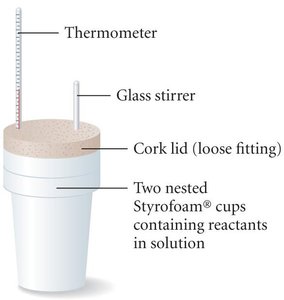
Calorimetry is the experimental technique used to measure heat flow in chemical and physical processes. Two main types are:
Constant Volume Calorimetry (Bomb Calorimeter): Used for reactions involving gases or combustion. No work is done, so $q_v = \Delta U_{rxn}$.
Constant Pressure Calorimetry (Coffee Cup Calorimeter): Used for reactions in solution at atmospheric pressure. $q_p = \Delta H_{rxn}$.
Work and Pressure-Volume Changes
Pressure-Volume Work
When a gas expands or contracts, it does work on its surroundings or has work done on it. The work done by a gas at constant pressure is:
$w = -P \Delta V$
P = external pressure
ΔV = change in volume
Enthalpy (H) and Enthalpy Changes (ΔH)
Definition of Enthalpy
Enthalpy (H) is a thermodynamic quantity equivalent to the total heat content of a system at constant pressure. The change in enthalpy (ΔH) during a reaction is the heat exchanged at constant pressure.
Exothermic Reaction: Releases heat (ΔH < 0)
Endothermic Reaction: Absorbs heat (ΔH > 0)
Relationships Involving ΔHrxn
Manipulating Chemical Equations
Reversing a reaction changes the sign of ΔHrxn.
Multiplying the coefficients in a reaction by a factor multiplies ΔHrxn by the same factor.
Hess’s Law
Hess’s Law states that if a reaction can be expressed as the sum of a series of steps, the overall ΔHrxn is the sum of the ΔH values for the individual steps.
Standard Enthalpy of Formation (ΔHf°)
Definition and Standard States
The standard enthalpy of formation (ΔHf°) is the enthalpy change when 1 mole of a compound is formed from its elements in their standard states. The standard state of a pure element is assigned a ΔHf° of zero.

Calculating ΔHrxn° from ΔHf°
The standard enthalpy change for a reaction can be calculated using:
$\Delta H_{rxn}^\circ = \sum n_p \Delta H_f^\circ (\text{products}) - \sum n_r \Delta H_f^\circ (\text{reactants})$
np, nr = stoichiometric coefficients of products and reactants
Summary Table: Key Thermochemical Quantities
Quantity | Symbol | Definition |
|---|---|---|
Internal Energy | U | Total energy (kinetic + potential) of a system |
Enthalpy | H | Heat content at constant pressure |
Heat | q | Energy transfer due to temperature difference |
Work | w | Energy transfer due to force over distance |
Specific Heat Capacity | cs | Heat required to raise 1 g of substance by 1°C |
Example: Calculate the heat required to raise the temperature of 100 g of water from 25°C to 75°C. (cs for water = 4.184 J/g·°C)
$q = m c_s \Delta T = 100 \times 4.184 \times (75-25) = 20,920 \text{ J}$
Additional info: These notes provide a comprehensive overview of the key concepts in thermochemistry, including energy forms, the first law of thermodynamics, calorimetry, enthalpy, and the use of standard enthalpies of formation in reaction calculations.
