 Back
BackChapter 7: Chemical Reactions and Chemical Quantities – Study Notes
Study Guide - Smart Notes
 Tailored notes based on your materials, expanded with key definitions, examples, and context.
Chemical Reactions and Chemical Quantities
Physical and Chemical Changes in Matter
Chemical and physical changes are fundamental concepts in chemistry, distinguishing between changes that alter the composition of matter and those that do not.
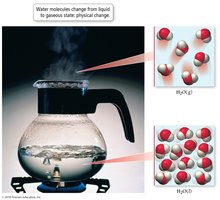
Physical Change: A change that alters only the state or appearance of a substance, but not its composition. The atoms or molecules retain their identity. Examples include melting, boiling, and dissolving.
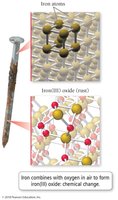
Chemical Change: A change that alters the composition of matter. Atoms rearrange, transforming the original substances into different substances. Examples include rusting, burning, and reacting acids with bases.
Example of Physical Change: Boiling water changes its state from liquid to gas, but the molecules remain H2O.
Example of Chemical Change: Rusting of iron involves the reaction of iron with oxygen to form iron(III) oxide (Fe2O3).
Writing and Balancing Chemical Equations
Chemical equations are symbolic representations of chemical reactions, showing the identities and quantities of reactants and products, as well as their physical states.
Reactants: Substances present before the reaction.
Products: Substances formed as a result of the reaction.
States: Indicated as (s) for solid, (l) for liquid, (g) for gas, and (aq) for aqueous solution.
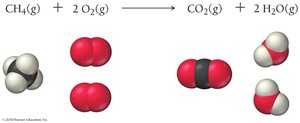
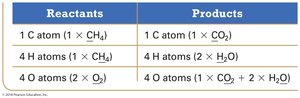
Balancing Equations: The number of atoms of each element must be the same on both sides of the equation, in accordance with the law of conservation of mass.
Example:
Stoichiometry: Quantitative Relationships in Chemical Reactions
Stoichiometry is the study of the numerical relationships between the amounts of reactants and products in a chemical reaction. It allows chemists to predict the quantities of substances consumed and produced.
Law of Conservation of Mass: Mass is conserved in a chemical reaction; the total mass of reactants equals the total mass of products.
Coefficients: Numbers in front of formulas in a balanced equation indicate the relative number of moles (or molecules) of each substance.
Example:
This equation means 2 moles of octane react with 25 moles of oxygen to produce 16 moles of carbon dioxide and 18 moles of water.
Predicting Amounts from Stoichiometry
Given the amount of one substance in a reaction, stoichiometry allows calculation of the amounts of other substances involved.
General Steps:
Convert the given quantity to moles (using molar mass if necessary).
Use the mole ratio from the balanced equation to find moles of the desired substance.
Convert moles back to grams or other units as needed.
Example: How many grams of CO2 are produced from 3.4 × 10¹⁵ g of octane (C8H18)?
Limiting Reactant, Theoretical Yield, and Percent Yield
In reactions with multiple reactants, the limiting reactant is the one that is completely consumed first, thus limiting the amount of product formed.
Limiting Reactant: The reactant that is completely consumed and limits the amount of product formed.
Excess Reactant: Reactants that are not completely consumed in the reaction.
Theoretical Yield: The maximum amount of product that can be formed from the limiting reactant.
Actual Yield: The amount of product actually obtained from the reaction (usually less than the theoretical yield).
Percent Yield:
Practice Example: Limiting Reactant and Excess Calculation
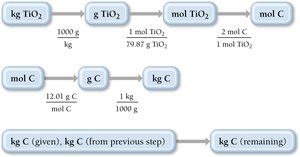
Given 28.6 kg of C and 88.2 kg of TiO2, TiO2 is the limiting reactant in the reaction:
Calculate the mass of excess C remaining after the reaction is complete.
Steps:
Convert mass of TiO2 to moles.
Use stoichiometry to find moles (and then mass) of C needed.
Subtract the mass of C used from the initial mass to find the excess.

Combustion Reactions
A combustion reaction involves the reaction of a substance with oxygen (O2) to form one or more oxygen-containing compounds, usually releasing energy as heat and light.
General Form: Hydrocarbon + O2 → CO2 + H2O (+ energy)
Example:
Alkali Metal and Halogen Reactions
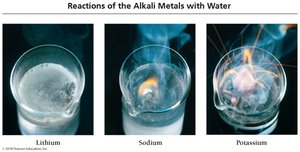
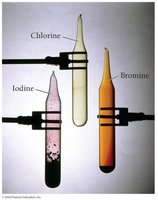
Alkali metals (Group 1A) and halogens (Group 7A) are highly reactive and participate in characteristic reactions.
Alkali Metals: ns1 outer electron configuration; form 1+ cations.
Reaction with Halogens: (e.g., )
Reaction with Water:
Halogens: ns2np5 configuration; form 1- anions; react with metals to form ionic compounds and with hydrogen to form hydrogen halides.
Example:
Summary Table: Balancing Chemical Equations
Balancing equations ensures the conservation of atoms for each element involved in the reaction.
Reactants | Products |
|---|---|
1 C atom (1 × CH4) | 1 C atom (1 × CO2) |
4 H atoms (1 × CH4) | 4 H atoms (2 × H2O) |
4 O atoms (2 × O2) | 4 O atoms (1 × CO2 + 2 × H2O) |
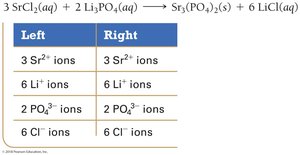
Reactants | Products |
|---|---|
3 Sr2+ ions | 3 Sr2+ ions |
6 Li+ ions | 6 Li+ ions |
2 PO43– ions | 2 PO43– ions |
6 Cl– ions | 6 Cl– ions |
Key Equations
Percent Yield:
Mole-Mass Conversions:
Stoichiometric Relationships: Use coefficients from balanced equations to relate moles of reactants and products.
Practice Problems
Write and balance equations for combustion, alkali metal, and halogen reactions.
Calculate limiting reactant, theoretical yield, and percent yield for given quantities of reactants.
Determine the amount of excess reactant remaining after a reaction is complete.
