 Back
BackChapter 7: Chemical Reactions – Types, Evidence, and Equations
Study Guide - Smart Notes
 Tailored notes based on your materials, expanded with key definitions, examples, and context.
Chemical Reactions
Definition and Evidence of Chemical Change
Chemical reactions, also known as chemical changes, occur when one or more substances are transformed into new substances with different physical and chemical properties. The original substances are called reactants, and the new substances formed are called products.
Evidence for Chemical Reactions:
Color changes
Formation of a solid (precipitate)
Formation of bubbles (gas production)
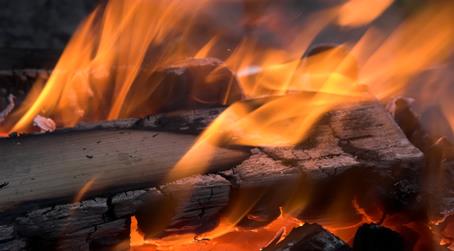
Heat and/or flame is produced, or heat is absorbed
Chemical Equations
Representing Chemical Reactions
Chemical equations use symbols and formulas to represent the identities and relative amounts of reactants and products in a reaction. They also indicate the physical states of substances involved:
(s): Solid
(l): Liquid
(g): Gas
(aq): Aqueous (dissolved in water)
Example:
Key Information from Chemical Equations:
Identities of reactants and products
Relative amounts (stoichiometry)
Physical states
Types of Chemical Reactions
Classification of Reactions
Chemical reactions can be classified into several types based on the rearrangement of atoms and the nature of the reactants and products:
Synthesis (Combination): Two or more substances combine to form one product. Example:
Decomposition: A single compound breaks down into two or more simpler substances. Example:
Single Replacement: One element replaces another in a compound. Example:
Double Replacement: Exchange of ions between two compounds. Example:
Combustion: A substance reacts with oxygen, releasing energy as heat and light. General form:
Balancing Chemical Equations
Law of Conservation of Mass
All chemical equations must be balanced to reflect the law of conservation of mass, which states that atoms are neither created nor destroyed in a chemical reaction. Only the coefficients in front of formulas can be changed to balance equations.
Start with atoms that appear in only one compound on each side.
Balance free elements last.
Use the lowest possible integer coefficients.
Example:
Driving Forces of Chemical Reactions
Why Do Chemical Reactions Occur?
Chemical reactions are driven by the formation of more stable products. The main driving forces include:
Formation of a solid (precipitate)
Formation of water
Transfer of electrons (redox reactions)
Formation of a gas
Reactions in Aqueous Solutions
Ionic Compounds and Dissociation
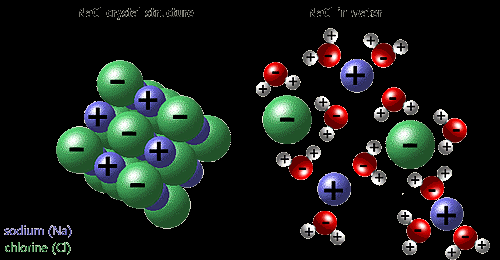
Many reactions occur in aqueous solutions, where water is the solvent. Ionic compounds may dissolve, dissociate into ions, and participate in reactions.
Soluble ionic compound: Completely dissociates in water.
Slightly soluble: Partially dissociates.
Insoluble: Does not dissociate (or only a negligible amount).
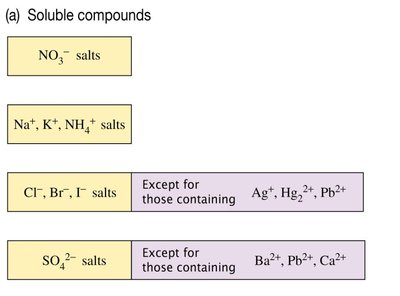
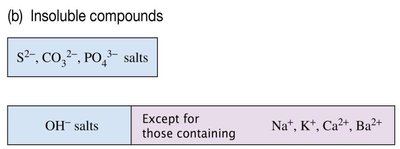
Solubility Rules
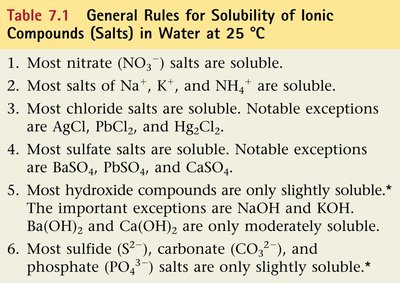
Solubility rules help predict whether an ionic compound will dissolve in water. Precipitation reactions occur when an insoluble product forms.
Soluble Compounds | Exceptions |
|---|---|
NO3- salts | None |
Na+, K+, NH4+ salts | None |
Cl-, Br-, I- salts | Ag+, Hg22+, Pb2+ |
SO42- salts | Ba2+, Pb2+, Ca2+ |
Insoluble Compounds | Exceptions |
|---|---|
S2-, CO32-, PO43- salts | None |
OH- salts | Na+, K+, Ca2+, Ba2+ |
Precipitation Reactions
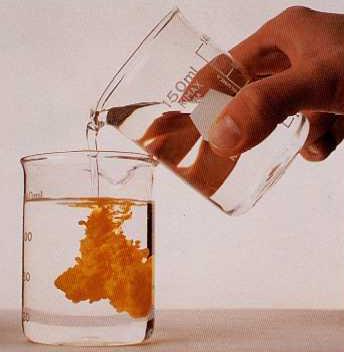
When two aqueous solutions of ionic compounds are mixed, a solid (precipitate) may form if an insoluble product is produced.
Molecular equation: Shows all reactants and products as compounds.
Complete ionic equation: Shows all strong electrolytes as ions.
Net ionic equation: Shows only the ions and molecules directly involved in the reaction.
Spectator ions: Ions that do not participate in the reaction.
Example:
Net ionic equation:
Acid-Base Reactions
Neutralization
Acid-base reactions involve the transfer of protons (H+) from acids to bases. A typical neutralization reaction produces water and a salt.
Example:
Net ionic equation:
Acids: Taste sour (e.g., citrus fruits)
Bases: Taste bitter or soapy (e.g., soap, ammonia)
Oxidation and Reduction (Redox) Reactions
Electron Transfer
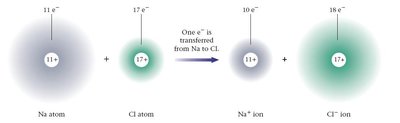
Redox reactions involve the transfer of electrons between substances. Oxidation is the loss of electrons, while reduction is the gain of electrons. These processes always occur together.
LEO says GER: Loss of Electrons is Oxidation; Gain of Electrons is Reduction.
Example:
Example:
Redox reactions include single replacement and combustion reactions, while double replacement reactions are typically not redox.
Summary Table: Classification of Chemical Reactions
Type | General Form | Example |
|---|---|---|
Synthesis | A + B → AB | 2H2 + O2 → 2H2O |
Decomposition | AB → A + B | 2NaCl → 2Na + Cl2 |
Single Replacement | A + BC → AC + B | Fe + CuSO4 → FeSO4 + Cu |
Double Replacement | AB + CD → AD + CB | NaCl + AgNO3 → NaNO3 + AgCl |
Combustion | AB + O2 → CO2 + H2O | CH4 + 2O2 → CO2 + 2H2O |
