 Back
BackCHEM 1001: General Chemistry for Non-Science Majors – Course Structure and Success Guide
Study Guide - Smart Notes
 Tailored notes based on your materials, expanded with key definitions, examples, and context.
Course Overview
This course, CHEM 1001, is an introduction to general chemistry designed for non-science majors. It covers foundational concepts in chemistry, including the scientific method, atomic structure, chemical bonding, chemical reactions, states of matter, acids and bases, and oxidation-reduction processes. The course emphasizes both quantitative and qualitative problem-solving skills and aims to provide students with a broad understanding of chemistry's role in the modern world.
Course Structure and Requirements
Lecture Schedule: TTh 1:30 P.M. to 2:50 P.M., 103 Tureaud Hall
Instructor: Prof. Robert Cook
Textbook: Chemistry for Changing Times, 15th ed., by John H. Hill, et al.
Online Platform: Moodle (with Mastering Chemistry integration for homework)
Calculator: Required, must perform logarithms and powers
Major Topics and Chapters
Chapter 1: Introduction to Chemistry, Scientific Method, Classification of Matter, Measurement, Density, Energy
Chapter 2: Atoms, Scientific Laws, Dalton’s Atomic Theory, The Mole, Mendeleev and the Periodic Table
Chapter 3: Atomic Structure, Rutherford’s Experiment, The Bohr and Quantum Models, Electron Configurations
Chapter 4: Chemical Bonds, Lewis Structures, Ionic and Covalent Bonds, Molecular Shapes (VSEPR Theory)
Chapter 5: Chemical Equations, Volume Relationships, Avogadro’s Number, Solutions
Chapter 6: States of Matter, Intermolecular Forces, Kinetic-Molecular Theory, Gas Laws
Chapter 7: Acids and Bases, pH Scale, Buffers, Neutralization
Chapter 8: Oxidation and Reduction, Electrochemistry, Corrosion, Biological Redox
Assessment and Grading
Three Semester Exams: 600 points (200 points each)
Online Homework Assignments: 100 points
Comprehensive Final Exam: 300 points
Total: 1000 points
Letter Grade Cut-offs: A+ (≥97%), A (≥93%), A– (≥90%), B+ (≥87%), B (≥83%), B– (≥80%), C+ (≥77%), C (≥73%), C– (≥70%), D+ (≥67%), D (≥63%), D– (≥60%), F (<60%)
Success Strategies: The Study Cycle
Overview
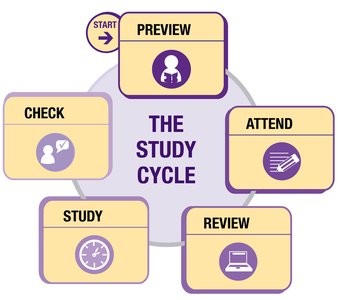
The Study Cycle is a proven approach to mastering course material in chemistry. It involves a continuous process of previewing, attending, reviewing, studying, and self-checking to reinforce learning and retention.
Preview: Skim upcoming material before class to activate prior knowledge and set learning goals.
Attend: Participate actively in lectures, taking organized notes and asking questions.
Review: Shortly after class, review notes and clarify any confusing points.
Study: Engage in focused study sessions, working through problems and reading the textbook in detail.
Check: Test your understanding by self-quizzing, doing practice problems, or explaining concepts to others.
Course Policies and Resources
Attendance: Required for all lectures and exams.
Homework: Complete all assignments on Mastering Chemistry by the deadlines.
Academic Integrity: Cheating, plagiarism, and use of unauthorized resources (including AI) are strictly prohibited.
Accommodations: Students with disabilities should contact Disability Services and arrange accommodations early.
Assistance: Office hours, Center for Academic Success, and peer tutoring are available for additional help.
Exam and Homework Tips
Start homework early and avoid guessing on multiple-choice questions due to penalties for incorrect answers.
Review end-of-chapter problems for exam preparation.
Communicate promptly with the instructor regarding absences or exam conflicts.
Additional Info
Bonus assignments are available for extra credit but cannot be made up if missed.
FERPA protects your educational records; only you can discuss your grades with the instructor unless you grant permission.
Course format and requirements may change due to unforeseen circumstances (e.g., public health emergencies).
