 Back
BackChemical and Physical Changes: Foundations of Chemical Reactions
Study Guide - Smart Notes
 Tailored notes based on your materials, expanded with key definitions, examples, and context.
Chemical and Physical Changes
Introduction to Chemical and Physical Changes
Chemistry distinguishes between physical changes and chemical changes in matter. Understanding these differences is fundamental to recognizing chemical reactions and their evidence in everyday life.
Physical Changes
Physical changes alter the form or appearance of a substance but do not produce a new substance. These changes are often reversible and do not affect the chemical composition of the material.
Definition: A change in which no new substances are formed; only the physical properties change.
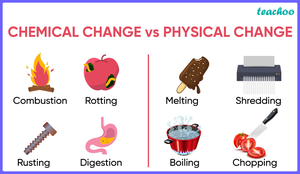
Examples: Melting ice, boiling water, shredding paper, chopping vegetables, dissolving sugar in water.
Key Properties:
Reversible (in many cases)
No new substances produced
Changes in state, shape, or size
Chemical Changes
Chemical changes, also known as chemical reactions, result in the formation of one or more new substances with different properties from the original materials. These changes are usually not reversible by simple physical means.
Definition: A process in which substances are transformed into new substances with different chemical properties.
Examples: Combustion (burning), rusting of iron, digestion of food, fermentation, baking, photosynthesis.
Key Properties:
Irreversible by simple physical means
New substances formed
Often accompanied by observable evidence (color change, gas production, temperature change, precipitate formation)
Evidence of Chemical Change
Several signs indicate that a chemical change has occurred:
Formation of a gas (bubbles, odor change)
Formation of a precipitate (solid from solution)
Color change
Temperature change (exothermic or endothermic reaction)
Production of light or sound
Endothermic and Exothermic Reactions
Chemical reactions can either absorb or release energy, usually in the form of heat.
Endothermic Reaction: Absorbs energy from the surroundings (e.g., photosynthesis, thermal decomposition).
Exothermic Reaction: Releases energy to the surroundings (e.g., combustion, neutralization reactions).
Law of Conservation of Matter
The Law of Conservation of Matter states that matter is neither created nor destroyed in a chemical reaction. This principle is why chemical equations must be balanced.
Balanced Equation: The number of atoms of each element is the same on both sides of the equation.
Example Equation:
Types of Chemical Reactions
Chemical reactions can be classified into five main types:
Synthesis (Combination): Two or more substances combine to form a single product.
Decomposition: A single compound breaks down into two or more simpler substances.
Single Replacement: One element replaces another in a compound.
Double Replacement: The ions of two compounds exchange places in an aqueous solution to form two new compounds.
Combustion: A substance combines with oxygen, releasing energy, usually as heat and light.
Key Terms and Definitions
Term | Definition |
|---|---|
Aqueous Solution | A solution in which the solvent is water. |
Chemical Equation | A symbolic representation of a chemical reaction. |
Chemical Formula | A notation showing the number and type of atoms in a molecule. |
Chemical Reaction | A process that changes substances into new substances. |
Coefficient | A number placed in front of a chemical formula to balance an equation. |
Endothermic | A reaction that absorbs energy. |
Exothermic | A reaction that releases energy. |
Insoluble | Unable to dissolve in a given solvent. |
Precipitate | A solid formed from a solution during a chemical reaction. |
Product | The substances formed as a result of a chemical reaction. |
Reactant | The starting substances in a chemical reaction. |
Solute | The substance dissolved in a solution. |
Solvent | The substance that dissolves the solute to form a solution. |
Examples of Chemical and Physical Changes
Chemical Changes: Combustion, rusting, rotting, digestion, fermentation, baking.
Physical Changes: Melting, boiling, shredding, chopping, dissolving.
Chemical Reactions in Everyday Life
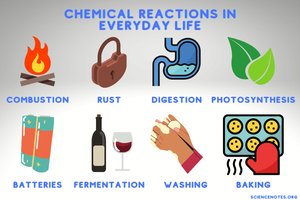
Chemical reactions are part of many daily processes, such as cooking, cleaning, and biological functions. Recognizing these reactions helps connect chemistry to real-world experiences.
Combustion (burning wood or fuel)
Rusting (iron reacting with oxygen and water)
Digestion (breaking down food in the body)
Photosynthesis (plants converting sunlight to energy)
Batteries (electrochemical reactions)
Fermentation (yeast converting sugars to alcohol)
Baking (chemical changes in dough)
