 Back
BackChemical Bonding I: The Lewis Model – Study Notes
Study Guide - Smart Notes
 Tailored notes based on your materials, expanded with key definitions, examples, and context.
Chemical Bonding I: The Lewis Model
Introduction to Bonding Theories
Chemical bonding theories explain how and why atoms attach together to form molecules, and why some combinations of atoms are stable while others are not. These theories allow us to predict molecular shapes, chemical and physical properties, and the stability of compounds.
The Lewis Model
Valence Electrons and Lewis Structures
The Lewis model is a foundational bonding theory that uses valence electrons to explain bonding. In this model, valence electrons are represented as dots around the element symbol, forming what are known as Lewis structures or electron dot structures. These structures help predict molecular stability and properties.
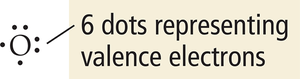
Valence electrons are the outermost electrons of an atom and are primarily involved in bonding.
The number of valence electrons for main-group elements corresponds to the group number on the periodic table.
Lewis structures use dots to represent valence electrons around the element symbol.

Why Do Atoms Bond?
Atoms bond to lower their potential energy. A chemical bond forms when the potential energy of the bonded atoms is less than that of the separate atoms. The interactions considered include nucleus-to-nucleus repulsions, electron-to-electron repulsions, and nucleus-to-electron attractions.
Types of Chemical Bonds
Classification of Bonds
Bonds are classified based on the types of atoms involved:
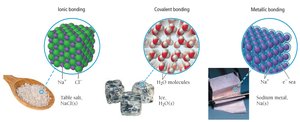
Ionic bonds: Formed between metals and nonmetals via electron transfer.
Covalent bonds: Formed between nonmetals via electron sharing.
Metallic bonds: Formed between metals, involving a 'sea' of delocalized electrons.
Ionic Bonds
Metals lose electrons to become cations; nonmetals gain electrons to become anions.
The resulting oppositely charged ions attract each other, forming an ionic bond.
Covalent Bonds
Nonmetals share valence electrons to achieve lower potential energy.
Shared electrons are attracted to the nuclei of both atoms, holding them together.
Metallic Bonds
Metals release valence electrons, which are delocalized and shared among all atoms in the metal.
This creates a structure of metal cations in a 'sea' of electrons, resulting in metallic bonding.
Lewis Structures of Atoms
Drawing Lewis Structures
Lewis structures represent the valence electrons of main-group elements as dots around the element symbol. The first two dots are paired for the s orbital, and the next three are placed singly for the p orbitals before pairing the remaining electrons.
Octet Rule
Atoms tend to bond in such a way that they each obtain an outer shell with eight electrons, similar to the electron configuration of noble gases. This is known as the octet rule. There are exceptions, such as hydrogen (which follows the duet rule), and elements that can have expanded or incomplete octets.
Lewis Theory and Ionic Bonding
Electron Transfer and Ionic Compounds
Lewis symbols can represent the transfer of electrons from a metal to a nonmetal, resulting in the formation of cations and anions that are held together by electrostatic attraction.

Crystal Lattice and Lattice Energy
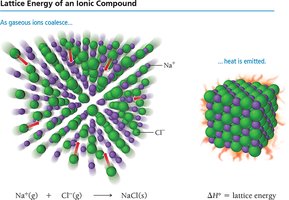
Ionic compounds form a crystal lattice, a repeating pattern of cations and anions. The stability of this structure is measured by the lattice energy, which is the energy released when the crystal forms from gaseous ions. Lattice energy is influenced by the charges and sizes of the ions.
Born–Haber Cycle
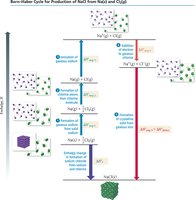
The Born–Haber cycle is a series of steps used to calculate the lattice energy of an ionic compound using Hess's law. It involves summing the enthalpy changes for each step in the formation of the compound from its elements.
Trends in Lattice Energy
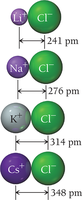
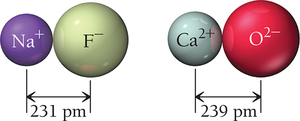
Lattice energy decreases (becomes less exothermic) as ion size increases.
Lattice energy increases (becomes more exothermic) as ion charge increases.
Properties of Ionic Compounds
Physical Properties
High melting and boiling points (generally > 300 °C).
Hard and brittle crystalline solids.
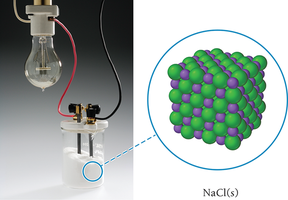
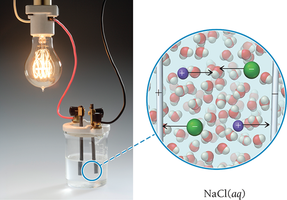
Conduct electricity when molten or dissolved in water, but not as solids.
Electrical Conductivity
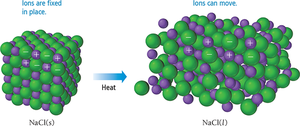
Ionic solids do not conduct electricity because ions are fixed in place. When melted or dissolved, ions are free to move and conduct electricity.
Covalent Bonding and Lewis Structures
Bonding and Lone Pairs
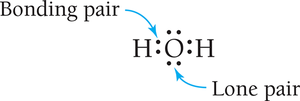
In covalent bonds, electrons shared between atoms are called bonding pairs, while electrons not shared are called lone pairs or nonbonding pairs.
Single, Double, and Triple Bonds
Single bond: Two atoms share one pair of electrons.
Double bond: Two atoms share two pairs of electrons.
Triple bond: Two atoms share three pairs of electrons.
Properties of Molecular Compounds
Low melting and boiling points (generally < 300 °C).
Can be found as solids, liquids, or gases at room temperature.
Do not conduct electricity in any state.
Bond Polarity and Electronegativity
Electronegativity
Electronegativity is the ability of an atom to attract bonding electrons to itself. It increases across a period and decreases down a group. The difference in electronegativity between atoms determines bond polarity:
ΔEN = 0: Pure covalent (nonpolar)
ΔEN = 0.1–0.4: Nonpolar covalent
ΔEN = 0.4–1.9: Polar covalent
ΔEN ≥ 2.0: Ionic
Bond Dipole Moments
A dipole moment (μ) measures bond polarity and is calculated as:
where q is the magnitude of the partial charges and r is the distance between them. Dipole moments are measured in Debyes (D).
Writing Lewis Structures for Molecules
Steps for Drawing Lewis Structures
Write the correct skeletal structure for the molecule (hydrogen and more electronegative atoms are terminal).
Sum the valence electrons for all atoms.
Distribute electrons to give octets (or duets for hydrogen).
If any atom lacks an octet, form double or triple bonds as needed.
Resonance
Some molecules have more than one valid Lewis structure, differing only in the position of electrons. These are called resonance structures. The actual molecule is a resonance hybrid, a combination of all resonance forms.
Formal Charge
Formal charge is a tool to evaluate the best Lewis structure. It is calculated as:
The sum of all formal charges in a neutral molecule must be zero.
Negative formal charges should reside on the most electronegative atom.
Exceptions to the Octet Rule
Odd-electron species (free radicals)
Incomplete octets (e.g., B, Al)
Expanded octets (elements with empty d orbitals)
Bond Energies and Bond Lengths
Bond Energy
Bond energy (or bond enthalpy) is the energy required to break one mole of a bond in the gas phase. It is always positive (endothermic). The overall enthalpy change for a reaction can be estimated using average bond energies:
Bond Length
Bond length is the distance between the nuclei of bonded atoms. In general:
More shared electrons = shorter bond
Bond length decreases across a period and increases down a group
Shorter bonds are stronger
Summary Table: Types of Chemical Bonds
Bond Type | Participants | Electron Behavior | Example |
|---|---|---|---|
Ionic | Metal + Nonmetal | Transfer | NaCl |
Covalent | Nonmetal + Nonmetal | Sharing | H2O |
Metallic | Metal + Metal | Delocalized | Na (metal) |
Additional info: This summary covers the core concepts of chemical bonding as described by the Lewis model, including ionic, covalent, and metallic bonding, the octet rule, resonance, formal charge, and trends in bond energies and lengths. These principles are foundational for understanding molecular structure and reactivity in general chemistry.
