 Back
BackChemical Equilibrium: Principles, Constants, and Applications
Study Guide - Smart Notes
 Tailored notes based on your materials, expanded with key definitions, examples, and context.
Chemical Equilibrium
The Concept of Chemical Equilibrium
Chemical equilibrium is a dynamic state in which the rates of the forward and reverse reactions are equal, resulting in constant concentrations of reactants and products. This balance does not mean the amounts are equal, but that their concentrations remain unchanged over time.
Dynamic equilibrium: Both forward and reverse reactions continue to occur, but there is no net change in the concentrations of reactants and products.
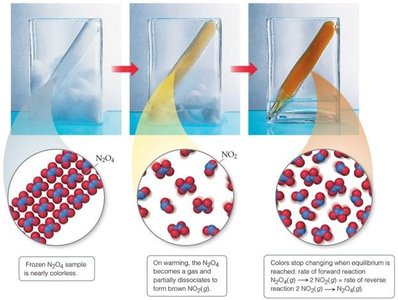
Visual evidence: The color or other observable properties of the system become constant when equilibrium is reached.
Example: The dissociation of dinitrogen tetroxide (N2O4) to nitrogen dioxide (NO2) demonstrates equilibrium as the color change stabilizes.
Approaching Equilibrium
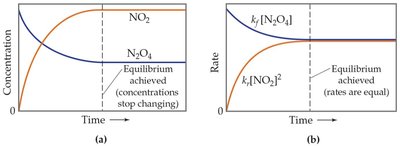
As a reaction mixture approaches equilibrium, the concentrations of reactants and products change until the rates of the forward and reverse reactions become equal. At this point, the system is at equilibrium and concentrations remain constant.
Forward reaction: Reactants are converted to products.
Reverse reaction: Products are converted back to reactants.
Equilibrium achieved: The rates of the forward and reverse reactions are equal.
The Equilibrium Constant
Expressing the Equilibrium Constant, Kc and Kp
The equilibrium constant quantifies the ratio of product and reactant concentrations at equilibrium. For a general reaction:
Kc (concentration):
Kp (pressure): Used for gaseous reactions, based on partial pressures.
Double arrow (\( \rightleftharpoons \)): Indicates a reversible reaction.
Interpreting the Equilibrium Constant
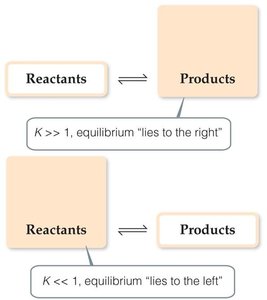
The magnitude of the equilibrium constant indicates the extent to which a reaction favors products or reactants at equilibrium.
If K >> 1: Products are favored; equilibrium "lies to the right."
If K << 1: Reactants are favored; equilibrium "lies to the left."
The Direction of the Chemical Equation and K
The equilibrium constant for a reaction written in the reverse direction is the reciprocal of the constant for the forward reaction.
Example: If , then .
Combining Equilibrium Expressions – Hess’s Law
When reactions are added together, their equilibrium constants are multiplied to obtain the overall equilibrium constant.
Heterogeneous vs. Homogeneous Equilibria
Homogeneous equilibrium: All reactants and products are in the same phase.
Heterogeneous equilibrium: Reactants or products are in different phases. Concentrations of pure solids and liquids are omitted from the equilibrium expression.
Calculating and Using Equilibrium Constants
Calculating Equilibrium Constants
Given equilibrium concentrations, substitute values into the equilibrium expression to solve for K.
Example: For , if M, M, then:
Reaction Quotient, Q
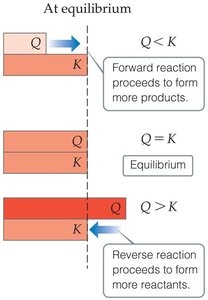
The reaction quotient (Q) is calculated using the same expression as K, but with current (not necessarily equilibrium) concentrations or pressures. Comparing Q to K predicts the direction the reaction will proceed to reach equilibrium.
If Q < K: The reaction proceeds forward (toward products).
If Q = K: The system is at equilibrium.
If Q > K: The reaction proceeds in reverse (toward reactants).
Calculating Equilibrium Concentrations
To find equilibrium concentrations, set up an ICE (Initial, Change, Equilibrium) table and solve for unknowns, often using the quadratic formula:
Le Châtelier’s Principle
Principle and Applications
Le Châtelier’s Principle states that if a system at equilibrium is disturbed by a change in concentration, pressure, or temperature, the system will shift its equilibrium position to counteract the disturbance and re-establish equilibrium.
Change in concentration: Adding or removing reactants/products shifts equilibrium to consume the added substance or replace the removed one.
Change in pressure/volume: For gaseous systems, increasing pressure (decreasing volume) shifts equilibrium toward the side with fewer moles of gas.
Change in temperature: Increasing temperature favors the endothermic direction; decreasing temperature favors the exothermic direction.
Catalysts: Increase the rate at which equilibrium is achieved but do not affect the equilibrium composition.
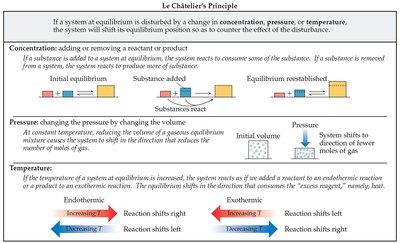
Summary Table: Effects on Equilibrium
Disturbance | System Response |
|---|---|
Add reactant | Shifts toward products |
Remove product | Shifts toward products |
Increase pressure (decrease volume) | Shifts toward fewer moles of gas |
Increase temperature (endothermic) | Shifts toward products |
Increase temperature (exothermic) | Shifts toward reactants |
Add catalyst | Equilibrium reached faster; no shift |
Additional info: The above table summarizes the qualitative effects of various disturbances on chemical equilibrium, as predicted by Le Châtelier’s Principle.
