 Back
BackChemical Equilibrium: Principles, Constants, and Applications
Study Guide - Smart Notes
 Tailored notes based on your materials, expanded with key definitions, examples, and context.
Chemical Equilibrium
The Concept of Chemical Equilibrium
Chemical equilibrium is a state in which the rates of the forward and reverse reactions are equal, resulting in constant concentrations of reactants and products. At equilibrium, the system is balanced, but both reactions continue to occur at the molecular level.
Dynamic Equilibrium: The system is dynamic, meaning that reactants are continuously converted to products and vice versa, but their concentrations remain unchanged.
Product-Favored vs. Reactant-Favored: If the equilibrium mixture contains more products than reactants, the reaction is product-favored; if the reverse is true, it is reactant-favored.


Graphical Representation of Equilibrium
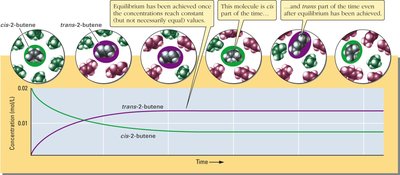
As a reaction approaches equilibrium, the concentrations of reactants and products change until they become constant.
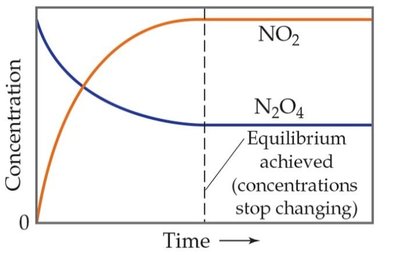
At equilibrium, the rates of the forward and reverse reactions are equal.
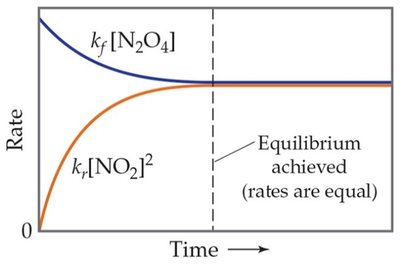
Example: For the reaction N2O4(g) ⇌ 2 NO2(g), both the concentration and rate graphs illustrate the establishment of equilibrium.
Dynamic Nature of Equilibrium
Equilibrium is not static; it is a dynamic process where the forward and reverse reactions continue at equal rates.


Balanced Equation: For a general reaction: aA + bB ⇌ cC + dD, equilibrium is achieved when the rate of the forward reaction equals the rate of the reverse reaction.

Equilibrium Is Independent of Direction
Regardless of whether a reaction starts with reactants or products, the same equilibrium state is achieved under identical conditions.
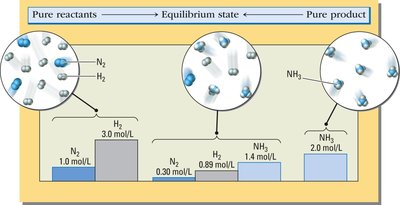

Example: Starting with either N2 and H2 or NH3, the system reaches the same equilibrium composition.
Equilibrium and Catalysts
Catalysts increase the rate of both the forward and reverse reactions equally, allowing equilibrium to be reached faster, but they do not affect the equilibrium concentrations.
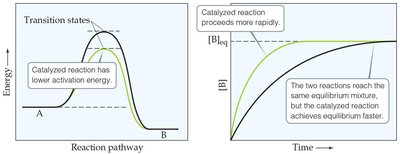

Example: The addition of a catalyst lowers the activation energy, speeding up the attainment of equilibrium but not altering the equilibrium position.
The Equilibrium Constant
Definition and Expression
The equilibrium constant (K) quantifies the ratio of product concentrations to reactant concentrations at equilibrium, each raised to the power of their stoichiometric coefficients.
Kc (concentration-based): For a reaction aA + bB ⇌ cC + dD,
Kp (pressure-based): Used for gaseous reactions, based on partial pressures.
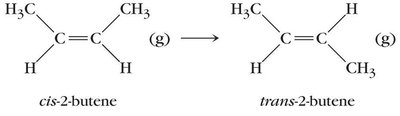
Example: 2-Butene Isomerization
For the isomerization of cis-2-butene to trans-2-butene:


Temperature Dependence: The value of Kc changes with temperature.



Special Cases in Equilibrium Expressions
Pure Solids and Liquids: Their concentrations are constant and omitted from the equilibrium expression.

Example: For S8(s) + O2(g) ⇌ SO2(g), (S8 is omitted).
Related Reactions and Manipulation of Kc
When a reaction is multiplied by a factor, raise Kc to that power.
Reversing a reaction inverts Kc.
For reactions that are the sum of two or more steps, the overall Kc is the product of the Kc values for the steps.



Equilibrium Constants in Terms of Pressure (Kp)
For gaseous reactions, equilibrium can also be expressed in terms of partial pressures:
The relationship between Kp and Kc is:
where is the change in moles of gas (products minus reactants).


Calculating Equilibrium Constants
Direct Calculation from Concentrations
If all equilibrium concentrations are known, Kc can be calculated directly using the equilibrium expression.

Using Stoichiometry to Find Equilibrium Concentrations
When not all equilibrium concentrations are given, use stoichiometry and initial values to solve for unknowns, often using an ICE (Initial, Change, Equilibrium) table.


Meaning of the Equilibrium Constant
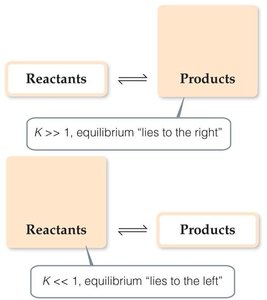
The magnitude of Kc indicates the extent to which a reaction favors products or reactants at equilibrium.
Kc >> 1: Reaction is product-favored; nearly all reactants are converted to products.
Kc << 1: Reaction is reactant-favored; very little product is formed.
Kc ≈ 1: Significant amounts of both reactants and products are present at equilibrium.






Predicting the Direction of a Reaction: The Reaction Quotient (Q)
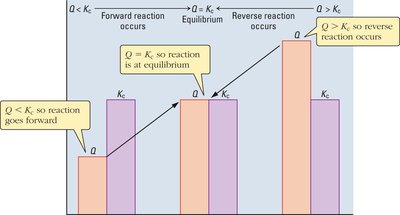
The reaction quotient, Q, is calculated using the same expression as Kc, but with initial (not equilibrium) concentrations. Comparing Q to Kc predicts the direction the reaction will proceed to reach equilibrium:
If Q < Kc, the reaction proceeds forward (toward products).
If Q > Kc, the reaction proceeds in reverse (toward reactants).
If Q = Kc, the system is at equilibrium.








Le Châtelier’s Principle
Response to Disturbances
If a system at equilibrium is disturbed by a change in concentration, pressure, or temperature, the system will shift its equilibrium position to counteract the disturbance.
Change in Concentration: Adding reactant or product shifts equilibrium to consume the added substance.
Change in Pressure/Volume (for gases): Increasing pressure (decreasing volume) favors the side with fewer moles of gas; decreasing pressure (increasing volume) favors the side with more moles of gas.
Change in Temperature: Increasing temperature favors the endothermic direction; decreasing temperature favors the exothermic direction.
Summary Table: Effects on Equilibrium
Change | System Response |
|---|---|
Add reactant | Shifts toward products |
Remove reactant | Shifts toward reactants |
Increase pressure (decrease volume) | Shifts toward fewer moles of gas |
Decrease pressure (increase volume) | Shifts toward more moles of gas |
Increase temperature | Shifts toward endothermic direction |
Decrease temperature | Shifts toward exothermic direction |
Applications and Examples
Haber-Bosch Process: Industrial synthesis of ammonia (NH3) from N2 and H2 is an application of equilibrium principles, using high pressure, moderate temperature, and a catalyst to maximize yield.
Calculating Equilibrium Concentrations: Use ICE tables and the quadratic formula when necessary to solve for unknown concentrations at equilibrium.
Additional info: This summary covers the core concepts, mathematical treatment, and practical implications of chemical equilibrium as presented in a typical general chemistry curriculum.
