 Back
BackChemical Quantities and Aqueous Reactions: Stoichiometry, Solutions, and Reaction Types
Study Guide - Smart Notes
 Tailored notes based on your materials, expanded with key definitions, examples, and context.
Chemical Quantities and Aqueous Reactions
Introduction
This chapter explores the quantitative relationships in chemical reactions, focusing on stoichiometry, solution chemistry, and the various types of reactions that occur in aqueous solutions. Understanding these concepts is essential for predicting the outcomes of reactions, calculating yields, and analyzing laboratory results.
The Greenhouse Effect and Combustion Reactions
The Greenhouse Effect
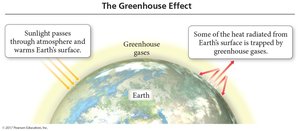
The greenhouse effect describes how certain gases in Earth's atmosphere trap heat, maintaining the planet's temperature. Sunlight passes through the atmosphere, warming Earth's surface, while greenhouse gases prevent some of the heat from escaping back into space. This balance determines Earth's average temperature.
Global Warming and Atmospheric CO2
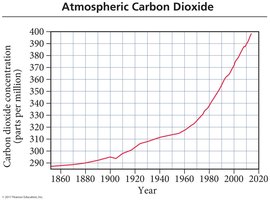
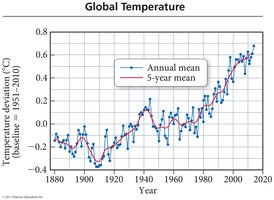
Since 1860, atmospheric CO2 levels have risen by 38%, correlating with a 0.7°C increase in global temperature. The combustion of fossil fuels is a major source of CO2, and chemical equations allow us to quantify the relationship between fuel burned and CO2 produced.
Stoichiometry: Quantitative Relationships in Chemical Reactions
Reaction Stoichiometry
Stoichiometry is the study of the numerical relationships between the amounts of reactants and products in a chemical reaction. The coefficients in a balanced chemical equation indicate the relative number of moles of each substance involved.
Law of Conservation of Mass: Atoms are neither created nor destroyed in a chemical reaction; equations must be balanced.
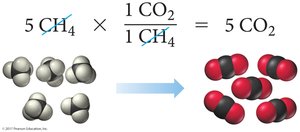
Stoichiometric Ratios: Used as conversion factors between moles of reactants and products.
Example:
Mole-to-Mole and Mass-to-Mass Conversions
To determine the amount of product formed or reactant required, use the following steps:
Convert mass of substance A to moles using molar mass.
Use the stoichiometric ratio from the balanced equation to convert moles of A to moles of B.
Convert moles of B to mass using molar mass.

Limiting Reactant, Theoretical Yield, and Percent Yield
Limiting Reactant
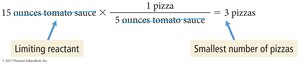
In reactions with multiple reactants, the limiting reactant is the one that is completely consumed first, thus limiting the amount of product formed. The other reactants are in excess.
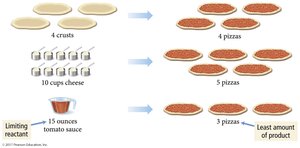
Theoretical Yield and Percent Yield
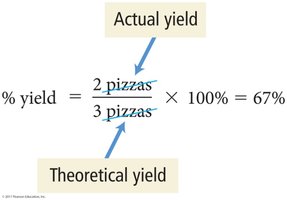
The theoretical yield is the maximum amount of product that can be formed from the limiting reactant. The actual yield is the amount actually obtained from the reaction. Percent yield is calculated as:
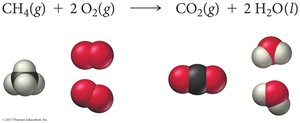
Example: Combustion of Methane
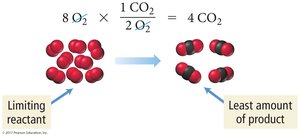
Given the reaction , if you have 5 molecules of CH4 and 8 molecules of O2, O2 is the limiting reactant, and the theoretical yield is 4 molecules of CO2.
Limiting Reactant from Masses
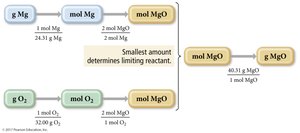
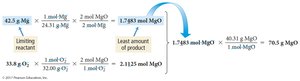
When reactant quantities are given in grams, convert to moles, use stoichiometric ratios, and identify the limiting reactant as the one producing the least product.
Solutions and Solution Stoichiometry
Solutions and Concentration
A solution is a homogeneous mixture of two or more substances. The solvent is the major component, and the solute is the minor component. Molarity (M) is a common unit of concentration, defined as: a solution in which water is the solvent is an aqueous solution (water would be solvent, Majority!!!, solute would be the minor things dissolved in)
If the solute doesnt dissolve its called a parcipate!! like the one lab
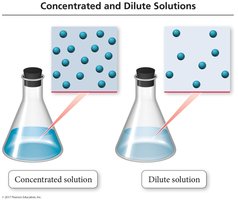
Concentration of solution: quantify the amount of solute relative to the solvent
DILUTE SOLUTIONS: have a small amount of solute compared to solvent
CONCENTRATE SOLUTIONS: have a large amount of solute compared to solvents
moles=molar
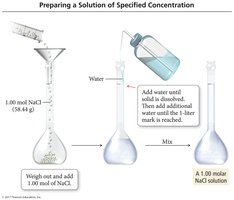
Using Molarity in Calculations
Molarity can be used as a conversion factor between moles of solute and volume of solution. For example, a 0.500 M NaCl solution contains 0.500 mol NaCl per liter of solution. take 250 ml and tell me how man moles of NaCL
.5ml NaCl/L x .250L =.125 moles NaCL
.125 moles NACLx (58.44 g MW NaCL/1 mole NaCl)= 7.305 g NaCL


Solution Dilution
To prepare a less concentrated solution from a stock solution, use the dilution equation:
M1= concentration of stock
V1= volume of stock
M2= concentration of dilution
V2= volume of dilution
where and are the molarity and volume of the stock solution, and and are those of the diluted solution.
Types of Aqueous Solutions and Solubility
Solubility and Dissolution
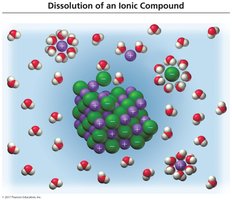
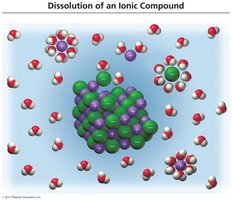
Solubility is the ability of a substance to dissolve in a solvent. When ionic compounds dissolve, their ions are separated and surrounded by solvent molecules, a process called dissociation. Molecular compounds may dissolve without forming ions.
(Ionic compound dissolves in water, Salt, sugar protein)
Polarity: tip of arrow shows were electro negativety is located
Solvation is what happens in solution
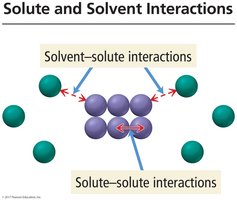
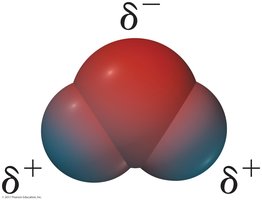
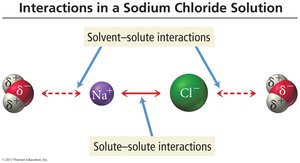
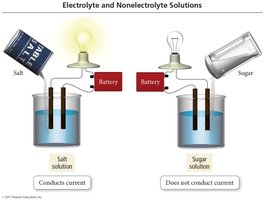
Electrolytes and Nonelectrolytes
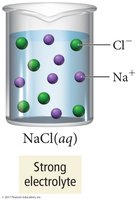
Electrolytes are substances that dissolve in water to produce ions and conduct electricity. (NACL,strong acids)Nonelectrolytes dissolve as molecules and do not conduct electricity.(sucrose,glucose,ethanol,proteins, urea,weak acids).
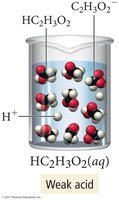
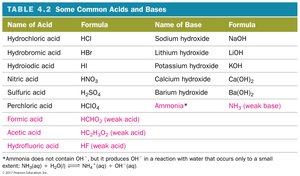
Acids ionize to varying degrees in water. Those that completely ionize are strong acids(HCL(aq)), that that don't are weak acids(HF)(aq).
rate 1 and rate 2 are equal which establishes equillibrium
Dissociation and Ionization
When ionic compounds dissolve, they dissociate into their constituent ions. Strong acids ionize completely, while weak acids only partially ionize.
Molecule ionizes when strong acids dissolve into water.(H+ and Anions)
When they dissolve in solution label them (aq)
Ionic compounds dissociate
Acids ionize
Solubility Rules
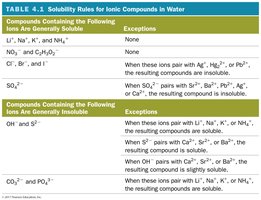
Solubility rules help predict whether an ionic compound will dissolve in water. These rules are based on experimental observations.
Not all ionic compounds dissolve, they become insoluvuble.
All nitrates dissolve in water
Precipitation Reactions
Precipitation and Predicting Reactions
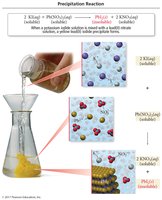
A precipitation reaction occurs when mixing two solutions produces an insoluble solid (precipitate). To predict precipitation reactions:
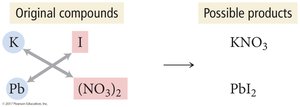
Identify ions in each reactant.
Exchange ions to form possible products.
Use solubility rules to determine if a precipitate forms.
Write balanced molecular, complete ionic, and net ionic equations.
AgNO3 aq+NaCl aq--->AgCl(s) +NaNO3 (aq) S=insoluble/percipitate, aq=soluble
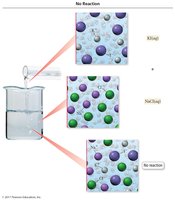
Percipitation reactions do not always occur when two aqueous solutions are mixed
nothing happens/no reaction
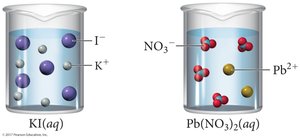
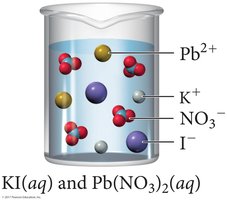
Net Ionic Equations
Net ionic equations show only the species that actually participate in the reaction, omitting spectator ions.
Acid–Base and Gas-Evolution Reactions
Acid–Base (Neutralization) Reactions
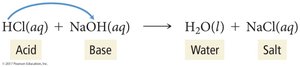
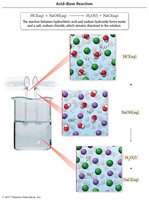
An acid–base reaction involves an acid reacting with a base to produce water and a salt. The Arrhenius definition classifies acids as substances that produce H+ in solution and bases as those that produce OH–.
General net ionic equation:
Acid base reaction is also called a neutralization reaction
Acid–Base Titrations
Titration is a laboratory technique to determine the concentration of an unknown solution by reacting it with a solution of known concentration. The equivalence point is when stoichiometric amounts of acid and base have reacted.
Equivalence point is the point in the titration when H+ and OH- from reactants are in their stochiometric ratio and are completely reacted. (used dye as indicator)
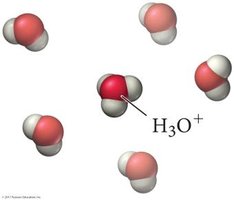
Arrhenius acid solution produces a proton in an aqueous solution (hydronium ion H3O+)
Polyprotic acids- contain more than one ionizable proton and relsese them sequentially
first ionizabable proton is strong while subsequent ionizable protons are weak
Acids ionize in water to produce proton H+
Base: substance that produces OH- ions in aqueous solution, produce hydroxides.
PH 7=neutral (H+=OH-)
PH is a indicator of proton concentration in solution
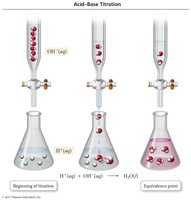
NAOH is added to a dillute HCL solution
HCL PH= 1-2 more H+ then OH-
when you add base you start to neutralize the H+ protons, becoming neutral
Gas-Evolution Reactions
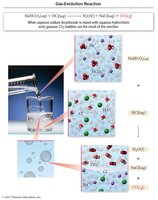
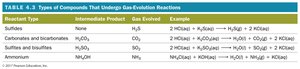
Some reactions in aqueous solution produce a gas, either directly or by decomposition of an intermediate. Common gases evolved include H2S, CO2, SO2, and NH3.
When you add more gas into solution over time, it starts to dissolve into the solution
Oxidation–Reduction (Redox) Reactions
Introduction to Redox Reactions
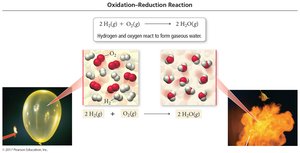
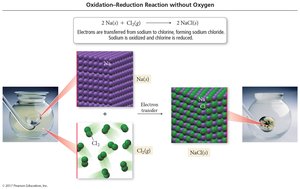
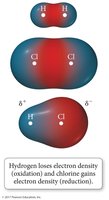
Redox reactions involve the transfer of electrons between substances. Oxidation is the loss of electrons, and reduction is the gain of electrons. These reactions are essential in processes such as combustion, corrosion, and metabolism.
4Fe(s)+3O2(g)-> 2 Fe2O3(s) =rusting
4Fe(s) + 3O2(g)-> 2Fe2O3 oxide is(-2,-2,-2=-6) ofr it to be neutral the Fe has to be +3,+3 Oxygen gained 2 electrons so its been reduced, Fe has lost two electrons becoming oxidized.
Reduction means something has gained an electron (element)
Oxidation means something has lost an electron (element or polyatomic) Na+,CL-(diatonics)
Redox is a combination of the two.
Assigning Oxidation States-
rules for assigning oxidation states
- free elements have an oxidation state=0
Na=0 and Cl2 = 0 in 2 Na(s)+Cl2(g)
-Monatomic ions have an oxidation state equal to their charge.
in NACL Na=+1 and CL=-1
-The sum of the oxidation states of all the atomes in a compound is 0
Na=+1 and Cl=-1 in NaCl, (+1)+(-1)=0
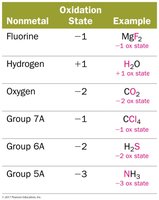
Oxidation states are assigned to atoms in compounds to track electron transfer. Key rules include:
Free elements: 0
Monatomic ions: charge of the ion
Sum of oxidation states in a compound: 0
Sum in a polyatomic ion: charge of the ion
Group I metals: +1; Group II metals: +2
Nonmetals: follow priority table
Identifying Redox Reactions
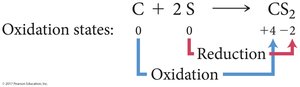
A reaction is a redox reaction if there is a change in oxidation state for any element. The substance that is oxidized is the reducing agent, and the substance that is reduced is the oxidizing agent.
Combustion Reactions
Combustion reactions are a type of redox reaction where a substance reacts with O2 to form oxygen-containing compounds and release heat. Examples include the combustion of hydrocarbons and alcohols.
